

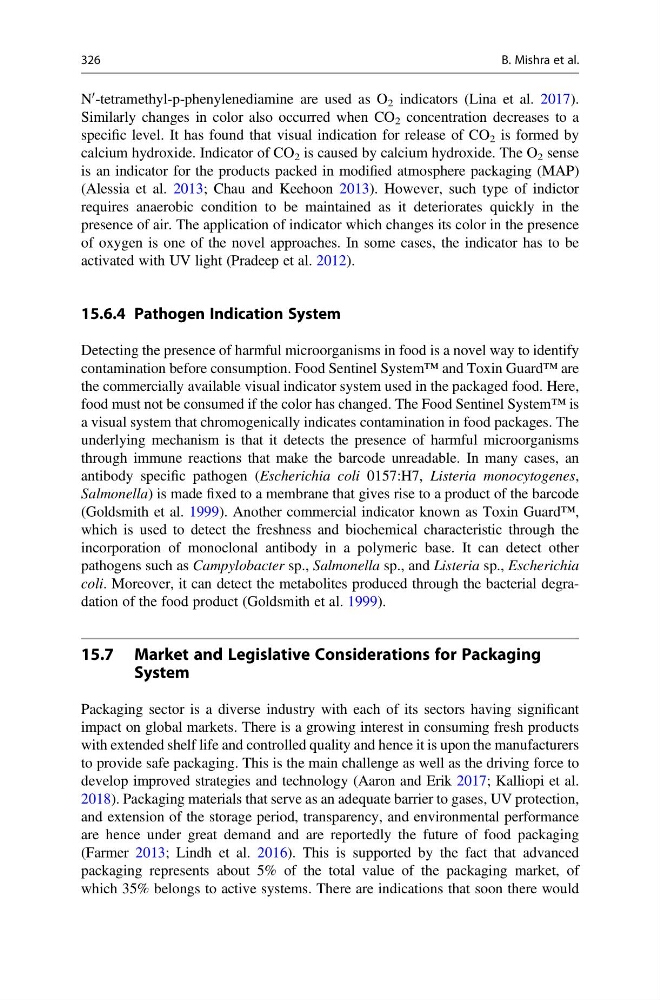
N
0 -tetramethyl-p-phenylenediamine are used as O 2 indicators (Lina et al. 2017).
Similarly changes in color also occurred when CO 2 concentration decreases to a
specific level. It has found that visual indication for release of CO 2 is formed by
calcium hydroxide. Indicator of CO 2 is caused by calcium hydroxide. The O 2 sense
is an indicator for the products packed in modified atmosphere packaging (MAP)
(Alessia et al. 2013; Chau and Keehoon 2013). However, such type of indictor
requires anaerobic condition to be maintained as it deteriorates quickly in the
presence of air. The application of indicator which changes its color in the presence
of oxygen is one of the novel approaches. In some cases, the indicator has to be
activated with UV light (Pradeep et al. 2012).
15.6.4 Pathogen Indication System
Detecting the presence of harmful microorganisms in food is a novel way to identify
contamination before consumption. Food Sentinel System™ and Toxin Guard™ are
the commercially available visual indicator system used in the packaged food. Here,
food must not be consumed if the color has changed. The Food Sentinel System™ is
a visual system that chromogenically indicates contamination in food packages. The
underlying mechanism is that it detects the presence of harmful microorganisms
through immune reactions that make the barcode unreadable. In many cases, an
antibody specific pathogen (Escherichia coli 0157:H7, Listeria monocytogenes,
Salmonella) is made fixed to a membrane that gives rise to a product of the barcode
(Goldsmith et al. 1999). Another commercial indicator known as Toxin Guard™,
which is used to detect the freshness and biochemical characteristic through the
incorporation of monoclonal antibody in a polymeric base. It can detect other
pathogens such as Campylobacter sp., Salmonella sp., and Listeria sp., Escherichia
coli. Moreover, it can detect the metabolites produced through the bacterial degradation of the food product (Goldsmith et al. 1999).
15.7 Market and Legislative Considerations for Packaging
System
Packaging sector is a diverse industry with each of its sectors having significant
impact on global markets. There is a growing interest in consuming fresh products
with extended shelf life and controlled quality and hence it is upon the manufacturers
to provide safe packaging. This is the main challenge as well as the driving force to
develop improved strategies and technology (Aaron and Erik 2017; Kalliopi et al.
2018). Packaging materials that serve as an adequate barrier to gases, UV protection,
and extension of the storage period, transparency, and environmental performance
are hence under great demand and are reportedly the future of food packaging
(Farmer 2013; Lindh et al. 2016). This is supported by the fact that advanced
packaging represents about 5% of the total value of the packaging market, of
which 35% belongs to active systems. There are indications that soon there would
326
B. Mishra et al.
0 -tetramethyl-p-phenylenediamine are used as O 2 indicators (Lina et al. 2017).
Similarly changes in color also occurred when CO 2 concentration decreases to a
specific level. It has found that visual indication for release of CO 2 is formed by
calcium hydroxide. Indicator of CO 2 is caused by calcium hydroxide. The O 2 sense
is an indicator for the products packed in modified atmosphere packaging (MAP)
(Alessia et al. 2013; Chau and Keehoon 2013). However, such type of indictor
requires anaerobic condition to be maintained as it deteriorates quickly in the
presence of air. The application of indicator which changes its color in the presence
of oxygen is one of the novel approaches. In some cases, the indicator has to be
activated with UV light (Pradeep et al. 2012).
15.6.4 Pathogen Indication System
Detecting the presence of harmful microorganisms in food is a novel way to identify
contamination before consumption. Food Sentinel System™ and Toxin Guard™ are
the commercially available visual indicator system used in the packaged food. Here,
food must not be consumed if the color has changed. The Food Sentinel System™ is
a visual system that chromogenically indicates contamination in food packages. The
underlying mechanism is that it detects the presence of harmful microorganisms
through immune reactions that make the barcode unreadable. In many cases, an
antibody specific pathogen (Escherichia coli 0157:H7, Listeria monocytogenes,
Salmonella) is made fixed to a membrane that gives rise to a product of the barcode
(Goldsmith et al. 1999). Another commercial indicator known as Toxin Guard™,
which is used to detect the freshness and biochemical characteristic through the
incorporation of monoclonal antibody in a polymeric base. It can detect other
pathogens such as Campylobacter sp., Salmonella sp., and Listeria sp., Escherichia
coli. Moreover, it can detect the metabolites produced through the bacterial degradation of the food product (Goldsmith et al. 1999).
15.7 Market and Legislative Considerations for Packaging
System
Packaging sector is a diverse industry with each of its sectors having significant
impact on global markets. There is a growing interest in consuming fresh products
with extended shelf life and controlled quality and hence it is upon the manufacturers
to provide safe packaging. This is the main challenge as well as the driving force to
develop improved strategies and technology (Aaron and Erik 2017; Kalliopi et al.
2018). Packaging materials that serve as an adequate barrier to gases, UV protection,
and extension of the storage period, transparency, and environmental performance
are hence under great demand and are reportedly the future of food packaging
(Farmer 2013; Lindh et al. 2016). This is supported by the fact that advanced
packaging represents about 5% of the total value of the packaging market, of
which 35% belongs to active systems. There are indications that soon there would
326
B. Mishra et al.