

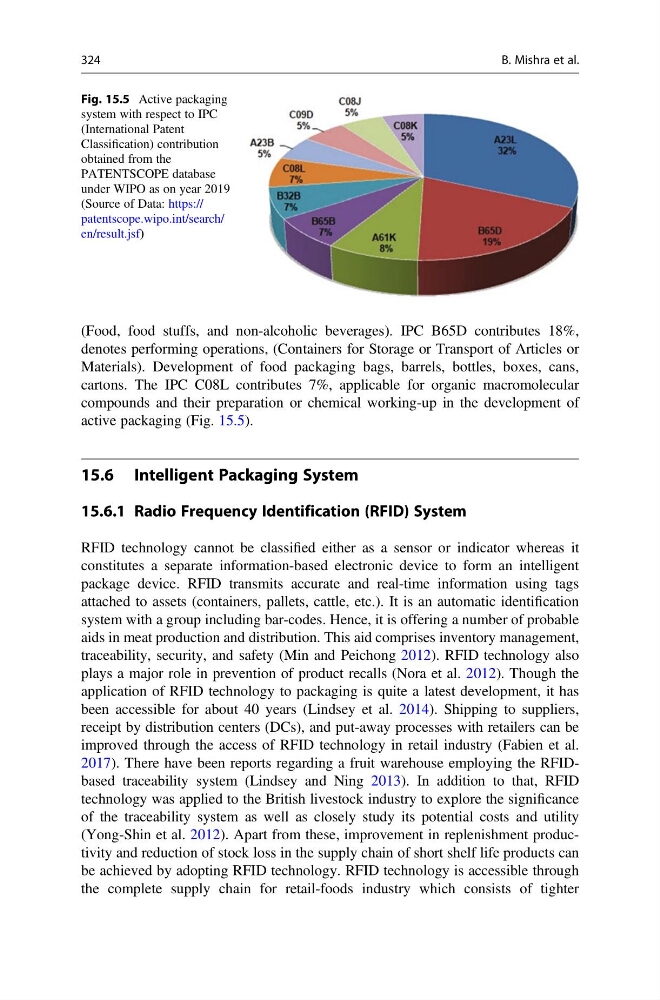
(Food, food stuffs, and non-alcoholic beverages). IPC B65D contributes 18%,
denotes performing operations, (Containers for Storage or Transport of Articles or
Materials). Development of food packaging bags, barrels, bottles, boxes, cans,
cartons. The IPC C08L contributes 7%, applicable for organic macromolecular
compounds and their preparation or chemical working-up in the development of
active packaging (Fig. 15.5).
15.6 Intelligent Packaging System
15.6.1 Radio Frequency Identification (RFID) System
RFID technology cannot be classified either as a sensor or indicator whereas it
constitutes a separate information-based electronic device to form an intelligent
package device. RFID transmits accurate and real-time information using tags
attached to assets (containers, pallets, cattle, etc.). It is an automatic identification
system with a group including bar-codes. Hence, it is offering a number of probable
aids in meat production and distribution. This aid comprises inventory management,
traceability, security, and safety (Min and Peichong 2012). RFID technology also
plays a major role in prevention of product recalls (Nora et al. 2012). Though the
application of RFID technology to packaging is quite a latest development, it has
been accessible for about 40 years (Lindsey et al. 2014). Shipping to suppliers,
receipt by distribution centers (DCs), and put-away processes with retailers can be
improved through the access of RFID technology in retail industry (Fabien et al.
2017). There have been reports regarding a fruit warehouse employing the RFIDbased traceability system (Lindsey and Ning 2013). In addition to that, RFID
technology was applied to the British livestock industry to explore the significance
of the traceability system as well as closely study its potential costs and utility
(Yong-Shin et al. 2012). Apart from these, improvement in replenishment productivity and reduction of stock loss in the supply chain of short shelf life products can
be achieved by adopting RFID technology. RFID technology is accessible through
the complete supply chain for retail-foods industry which consists of tighter
Fig. 15.5 Active packaging
system with respect to IPC
(International Patent
Classification) contribution
obtained from the
PATENTSCOPE database
under WIPO as on year 2019
(Source of Data: https://
patentscope.wipo.int/search/
en/result.jsf)
324
B. Mishra et al.
denotes performing operations, (Containers for Storage or Transport of Articles or
Materials). Development of food packaging bags, barrels, bottles, boxes, cans,
cartons. The IPC C08L contributes 7%, applicable for organic macromolecular
compounds and their preparation or chemical working-up in the development of
active packaging (Fig. 15.5).
15.6 Intelligent Packaging System
15.6.1 Radio Frequency Identification (RFID) System
RFID technology cannot be classified either as a sensor or indicator whereas it
constitutes a separate information-based electronic device to form an intelligent
package device. RFID transmits accurate and real-time information using tags
attached to assets (containers, pallets, cattle, etc.). It is an automatic identification
system with a group including bar-codes. Hence, it is offering a number of probable
aids in meat production and distribution. This aid comprises inventory management,
traceability, security, and safety (Min and Peichong 2012). RFID technology also
plays a major role in prevention of product recalls (Nora et al. 2012). Though the
application of RFID technology to packaging is quite a latest development, it has
been accessible for about 40 years (Lindsey et al. 2014). Shipping to suppliers,
receipt by distribution centers (DCs), and put-away processes with retailers can be
improved through the access of RFID technology in retail industry (Fabien et al.
2017). There have been reports regarding a fruit warehouse employing the RFIDbased traceability system (Lindsey and Ning 2013). In addition to that, RFID
technology was applied to the British livestock industry to explore the significance
of the traceability system as well as closely study its potential costs and utility
(Yong-Shin et al. 2012). Apart from these, improvement in replenishment productivity and reduction of stock loss in the supply chain of short shelf life products can
be achieved by adopting RFID technology. RFID technology is accessible through
the complete supply chain for retail-foods industry which consists of tighter
Fig. 15.5 Active packaging
system with respect to IPC
(International Patent
Classification) contribution
obtained from the
PATENTSCOPE database
under WIPO as on year 2019
(Source of Data: https://
patentscope.wipo.int/search/
en/result.jsf)
324
B. Mishra et al.