

emission from automobile emissions and burning of wood, tar and coal, etc. (Alcock
and Jones 1996; Kuehl et al. 1987; Thacker et al. 2007).
As a potent POP and toxicant, it has been a growing concern due to its resistance
to any mode of environmental degradation processes. Dioxins have the ability to
bioaccumulate due to their persistence property that in turn lead to hazardous effects
on health of human/animal and the environment. In general, Stockholm Convention
(2001) has explored and resolved the elimination or severely restriction on the
production on POPs that are hazardous to human as well as environment (Stockholm
Convention 2001).
Dioxins mediated toxicity have been well explored by various workers indicating
its association with several adverse effects in human health, including but not limited
to immune-toxicity, induction of enzyme related disorders, chloracne, carcinogen
that can induce tumour promotion and progression and increase in developmental
birth defects that can lead to stillbirths. Also, the animal derived food is one of the
major sources of dioxins exposure (White and Birnbaum 2009).
14.2 Dioxins and Dioxins-Like Compound
‘Dioxins’ also referred as POPs, share backbone of chemical structures which is
essential of its toxicity and persistence. There are several hundred types of these
compounds have been found but broadly, it can be categorized into three categories:
Halogenated dibenzo-p-dioxins (DD), halogenated dibenzofurans (DF) and
polychlorinated biphenyls (PCBs).
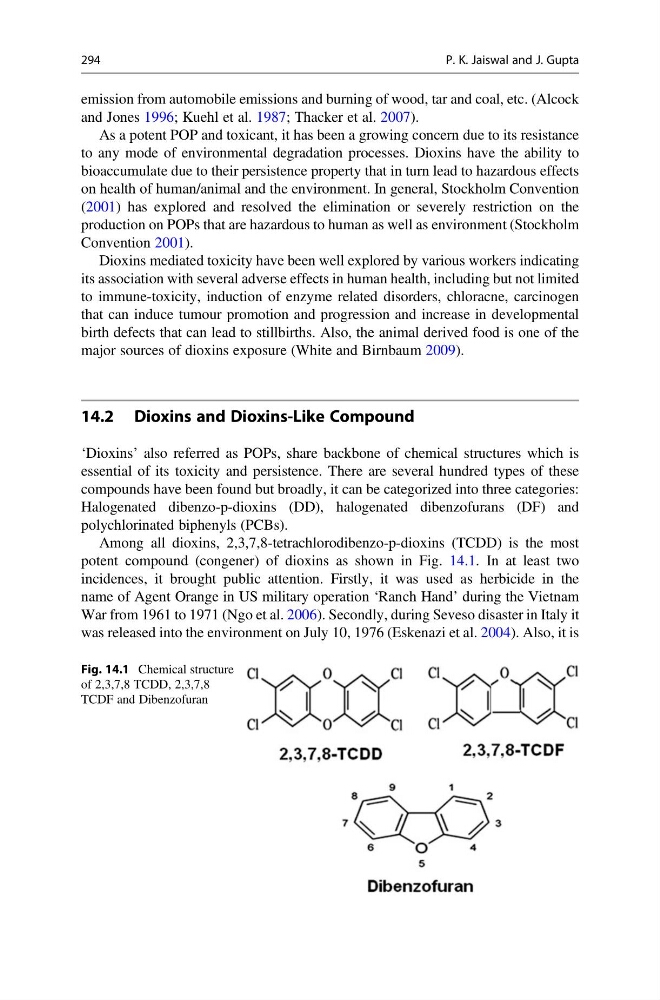
Among all dioxins, 2,3,7,8-tetrachlorodibenzo-p-dioxins (TCDD) is the most
potent compound (congener) of dioxins as shown in Fig. 14.1. In at least two
incidences, it brought public attention. Firstly, it was used as herbicide in the
name of Agent Orange in US military operation ‘Ranch Hand’ during the Vietnam
War from 1961 to 1971 (Ngo et al. 2006). Secondly, during Seveso disaster in Italy it
was released into the environment on July 10, 1976 (Eskenazi et al. 2004). Also, it is
Fig. 14.1 Chemical structure
of 2,3,7,8 TCDD, 2,3,7,8
TCDF and Dibenzofuran
294
P. K. Jaiswal and J. Gupta
and Jones 1996; Kuehl et al. 1987; Thacker et al. 2007).
As a potent POP and toxicant, it has been a growing concern due to its resistance
to any mode of environmental degradation processes. Dioxins have the ability to
bioaccumulate due to their persistence property that in turn lead to hazardous effects
on health of human/animal and the environment. In general, Stockholm Convention
(2001) has explored and resolved the elimination or severely restriction on the
production on POPs that are hazardous to human as well as environment (Stockholm
Convention 2001).
Dioxins mediated toxicity have been well explored by various workers indicating
its association with several adverse effects in human health, including but not limited
to immune-toxicity, induction of enzyme related disorders, chloracne, carcinogen
that can induce tumour promotion and progression and increase in developmental
birth defects that can lead to stillbirths. Also, the animal derived food is one of the
major sources of dioxins exposure (White and Birnbaum 2009).
14.2 Dioxins and Dioxins-Like Compound
‘Dioxins’ also referred as POPs, share backbone of chemical structures which is
essential of its toxicity and persistence. There are several hundred types of these
compounds have been found but broadly, it can be categorized into three categories:
Halogenated dibenzo-p-dioxins (DD), halogenated dibenzofurans (DF) and
polychlorinated biphenyls (PCBs).
Among all dioxins, 2,3,7,8-tetrachlorodibenzo-p-dioxins (TCDD) is the most
potent compound (congener) of dioxins as shown in Fig. 14.1. In at least two
incidences, it brought public attention. Firstly, it was used as herbicide in the
name of Agent Orange in US military operation ‘Ranch Hand’ during the Vietnam
War from 1961 to 1971 (Ngo et al. 2006). Secondly, during Seveso disaster in Italy it
was released into the environment on July 10, 1976 (Eskenazi et al. 2004). Also, it is
Fig. 14.1 Chemical structure
of 2,3,7,8 TCDD, 2,3,7,8
TCDF and Dibenzofuran
294
P. K. Jaiswal and J. Gupta