

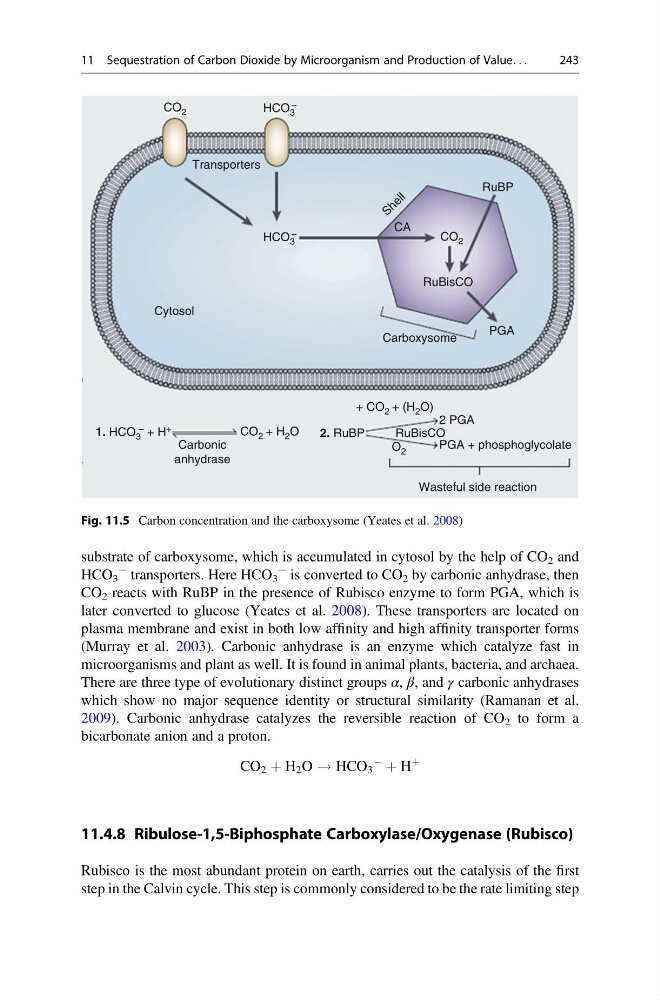
substrate of carboxysome, which is accumulated in cytosol by the help of CO 2 and
HCO 3
À transporters. Here HCO 3
À is converted to CO 2 by carbonic anhydrase, then
CO 2 reacts with RuBP in the presence of Rubisco enzyme to form PGA, which is
later converted to glucose (Yeates et al. 2008). These transporters are located on
plasma membrane and exist in both low affinity and high affinity transporter forms
(Murray et al. 2003). Carbonic anhydrase is an enzyme which catalyze fast in
microorganisms and plant as well. It is found in animal plants, bacteria, and archaea.
There are three type of evolutionary distinct groups α, β, and γ carbonic anhydrases
which show no major sequence identity or structural similarity (Ramanan et al.
2009). Carbonic anhydrase catalyzes the reversible reaction of CO 2 to form a
bicarbonate anion and a proton.
CO 2 þ H 2 O ! HCO 3
À
þ H
þ
11.4.8 Ribulose-1,5-Biphosphate Carboxylase/Oxygenase (Rubisco)
Rubisco is the most abundant protein on earth, carries out the catalysis of the first
step in the Calvin cycle. This step is commonly considered to be the rate limiting step
CO 2
HCO 3
–
HCO 3
–
RuBP
CA
CO 2
RuBisCO
Carboxysome
Cytosol
1. HCO 3
– + H +
CO 2 + H 2 O
+ CO 2 + (H 2 O)
2. RuBP
RuBisCO
2 PGA
PGA + phosphoglycolate
Wasteful side reaction
O 2
Carbonic
anhydrase
PGA
S h e l l
Transporters
Fig. 11.5 Carbon concentration and the carboxysome (Yeates et al. 2008)
11 Sequestration of Carbon Dioxide by Microorganism and Production of Value. . .
243
HCO 3
À transporters. Here HCO 3
À is converted to CO 2 by carbonic anhydrase, then
CO 2 reacts with RuBP in the presence of Rubisco enzyme to form PGA, which is
later converted to glucose (Yeates et al. 2008). These transporters are located on
plasma membrane and exist in both low affinity and high affinity transporter forms
(Murray et al. 2003). Carbonic anhydrase is an enzyme which catalyze fast in
microorganisms and plant as well. It is found in animal plants, bacteria, and archaea.
There are three type of evolutionary distinct groups α, β, and γ carbonic anhydrases
which show no major sequence identity or structural similarity (Ramanan et al.
2009). Carbonic anhydrase catalyzes the reversible reaction of CO 2 to form a
bicarbonate anion and a proton.
CO 2 þ H 2 O ! HCO 3
À
þ H
þ
11.4.8 Ribulose-1,5-Biphosphate Carboxylase/Oxygenase (Rubisco)
Rubisco is the most abundant protein on earth, carries out the catalysis of the first
step in the Calvin cycle. This step is commonly considered to be the rate limiting step
CO 2
HCO 3
–
HCO 3
–
RuBP
CA
CO 2
RuBisCO
Carboxysome
Cytosol
1. HCO 3
– + H +
CO 2 + H 2 O
+ CO 2 + (H 2 O)
2. RuBP
RuBisCO
2 PGA
PGA + phosphoglycolate
Wasteful side reaction
O 2
Carbonic
anhydrase
PGA
S h e l l
Transporters
Fig. 11.5 Carbon concentration and the carboxysome (Yeates et al. 2008)
11 Sequestration of Carbon Dioxide by Microorganism and Production of Value. . .
243