

well studied and the variant allele is usually found in linkage disequilibrium with
GSTP1 I105V. This polymorphism has not emerged as a prominent genetic variation
of GSTP1 owing to its lower frequency and no effect on enzyme activity. It also
exhibits a lower frequency of 5% in African Americans and 9% in European
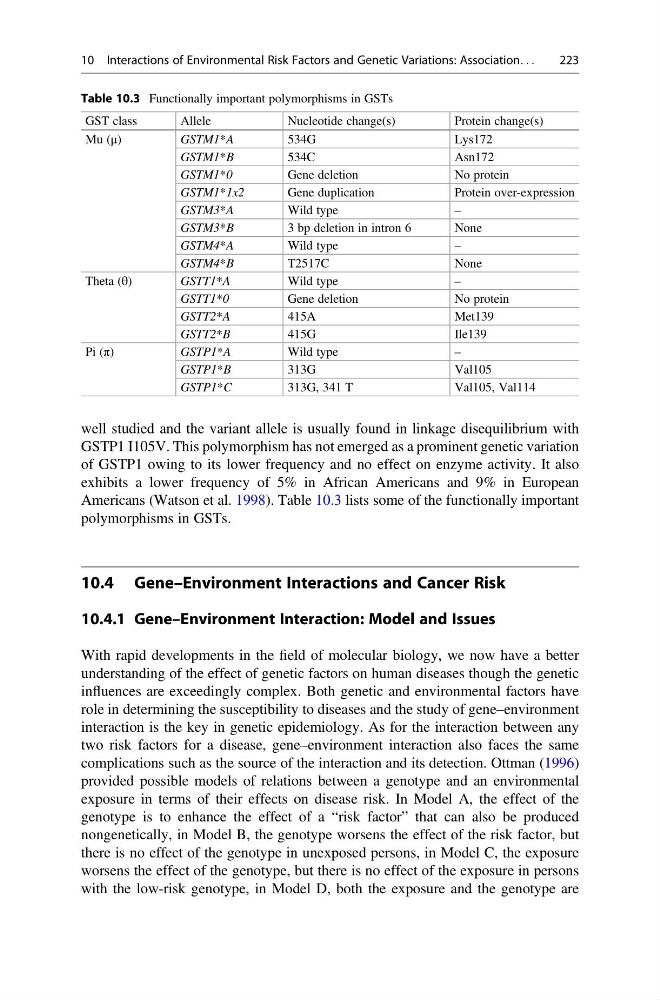
Americans (Watson et al. 1998). Table 10.3 lists some of the functionally important
polymorphisms in GSTs.
10.4 Gene–Environment Interactions and Cancer Risk
10.4.1 Gene–Environment Interaction: Model and Issues
With rapid developments in the field of molecular biology, we now have a better
understanding of the effect of genetic factors on human diseases though the genetic
influences are exceedingly complex. Both genetic and environmental factors have
role in determining the susceptibility to diseases and the study of gene–environment
interaction is the key in genetic epidemiology. As for the interaction between any
two risk factors for a disease, gene–environment interaction also faces the same
complications such as the source of the interaction and its detection. Ottman (1996)
provided possible models of relations between a genotype and an environmental
exposure in terms of their effects on disease risk. In Model A, the effect of the
genotype is to enhance the effect of a “risk factor” that can also be produced
nongenetically, in Model B, the genotype worsens the effect of the risk factor, but
there is no effect of the genotype in unexposed persons, in Model C, the exposure
worsens the effect of the genotype, but there is no effect of the exposure in persons
with the low-risk genotype, in Model D, both the exposure and the genotype are
Table 10.3 Functionally important polymorphisms in GSTs
GST class
Allele
Nucleotide change(s)
Protein change(s)
Mu (μ)
GSTM1*A
534G
Lys172
GSTM1*B
534C
Asn172
GSTM1*0
Gene deletion
No protein
GSTM1*1x2
Gene duplication
Protein over-expression
GSTM3*A
Wild type
–
GSTM3*B
3 bp deletion in intron 6
None
GSTM4*A
Wild type
–
GSTM4*B
T2517C
None
Theta (θ)
GSTT1*A
Wild type
–
GSTT1*0
Gene deletion
No protein
GSTT2*A
415A
Met139
GSTT2*B
415G
Ile139
Pi (π)
GSTP1*A
Wild type
–
GSTP1*B
313G
Val105
GSTP1*C
313G, 341 T
Val105, Val114
10 Interactions of Environmental Risk Factors and Genetic Variations: Association. . .
223
GSTP1 I105V. This polymorphism has not emerged as a prominent genetic variation
of GSTP1 owing to its lower frequency and no effect on enzyme activity. It also
exhibits a lower frequency of 5% in African Americans and 9% in European
Americans (Watson et al. 1998). Table 10.3 lists some of the functionally important
polymorphisms in GSTs.
10.4 Gene–Environment Interactions and Cancer Risk
10.4.1 Gene–Environment Interaction: Model and Issues
With rapid developments in the field of molecular biology, we now have a better
understanding of the effect of genetic factors on human diseases though the genetic
influences are exceedingly complex. Both genetic and environmental factors have
role in determining the susceptibility to diseases and the study of gene–environment
interaction is the key in genetic epidemiology. As for the interaction between any
two risk factors for a disease, gene–environment interaction also faces the same
complications such as the source of the interaction and its detection. Ottman (1996)
provided possible models of relations between a genotype and an environmental
exposure in terms of their effects on disease risk. In Model A, the effect of the
genotype is to enhance the effect of a “risk factor” that can also be produced
nongenetically, in Model B, the genotype worsens the effect of the risk factor, but
there is no effect of the genotype in unexposed persons, in Model C, the exposure
worsens the effect of the genotype, but there is no effect of the exposure in persons
with the low-risk genotype, in Model D, both the exposure and the genotype are
Table 10.3 Functionally important polymorphisms in GSTs
GST class
Allele
Nucleotide change(s)
Protein change(s)
Mu (μ)
GSTM1*A
534G
Lys172
GSTM1*B
534C
Asn172
GSTM1*0
Gene deletion
No protein
GSTM1*1x2
Gene duplication
Protein over-expression
GSTM3*A
Wild type
–
GSTM3*B
3 bp deletion in intron 6
None
GSTM4*A
Wild type
–
GSTM4*B
T2517C
None
Theta (θ)
GSTT1*A
Wild type
–
GSTT1*0
Gene deletion
No protein
GSTT2*A
415A
Met139
GSTT2*B
415G
Ile139
Pi (π)
GSTP1*A
Wild type
–
GSTP1*B
313G
Val105
GSTP1*C
313G, 341 T
Val105, Val114
10 Interactions of Environmental Risk Factors and Genetic Variations: Association. . .
223