

8.7
Major Pathways
As we know that the process of bioremediation can be executed either through the
process of biostimulation, bioaugmentation or simply natural attenuation. This has
been seen in case of not only industrial waste, petroleum waste, or even treating
plastic waste.
Petroleum waste also contributes towards wastewater, the presence of phenols
and phenolic compounds cause serious damage to the environment. Biological
treatment which include green process treatment with the help of bacteria like
Pseudomonas, Acinetobacter, Bacillus, Alcaligenes work on the concept of aerobic
degradation of phenolic compounds which happens when hydroxylation of the ring
occurs at the adjacent carbon atom, this is followed by cleavage of catecholics using
ortho cleavage using 1, 2-dioxygenase enzyme or meta cleavage pathway using 2, 3dioxygenase enzyme.
Aniline is one of the toxic cancer causing organic compounds which is used in
paints, pesticides, herbicides, plastics, and many more. Some of the bacterial species
like pseudomonas, acinetobacter, rhodococcus are able to utilize aniline for carbon
and nitrogen source. It has been found that two different pathways have been utilized
for aniline/aminobenzene degradation, which include Beta ketoadipate pathway.
Beta ketoadipate, gentisate pathway, and extradiol cleavage pathways have been
identified to play major role in the degradation of aniline, mono cyclic aromatic
compounds, hydroxybenzoate, toluene, xylenes, and salicylate (Lee et al. 2016).
It has already been seen in case of Aspergillus nidulans that degradation of mono
chloro phenols makes use of 4-chlorocatechol and 3-cholorocatechol pathways
(Martins et al. 2014).
Another important pathway based on carbon as source of energy utilization has
been noticed in case of aerobic methanotrophs, which have been using ribulose
monophosphate (RuMP) pathway and serine pathway (Ross and Rosenzweig 2016).
It has been seen that the microbial degradation of dioxane makes use of two
distinct pathways—metabloic (most common) and cometabolic (several
monooxygenase are involved—MMO, PMO, PHE, TOL, RMO, etc.).
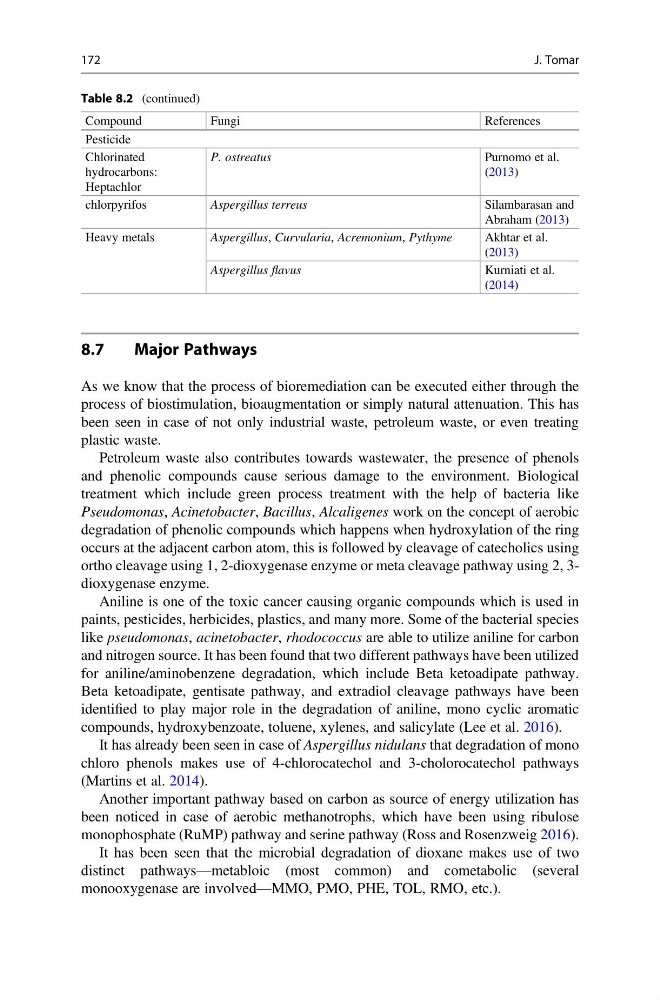
Table 8.2 (continued)
Compound
Fungi
References
Pesticide
Chlorinated
hydrocarbons:
Heptachlor
P. ostreatus
Purnomo et al.
(2013)
chlorpyrifos
Aspergillus terreus
Silambarasan and
Abraham (2013)
Heavy metals
Aspergillus, Curvularia, Acremonium, Pythyme
Akhtar et al.
(2013)
Aspergillus flavus
Kurniati et al.
(2014)
172
J. Tomar
Major Pathways
As we know that the process of bioremediation can be executed either through the
process of biostimulation, bioaugmentation or simply natural attenuation. This has
been seen in case of not only industrial waste, petroleum waste, or even treating
plastic waste.
Petroleum waste also contributes towards wastewater, the presence of phenols
and phenolic compounds cause serious damage to the environment. Biological
treatment which include green process treatment with the help of bacteria like
Pseudomonas, Acinetobacter, Bacillus, Alcaligenes work on the concept of aerobic
degradation of phenolic compounds which happens when hydroxylation of the ring
occurs at the adjacent carbon atom, this is followed by cleavage of catecholics using
ortho cleavage using 1, 2-dioxygenase enzyme or meta cleavage pathway using 2, 3dioxygenase enzyme.
Aniline is one of the toxic cancer causing organic compounds which is used in
paints, pesticides, herbicides, plastics, and many more. Some of the bacterial species
like pseudomonas, acinetobacter, rhodococcus are able to utilize aniline for carbon
and nitrogen source. It has been found that two different pathways have been utilized
for aniline/aminobenzene degradation, which include Beta ketoadipate pathway.
Beta ketoadipate, gentisate pathway, and extradiol cleavage pathways have been
identified to play major role in the degradation of aniline, mono cyclic aromatic
compounds, hydroxybenzoate, toluene, xylenes, and salicylate (Lee et al. 2016).
It has already been seen in case of Aspergillus nidulans that degradation of mono
chloro phenols makes use of 4-chlorocatechol and 3-cholorocatechol pathways
(Martins et al. 2014).
Another important pathway based on carbon as source of energy utilization has
been noticed in case of aerobic methanotrophs, which have been using ribulose
monophosphate (RuMP) pathway and serine pathway (Ross and Rosenzweig 2016).
It has been seen that the microbial degradation of dioxane makes use of two
distinct pathways—metabloic (most common) and cometabolic (several
monooxygenase are involved—MMO, PMO, PHE, TOL, RMO, etc.).
Table 8.2 (continued)
Compound
Fungi
References
Pesticide
Chlorinated
hydrocarbons:
Heptachlor
P. ostreatus
Purnomo et al.
(2013)
chlorpyrifos
Aspergillus terreus
Silambarasan and
Abraham (2013)
Heavy metals
Aspergillus, Curvularia, Acremonium, Pythyme
Akhtar et al.
(2013)
Aspergillus flavus
Kurniati et al.
(2014)
172
J. Tomar