

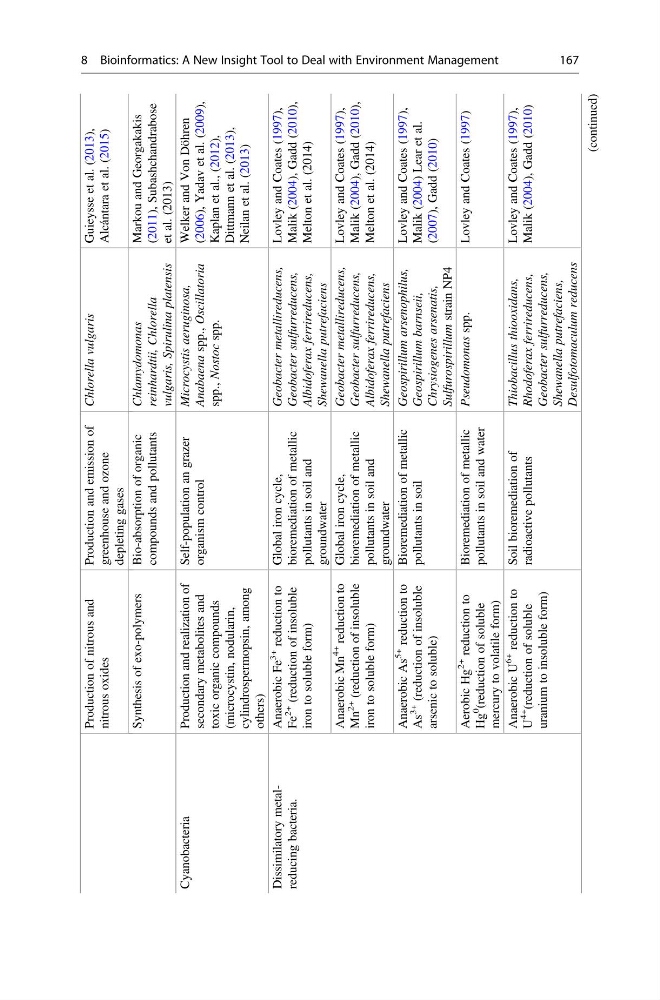
Production of nitrous and
nitrous oxides
Production and emission of
greenhouse and ozone
depleting gases
Chlorella vulgaris
Guieysse et al. (2013),
Alcántara et al. (2015)
Synthesis of exo-polymers
Bio-absorption of organic
compounds and pollutants
Chlamydomonas
reinhardtii, Chlorella
vulgaris, Spirulina platensis
Markou and Georgakakis
(2011), Subashchandrabose
et al. (2013)
Cyanobacteria
Production and realization of
secondary metabolites and
toxic organic compounds
(microcystin, nodularin,
cylindrospermopsin, among
others)
Self-population an grazer
organism control
Microcystis aeruginosa,
Anabaena
spp., Oscillatoria
spp., Nostoc
spp.
Welker and Von Döhren
(2006), Yadav et al. (2009),
Kaplan et al., (2012),
Dittmann et al. (2013),
Neilan et al. (2013)
Dissimilatory metalreducing bacteria.
Anaerobic Fe
3+
reduction to
Fe
2+
(reduction of insoluble
iron to soluble form)
Global iron cycle,
bioremediation of metallic
pollutants in soil and
groundwater
Geobacter metallireducens,
Geobacter sulfurreducens,
Albidoferax ferrireducens,
Shewanella putrefaciens
Lovley and Coates (1997),
Malik (2004), Gadd (2010),
Melton et al. (2014)
Anaerobic Mn
4+
reduction to
Mn
2+
(reduction of insoluble
iron to soluble form)
Global iron cycle,
bioremediation of metallic
pollutants in soil and
groundwater
Geobacter metallireducens,
Geobacter sulfurreducens,
Albidoferax ferrireducens,
Shewanella putrefaciens
Lovley and Coates (1997),
Malik (2004), Gadd (2010),
Melton et al. (2014)
Anaerobic As
5+
reduction to
As
3+
(reduction of insoluble
arsenic to soluble)
Bioremediation of metallic
pollutants in soil
Geospirillum arsenophilus,
Geospirillum barnseii,
Chrysiogenes arsenatis,
Sulfurospirillum
strain NP4
Lovley and Coates (1997),
Malik (2004) Lear et al.
(2007), Gadd (2010)
Aerobic Hg
2+
reduction to
Hg
0
(reduction of soluble
mercury to volatile form)
Bioremediation of metallic
pollutants in soil and water
Pseudomonas
spp.
Lovley and Coates (1997)
Anaerobic U
6+
reduction to
U
4+
(reduction of soluble
uranium to insoluble form)
Soil bioremediation of
radioactive pollutants
Thiobacillus thiooxidans,
Rhodoferax ferrireducens,
Geobacter sulfurreducens,
Shewanella putrefaciens,
Desulfotomaculum reducens
Lovley and Coates (1997),
Malik (2004), Gadd (2010)
(continued)
8 Bioinformatics: A New Insight Tool to Deal with Environment Management
167
nitrous oxides
Production and emission of
greenhouse and ozone
depleting gases
Chlorella vulgaris
Guieysse et al. (2013),
Alcántara et al. (2015)
Synthesis of exo-polymers
Bio-absorption of organic
compounds and pollutants
Chlamydomonas
reinhardtii, Chlorella
vulgaris, Spirulina platensis
Markou and Georgakakis
(2011), Subashchandrabose
et al. (2013)
Cyanobacteria
Production and realization of
secondary metabolites and
toxic organic compounds
(microcystin, nodularin,
cylindrospermopsin, among
others)
Self-population an grazer
organism control
Microcystis aeruginosa,
Anabaena
spp., Oscillatoria
spp., Nostoc
spp.
Welker and Von Döhren
(2006), Yadav et al. (2009),
Kaplan et al., (2012),
Dittmann et al. (2013),
Neilan et al. (2013)
Dissimilatory metalreducing bacteria.
Anaerobic Fe
3+
reduction to
Fe
2+
(reduction of insoluble
iron to soluble form)
Global iron cycle,
bioremediation of metallic
pollutants in soil and
groundwater
Geobacter metallireducens,
Geobacter sulfurreducens,
Albidoferax ferrireducens,
Shewanella putrefaciens
Lovley and Coates (1997),
Malik (2004), Gadd (2010),
Melton et al. (2014)
Anaerobic Mn
4+
reduction to
Mn
2+
(reduction of insoluble
iron to soluble form)
Global iron cycle,
bioremediation of metallic
pollutants in soil and
groundwater
Geobacter metallireducens,
Geobacter sulfurreducens,
Albidoferax ferrireducens,
Shewanella putrefaciens
Lovley and Coates (1997),
Malik (2004), Gadd (2010),
Melton et al. (2014)
Anaerobic As
5+
reduction to
As
3+
(reduction of insoluble
arsenic to soluble)
Bioremediation of metallic
pollutants in soil
Geospirillum arsenophilus,
Geospirillum barnseii,
Chrysiogenes arsenatis,
Sulfurospirillum
strain NP4
Lovley and Coates (1997),
Malik (2004) Lear et al.
(2007), Gadd (2010)
Aerobic Hg
2+
reduction to
Hg
0
(reduction of soluble
mercury to volatile form)
Bioremediation of metallic
pollutants in soil and water
Pseudomonas
spp.
Lovley and Coates (1997)
Anaerobic U
6+
reduction to
U
4+
(reduction of soluble
uranium to insoluble form)
Soil bioremediation of
radioactive pollutants
Thiobacillus thiooxidans,
Rhodoferax ferrireducens,
Geobacter sulfurreducens,
Shewanella putrefaciens,
Desulfotomaculum reducens
Lovley and Coates (1997),
Malik (2004), Gadd (2010)
(continued)
8 Bioinformatics: A New Insight Tool to Deal with Environment Management
167