

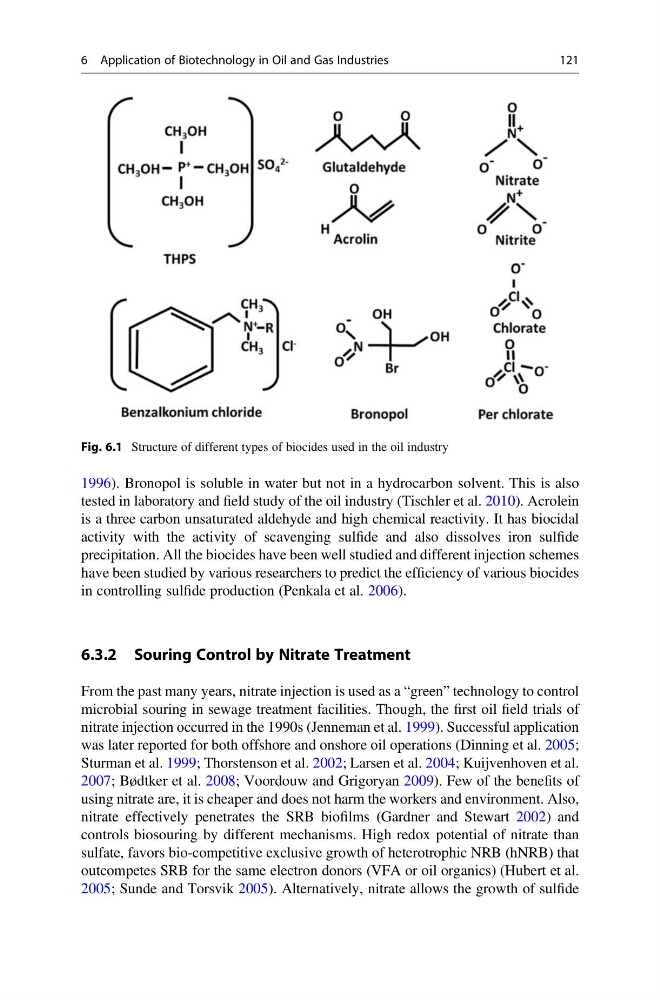
1996). Bronopol is soluble in water but not in a hydrocarbon solvent. This is also
tested in laboratory and field study of the oil industry (Tischler et al. 2010). Acrolein
is a three carbon unsaturated aldehyde and high chemical reactivity. It has biocidal
activity with the activity of scavenging sulfide and also dissolves iron sulfide
precipitation. All the biocides have been well studied and different injection schemes
have been studied by various researchers to predict the efficiency of various biocides
in controlling sulfide production (Penkala et al. 2006).
6.3.2 Souring Control by Nitrate Treatment
From the past many years, nitrate injection is used as a “green” technology to control
microbial souring in sewage treatment facilities. Though, the first oil field trials of
nitrate injection occurred in the 1990s (Jenneman et al. 1999). Successful application
was later reported for both offshore and onshore oil operations (Dinning et al. 2005;
Sturman et al. 1999; Thorstenson et al. 2002; Larsen et al. 2004; Kuijvenhoven et al.
2007; Bødtker et al. 2008; Voordouw and Grigoryan 2009). Few of the benefits of
using nitrate are, it is cheaper and does not harm the workers and environment. Also,
nitrate effectively penetrates the SRB biofilms (Gardner and Stewart 2002) and
controls biosouring by different mechanisms. High redox potential of nitrate than
sulfate, favors bio-competitive exclusive growth of heterotrophic NRB (hNRB) that
outcompetes SRB for the same electron donors (VFA or oil organics) (Hubert et al.
2005; Sunde and Torsvik 2005). Alternatively, nitrate allows the growth of sulfide
Fig. 6.1 Structure of different types of biocides used in the oil industry
6 Application of Biotechnology in Oil and Gas Industries
121
tested in laboratory and field study of the oil industry (Tischler et al. 2010). Acrolein
is a three carbon unsaturated aldehyde and high chemical reactivity. It has biocidal
activity with the activity of scavenging sulfide and also dissolves iron sulfide
precipitation. All the biocides have been well studied and different injection schemes
have been studied by various researchers to predict the efficiency of various biocides
in controlling sulfide production (Penkala et al. 2006).
6.3.2 Souring Control by Nitrate Treatment
From the past many years, nitrate injection is used as a “green” technology to control
microbial souring in sewage treatment facilities. Though, the first oil field trials of
nitrate injection occurred in the 1990s (Jenneman et al. 1999). Successful application
was later reported for both offshore and onshore oil operations (Dinning et al. 2005;
Sturman et al. 1999; Thorstenson et al. 2002; Larsen et al. 2004; Kuijvenhoven et al.
2007; Bødtker et al. 2008; Voordouw and Grigoryan 2009). Few of the benefits of
using nitrate are, it is cheaper and does not harm the workers and environment. Also,
nitrate effectively penetrates the SRB biofilms (Gardner and Stewart 2002) and
controls biosouring by different mechanisms. High redox potential of nitrate than
sulfate, favors bio-competitive exclusive growth of heterotrophic NRB (hNRB) that
outcompetes SRB for the same electron donors (VFA or oil organics) (Hubert et al.
2005; Sunde and Torsvik 2005). Alternatively, nitrate allows the growth of sulfide
Fig. 6.1 Structure of different types of biocides used in the oil industry
6 Application of Biotechnology in Oil and Gas Industries
121