

(4) does not need additional gas treatments. Finally, (5) energy is not necessary for
aeration (Logan and Rabaey 2012).
5.2
Microbial Group and Their Quantification
for Bioelectrochemical System
Geobacter species play a vital role in the bioelectrochemical system for the electron
transfer; the basic mechanism of the electron transfer is direct electron transfer.
Bioelectrochemical systems (BESs) are campaigns that harness the electroactivity of
microorganisms as power, hydrogen, and/or chemicals, performance guarantee for
the processing of and energy recovery from organic wastes. BES performance is at
the end of the day dependent on the capability of microorganisms to catalyze redox
reactions using electrodes. Not unexpectedly, any parameter that influences the
augmentation of BES microorganisms also affects liveliness outputs. The beststudied BESs are those single-minded by anode-reducing bacteria in the genus
Geobacter (Dominguez-Benetton et al. 2012). The group contains some of the
most resourceful exoelectrogens presented in pure culture, and their growth and
electroactivity are what in due course drive the catalytic activity of mixed-species
anode biofilms in BESs (Schröder 2007). The theory and practice of Geobacterdriven BESs, focusing on the model representative Geobacter sulfurreducens.
MFC Mode
H +
H +
e -
e -
e -
O 2
Organic
Compound
+ XenobioƟc
compound 1
CO 2 + H + + e -
+ Biomass
H + + e - +
XenobioƟc
compound 2
+O 2 + Other
CO 2 + H 2 O + +
Biomass +
Residue (S)
Cathode
Cathodic
chamber
Anode
Anodic
chamber
Sparger
Proton
exchange
membrane
Electrogenic
bacteria
Denitrifying
bacteria (In
case of
biocathode)
External
Resistance
H +
H +
Wastewater
N+
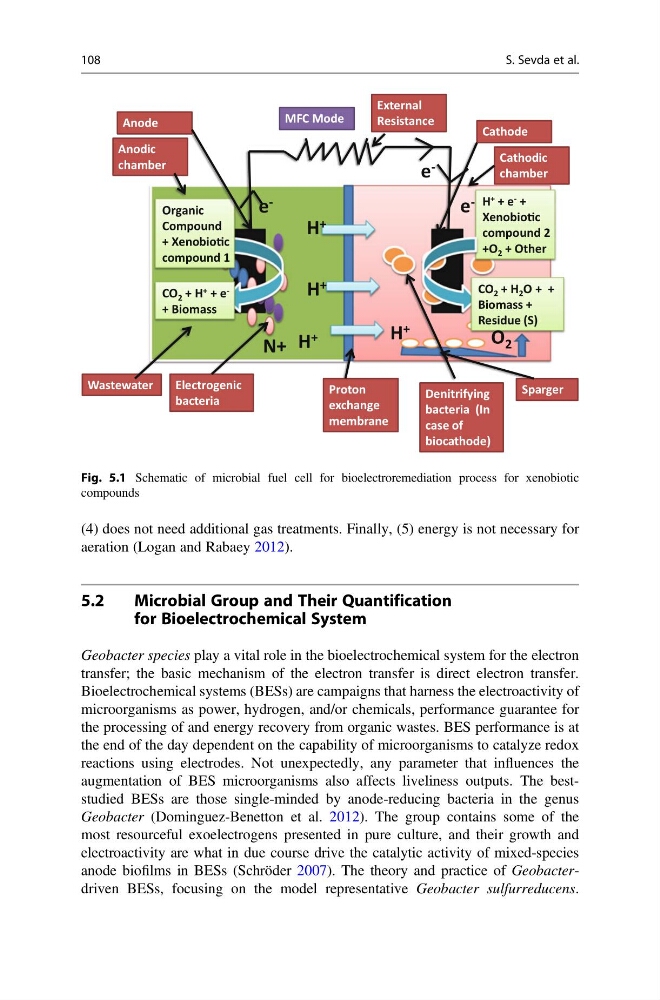
Fig. 5.1 Schematic of microbial fuel cell for bioelectroremediation process for xenobiotic
compounds
108
S. Sevda et al.
aeration (Logan and Rabaey 2012).
5.2
Microbial Group and Their Quantification
for Bioelectrochemical System
Geobacter species play a vital role in the bioelectrochemical system for the electron
transfer; the basic mechanism of the electron transfer is direct electron transfer.
Bioelectrochemical systems (BESs) are campaigns that harness the electroactivity of
microorganisms as power, hydrogen, and/or chemicals, performance guarantee for
the processing of and energy recovery from organic wastes. BES performance is at
the end of the day dependent on the capability of microorganisms to catalyze redox
reactions using electrodes. Not unexpectedly, any parameter that influences the
augmentation of BES microorganisms also affects liveliness outputs. The beststudied BESs are those single-minded by anode-reducing bacteria in the genus
Geobacter (Dominguez-Benetton et al. 2012). The group contains some of the
most resourceful exoelectrogens presented in pure culture, and their growth and
electroactivity are what in due course drive the catalytic activity of mixed-species
anode biofilms in BESs (Schröder 2007). The theory and practice of Geobacterdriven BESs, focusing on the model representative Geobacter sulfurreducens.
MFC Mode
H +
H +
e -
e -
e -
O 2
Organic
Compound
+ XenobioƟc
compound 1
CO 2 + H + + e -
+ Biomass
H + + e - +
XenobioƟc
compound 2
+O 2 + Other
CO 2 + H 2 O + +
Biomass +
Residue (S)
Cathode
Cathodic
chamber
Anode
Anodic
chamber
Sparger
Proton
exchange
membrane
Electrogenic
bacteria
Denitrifying
bacteria (In
case of
biocathode)
External
Resistance
H +
H +
Wastewater
N+
Fig. 5.1 Schematic of microbial fuel cell for bioelectroremediation process for xenobiotic
compounds
108
S. Sevda et al.