

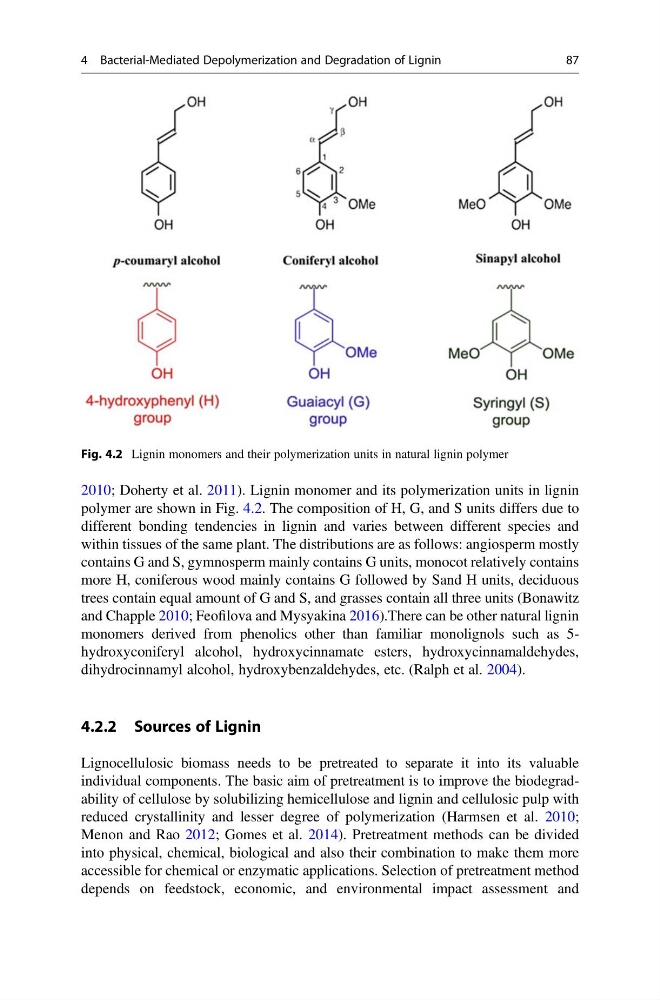
2010; Doherty et al. 2011). Lignin monomer and its polymerization units in lignin
polymer are shown in Fig. 4.2. The composition of H, G, and S units differs due to
different bonding tendencies in lignin and varies between different species and
within tissues of the same plant. The distributions are as follows: angiosperm mostly
contains G and S, gymnosperm mainly contains G units, monocot relatively contains
more H, coniferous wood mainly contains G followed by Sand H units, deciduous
trees contain equal amount of G and S, and grasses contain all three units (Bonawitz
and Chapple 2010; Feofilova and Mysyakina 2016).There can be other natural lignin
monomers derived from phenolics other than familiar monolignols such as 5hydroxyconiferyl alcohol, hydroxycinnamate esters, hydroxycinnamaldehydes,
dihydrocinnamyl alcohol, hydroxybenzaldehydes, etc. (Ralph et al. 2004).
4.2.2 Sources of Lignin
Lignocellulosic biomass needs to be pretreated to separate it into its valuable
individual components. The basic aim of pretreatment is to improve the biodegradability of cellulose by solubilizing hemicellulose and lignin and cellulosic pulp with
reduced crystallinity and lesser degree of polymerization (Harmsen et al. 2010;
Menon and Rao 2012; Gomes et al. 2014). Pretreatment methods can be divided
into physical, chemical, biological and also their combination to make them more
accessible for chemical or enzymatic applications. Selection of pretreatment method
depends on feedstock, economic, and environmental impact assessment and
Fig. 4.2 Lignin monomers and their polymerization units in natural lignin polymer
4 Bacterial-Mediated Depolymerization and Degradation of Lignin
87
polymer are shown in Fig. 4.2. The composition of H, G, and S units differs due to
different bonding tendencies in lignin and varies between different species and
within tissues of the same plant. The distributions are as follows: angiosperm mostly
contains G and S, gymnosperm mainly contains G units, monocot relatively contains
more H, coniferous wood mainly contains G followed by Sand H units, deciduous
trees contain equal amount of G and S, and grasses contain all three units (Bonawitz
and Chapple 2010; Feofilova and Mysyakina 2016).There can be other natural lignin
monomers derived from phenolics other than familiar monolignols such as 5hydroxyconiferyl alcohol, hydroxycinnamate esters, hydroxycinnamaldehydes,
dihydrocinnamyl alcohol, hydroxybenzaldehydes, etc. (Ralph et al. 2004).
4.2.2 Sources of Lignin
Lignocellulosic biomass needs to be pretreated to separate it into its valuable
individual components. The basic aim of pretreatment is to improve the biodegradability of cellulose by solubilizing hemicellulose and lignin and cellulosic pulp with
reduced crystallinity and lesser degree of polymerization (Harmsen et al. 2010;
Menon and Rao 2012; Gomes et al. 2014). Pretreatment methods can be divided
into physical, chemical, biological and also their combination to make them more
accessible for chemical or enzymatic applications. Selection of pretreatment method
depends on feedstock, economic, and environmental impact assessment and
Fig. 4.2 Lignin monomers and their polymerization units in natural lignin polymer
4 Bacterial-Mediated Depolymerization and Degradation of Lignin
87