

59
This upward spike in petroleum demand occurred while conventional oil and gas
wells in the U.S. that had been drilled in the 1930s and 40s were in the middle stages
of decline. Oil and gas field development continued during the 1950s and 60s, but
by then most of the large, onshore fields in the U.S. had already been discovered.
Some of the wasteful practices of the past century, such as burning off gas in a flambeau, or allowing a field to depressurize with uncapped gushers were now coming
home to roost. A number of small, new fields came online, and operators also began
to apply techniques like infill drilling, waterflooding, reservoir re-pressurization,
and new types of artificial lift on old fields to get more oil out of the ground.
The majors began to move increasingly into more challenging regions like the
Alaska North Slope and deeper waters in the Gulf of Mexico in search of new oilfields. Such ventures were frightfully expensive, and required the discovery of enormous amounts of oil to provide a reasonable ROI. The large quantities of oil that
were in fact discovered in these places led to an increase in upstream and midstream
environmental risks – as evidenced by the 1989 Exxon Valdez oil spill in Alaska,
and the 2010 Deepwater Horizon accident in the Gulf.
The international nature of the major oil companies (driven in part by Standard
Oil’s lockdown of the American market) sent them to all parts of the planet to obtain
crude oil. They refined it at many places around the world, and sold the resulting
products on the global market. After the Second World War, the United States
became the largest oil-consuming nation on Earth. Driven by this increased demand,
oil companies became even more multinational than they had been in the first half
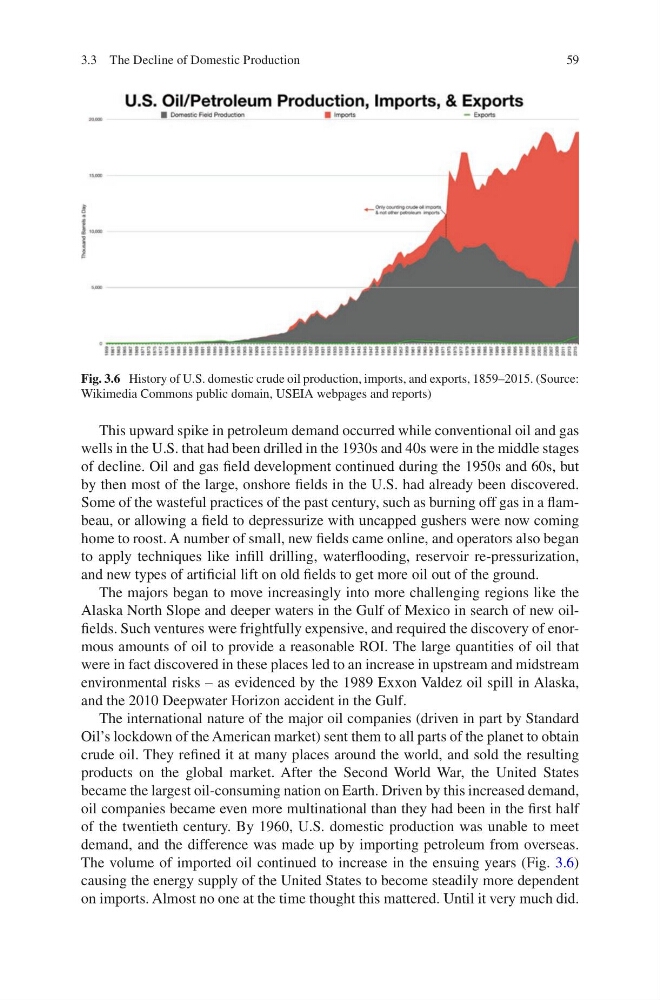
of the twentieth century. By 1960, U.S. domestic production was unable to meet
demand, and the difference was made up by importing petroleum from overseas.
The volume of imported oil continued to increase in the ensuing years (Fig. 3.6)
causing the energy supply of the United States to become steadily more dependent
on imports. Almost no one at the time thought this mattered. Until it very much did.
Fig. 3.6 History of U.S. domestic crude oil production, imports, and exports, 1859–2015. (Source:
Wikimedia Commons public domain, USEIA webpages and reports)
3.3 The Decline of Domestic Production
This upward spike in petroleum demand occurred while conventional oil and gas
wells in the U.S. that had been drilled in the 1930s and 40s were in the middle stages
of decline. Oil and gas field development continued during the 1950s and 60s, but
by then most of the large, onshore fields in the U.S. had already been discovered.
Some of the wasteful practices of the past century, such as burning off gas in a flambeau, or allowing a field to depressurize with uncapped gushers were now coming
home to roost. A number of small, new fields came online, and operators also began
to apply techniques like infill drilling, waterflooding, reservoir re-pressurization,
and new types of artificial lift on old fields to get more oil out of the ground.
The majors began to move increasingly into more challenging regions like the
Alaska North Slope and deeper waters in the Gulf of Mexico in search of new oilfields. Such ventures were frightfully expensive, and required the discovery of enormous amounts of oil to provide a reasonable ROI. The large quantities of oil that
were in fact discovered in these places led to an increase in upstream and midstream
environmental risks – as evidenced by the 1989 Exxon Valdez oil spill in Alaska,
and the 2010 Deepwater Horizon accident in the Gulf.
The international nature of the major oil companies (driven in part by Standard
Oil’s lockdown of the American market) sent them to all parts of the planet to obtain
crude oil. They refined it at many places around the world, and sold the resulting
products on the global market. After the Second World War, the United States
became the largest oil-consuming nation on Earth. Driven by this increased demand,
oil companies became even more multinational than they had been in the first half
of the twentieth century. By 1960, U.S. domestic production was unable to meet
demand, and the difference was made up by importing petroleum from overseas.
The volume of imported oil continued to increase in the ensuing years (Fig. 3.6)
causing the energy supply of the United States to become steadily more dependent
on imports. Almost no one at the time thought this mattered. Until it very much did.
Fig. 3.6 History of U.S. domestic crude oil production, imports, and exports, 1859–2015. (Source:
Wikimedia Commons public domain, USEIA webpages and reports)
3.3 The Decline of Domestic Production