

32
that produce a little bit of oil and gas. The ratio of this water to the total produced
fluids from the well is called the “water cut” and it can change over the course of
production. If the water cut gets too high for the well to remain profitable, it is said
to have “watered out” and is shut in or plugged. The economics would improve if a
beneficial use like crop irrigation could be found for produced water. Produced
waters with low salinity have been used for irrigation in California and Wyoming.
However, most produced water needs the high levels of TDS reduced before any
large-scale use.
Dealing with produced water in a responsible manner is a major technical and
economic issue for the O&G industry that includes both conventional and unconventional production. Some states allow surface disposal, usually by evaporation.
This is more prevalent in the west where the drier air and hotter sun speeds up the
process. Once the water evaporates off, the residual minerals that remain behind can
be disposed of as solid waste. Other states require industrial wastewater treatment
to reduce the TDS content of the produced water prior to surface disposal. This is an
expensive process, and is largely avoided by the use of UIC wells.
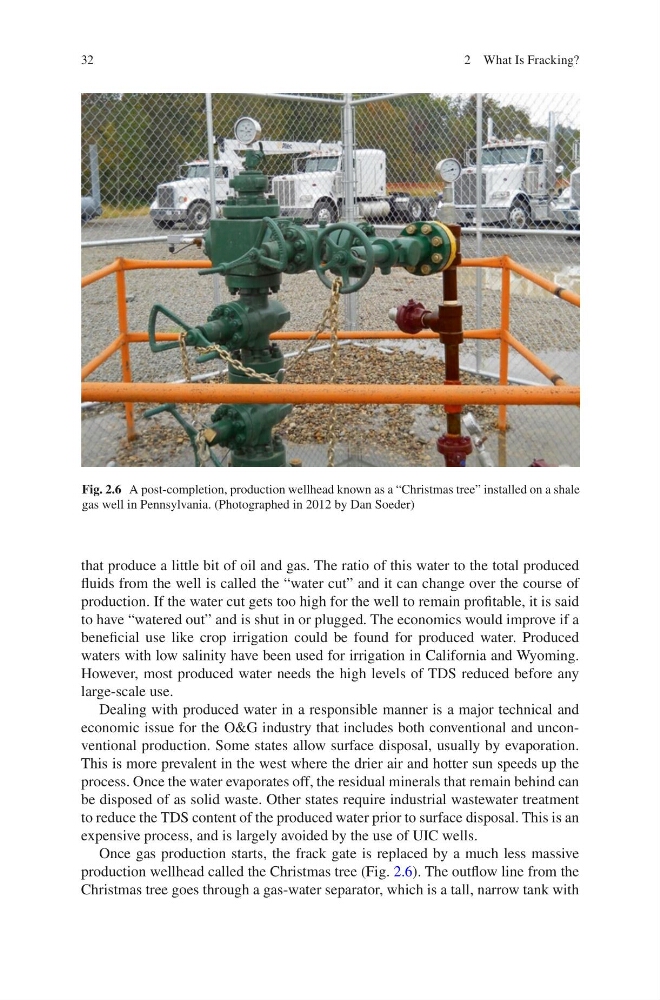
Once gas production starts, the frack gate is replaced by a much less massive
production wellhead called the Christmas tree (Fig. 2.6). The outflow line from the
Christmas tree goes through a gas-water separator, which is a tall, narrow tank with
Fig. 2.6 A post-completion, production wellhead known as a “Christmas tree” installed on a shale
gas well in Pennsylvania. (Photographed in 2012 by Dan Soeder)
2 What Is Fracking?
that produce a little bit of oil and gas. The ratio of this water to the total produced
fluids from the well is called the “water cut” and it can change over the course of
production. If the water cut gets too high for the well to remain profitable, it is said
to have “watered out” and is shut in or plugged. The economics would improve if a
beneficial use like crop irrigation could be found for produced water. Produced
waters with low salinity have been used for irrigation in California and Wyoming.
However, most produced water needs the high levels of TDS reduced before any
large-scale use.
Dealing with produced water in a responsible manner is a major technical and
economic issue for the O&G industry that includes both conventional and unconventional production. Some states allow surface disposal, usually by evaporation.
This is more prevalent in the west where the drier air and hotter sun speeds up the
process. Once the water evaporates off, the residual minerals that remain behind can
be disposed of as solid waste. Other states require industrial wastewater treatment
to reduce the TDS content of the produced water prior to surface disposal. This is an
expensive process, and is largely avoided by the use of UIC wells.
Once gas production starts, the frack gate is replaced by a much less massive
production wellhead called the Christmas tree (Fig. 2.6). The outflow line from the
Christmas tree goes through a gas-water separator, which is a tall, narrow tank with
Fig. 2.6 A post-completion, production wellhead known as a “Christmas tree” installed on a shale
gas well in Pennsylvania. (Photographed in 2012 by Dan Soeder)
2 What Is Fracking?