

25
provide an electrical ground for the rig. Conductor casing may or may not be used
depending on the conditions at an individual site.
The “spud” occurs when the drill bit first penetrates the ground surface. The
borehole is usually drilled down a few hundred feet (a few dozen meters) to the base
of the drinking water aquifers before stopping, and a casing string known as the
surface casing is set and cemented into place to protect the groundwater. State regulations mandate the depth to which surface casing must be set for groundwater protection, and this varies from state to state. In many states, drilling cannot proceed
until the surface casing has been inspected, tested, and certified.
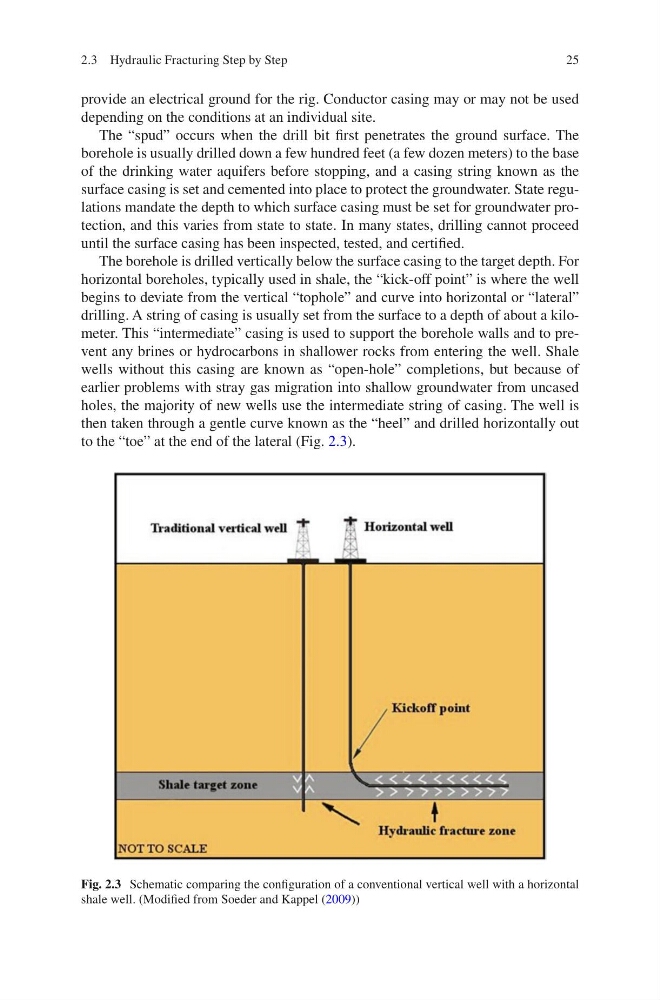
The borehole is drilled vertically below the surface casing to the target depth. For
horizontal boreholes, typically used in shale, the “kick-off point” is where the well
begins to deviate from the vertical “tophole” and curve into horizontal or “lateral”
drilling. A string of casing is usually set from the surface to a depth of about a kilometer. This “intermediate” casing is used to support the borehole walls and to prevent any brines or hydrocarbons in shallower rocks from entering the well. Shale
wells without this casing are known as “open-hole” completions, but because of
earlier problems with stray gas migration into shallow groundwater from uncased
holes, the majority of new wells use the intermediate string of casing. The well is
then taken through a gentle curve known as the “heel” and drilled horizontally out
to the “toe” at the end of the lateral (Fig. 2.3).
Fig. 2.3 Schematic comparing the configuration of a conventional vertical well with a horizontal
shale well. (Modified from Soeder and Kappel (2009))
2.3 Hydraulic Fracturing Step by Step
provide an electrical ground for the rig. Conductor casing may or may not be used
depending on the conditions at an individual site.
The “spud” occurs when the drill bit first penetrates the ground surface. The
borehole is usually drilled down a few hundred feet (a few dozen meters) to the base
of the drinking water aquifers before stopping, and a casing string known as the
surface casing is set and cemented into place to protect the groundwater. State regulations mandate the depth to which surface casing must be set for groundwater protection, and this varies from state to state. In many states, drilling cannot proceed
until the surface casing has been inspected, tested, and certified.
The borehole is drilled vertically below the surface casing to the target depth. For
horizontal boreholes, typically used in shale, the “kick-off point” is where the well
begins to deviate from the vertical “tophole” and curve into horizontal or “lateral”
drilling. A string of casing is usually set from the surface to a depth of about a kilometer. This “intermediate” casing is used to support the borehole walls and to prevent any brines or hydrocarbons in shallower rocks from entering the well. Shale
wells without this casing are known as “open-hole” completions, but because of
earlier problems with stray gas migration into shallow groundwater from uncased
holes, the majority of new wells use the intermediate string of casing. The well is
then taken through a gentle curve known as the “heel” and drilled horizontally out
to the “toe” at the end of the lateral (Fig. 2.3).
Fig. 2.3 Schematic comparing the configuration of a conventional vertical well with a horizontal
shale well. (Modified from Soeder and Kappel (2009))
2.3 Hydraulic Fracturing Step by Step