

22
shale have permeabilities as low as a nanodarcy (nd), or 10
−9
darcy (Civan and
Devegowda 2015). Commercial amounts of O&G are successfully being produced
from shales this tight.
The SI permeability units are generally not used on oil and gas resources because
the conversion requires working with extremely small numbers: one md equals
about 10
−15
m
2
, one μd is about 10
−18
m
2
and one nd is 10
−21
m
2
. Most researchers
consider the darcy to be a more practical unit, especially when expressed as md, μd,
or nd (Soeder 2017).
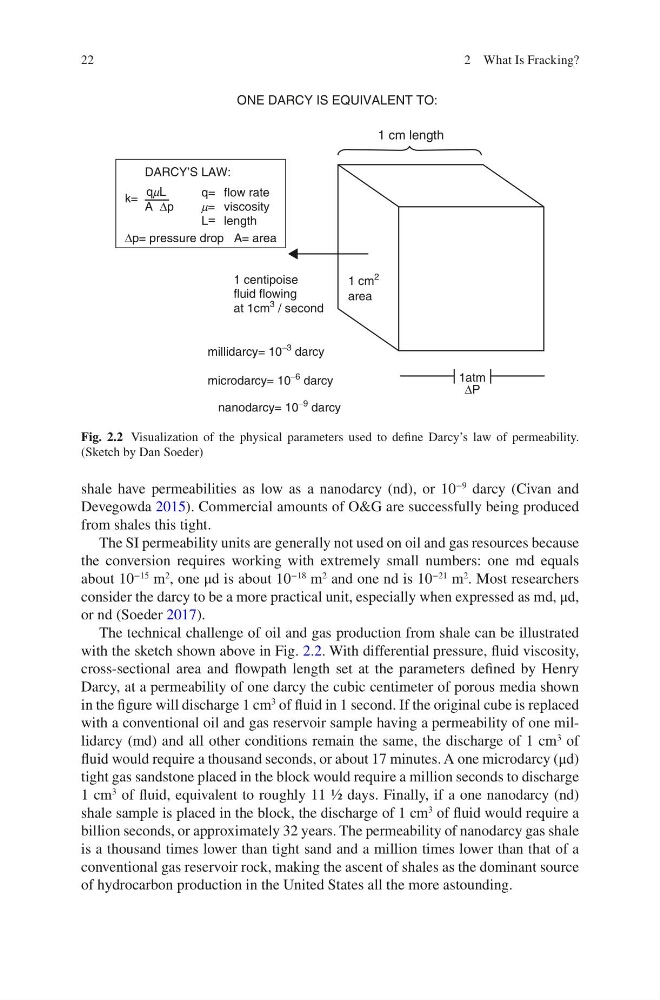
The technical challenge of oil and gas production from shale can be illustrated
with the sketch shown above in Fig. 2.2. With differential pressure, fluid viscosity,
cross-sectional area and flowpath length set at the parameters defined by Henry
Darcy, at a permeability of one darcy the cubic centimeter of porous media shown
in the figure will discharge 1 cm
3
of fluid in 1 second. If the original cube is replaced
with a conventional oil and gas reservoir sample having a permeability of one millidarcy (md) and all other conditions remain the same, the discharge of 1 cm
3
of
fluid would require a thousand seconds, or about 17 minutes. A one microdarcy (μd)
tight gas sandstone placed in the block would require a million seconds to discharge
1 cm
3
of fluid, equivalent to roughly 11 ½ days. Finally, if a one nanodarcy (nd)
shale sample is placed in the block, the discharge of 1 cm
3
of fluid would require a
billion seconds, or approximately 32 years. The permeability of nanodarcy gas shale
is a thousand times lower than tight sand and a million times lower than that of a
conventional gas reservoir rock, making the ascent of shales as the dominant source
of hydrocarbon production in the United States all the more astounding.
ONE DARCY IS EQUIVALENT TO:
1 cm length
millidarcy= 10
−3 darcy
nanodarcy= 10
−9 darcy
microdarcy= 10
−6 darcy
1 centipoise
fluid flowing
at 1cm
3 / second
1 cm
2
area
1atm
∆P
DARCY’S LAW:
k=
q= flow rate
L= length
m= viscosity
qmL
A ∆p
∆p= pressure drop A= area
Fig. 2.2 Visualization of the physical parameters used to define Darcy’s law of permeability.
(Sketch by Dan Soeder)
2 What Is Fracking?
shale have permeabilities as low as a nanodarcy (nd), or 10
−9
darcy (Civan and
Devegowda 2015). Commercial amounts of O&G are successfully being produced
from shales this tight.
The SI permeability units are generally not used on oil and gas resources because
the conversion requires working with extremely small numbers: one md equals
about 10
−15
m
2
, one μd is about 10
−18
m
2
and one nd is 10
−21
m
2
. Most researchers
consider the darcy to be a more practical unit, especially when expressed as md, μd,
or nd (Soeder 2017).
The technical challenge of oil and gas production from shale can be illustrated
with the sketch shown above in Fig. 2.2. With differential pressure, fluid viscosity,
cross-sectional area and flowpath length set at the parameters defined by Henry
Darcy, at a permeability of one darcy the cubic centimeter of porous media shown
in the figure will discharge 1 cm
3
of fluid in 1 second. If the original cube is replaced
with a conventional oil and gas reservoir sample having a permeability of one millidarcy (md) and all other conditions remain the same, the discharge of 1 cm
3
of
fluid would require a thousand seconds, or about 17 minutes. A one microdarcy (μd)
tight gas sandstone placed in the block would require a million seconds to discharge
1 cm
3
of fluid, equivalent to roughly 11 ½ days. Finally, if a one nanodarcy (nd)
shale sample is placed in the block, the discharge of 1 cm
3
of fluid would require a
billion seconds, or approximately 32 years. The permeability of nanodarcy gas shale
is a thousand times lower than tight sand and a million times lower than that of a
conventional gas reservoir rock, making the ascent of shales as the dominant source
of hydrocarbon production in the United States all the more astounding.
ONE DARCY IS EQUIVALENT TO:
1 cm length
millidarcy= 10
−3 darcy
nanodarcy= 10
−9 darcy
microdarcy= 10
−6 darcy
1 centipoise
fluid flowing
at 1cm
3 / second
1 cm
2
area
1atm
∆P
DARCY’S LAW:
k=
q= flow rate
L= length
m= viscosity
qmL
A ∆p
∆p= pressure drop A= area
Fig. 2.2 Visualization of the physical parameters used to define Darcy’s law of permeability.
(Sketch by Dan Soeder)
2 What Is Fracking?