

20
2.2 Why Frack?
So why even do this? Oil and gas wells had been around for 90 years before fracking
was ever invented. Couldn’t the whole controversy be avoided by just drilling and
producing wells without reservoir stimulation? Well, yes, but the wells that can be
produced without hydraulic fracturing make up less than half of our current hydrocarbon production. To recover shale gas (70% of our current gas production) and
tight oil (50% of our current oil production) from the extremely low permeability
rocks that make up these reservoirs, hydraulic fracturing is absolutely essential.
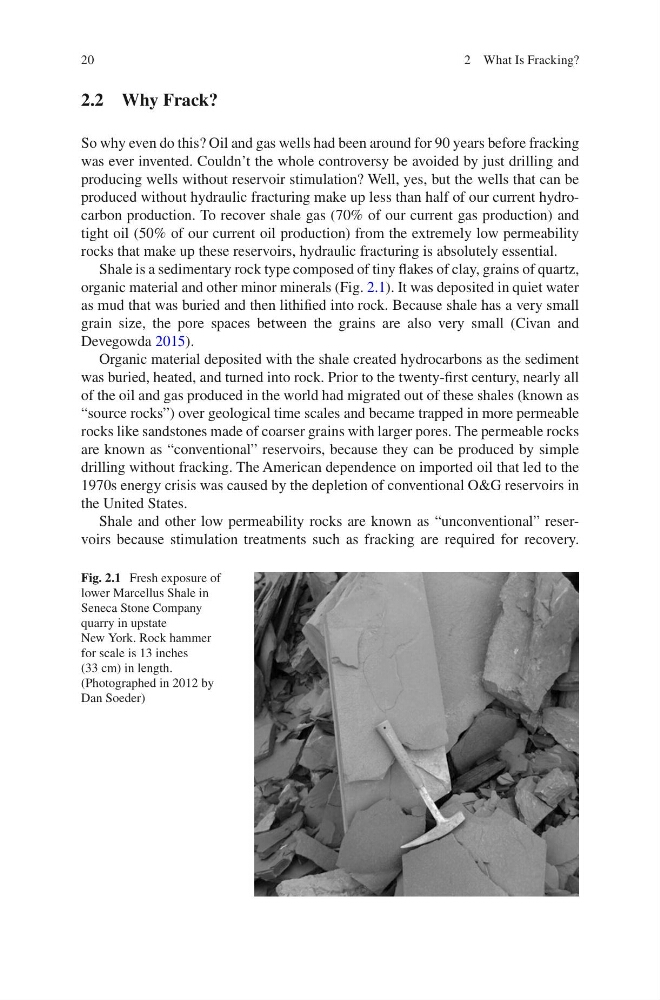
Shale is a sedimentary rock type composed of tiny flakes of clay, grains of quartz,
organic material and other minor minerals (Fig. 2.1). It was deposited in quiet water
as mud that was buried and then lithified into rock. Because shale has a very small
grain size, the pore spaces between the grains are also very small (Civan and
Devegowda 2015).
Organic material deposited with the shale created hydrocarbons as the sediment
was buried, heated, and turned into rock. Prior to the twenty-first century, nearly all
of the oil and gas produced in the world had migrated out of these shales (known as
“source rocks”) over geological time scales and became trapped in more permeable
rocks like sandstones made of coarser grains with larger pores. The permeable rocks
are known as “conventional” reservoirs, because they can be produced by simple
drilling without fracking. The American dependence on imported oil that led to the
1970s energy crisis was caused by the depletion of conventional O&G reservoirs in
the United States.
Shale and other low permeability rocks are known as “unconventional” reservoirs because stimulation treatments such as fracking are required for recovery.
Fig. 2.1 Fresh exposure of
lower Marcellus Shale in
Seneca Stone Company
quarry in upstate
New York. Rock hammer
for scale is 13 inches
(33 cm) in length.
(Photographed in 2012 by
Dan Soeder)
2 What Is Fracking?
2.2 Why Frack?
So why even do this? Oil and gas wells had been around for 90 years before fracking
was ever invented. Couldn’t the whole controversy be avoided by just drilling and
producing wells without reservoir stimulation? Well, yes, but the wells that can be
produced without hydraulic fracturing make up less than half of our current hydrocarbon production. To recover shale gas (70% of our current gas production) and
tight oil (50% of our current oil production) from the extremely low permeability
rocks that make up these reservoirs, hydraulic fracturing is absolutely essential.
Shale is a sedimentary rock type composed of tiny flakes of clay, grains of quartz,
organic material and other minor minerals (Fig. 2.1). It was deposited in quiet water
as mud that was buried and then lithified into rock. Because shale has a very small
grain size, the pore spaces between the grains are also very small (Civan and
Devegowda 2015).
Organic material deposited with the shale created hydrocarbons as the sediment
was buried, heated, and turned into rock. Prior to the twenty-first century, nearly all
of the oil and gas produced in the world had migrated out of these shales (known as
“source rocks”) over geological time scales and became trapped in more permeable
rocks like sandstones made of coarser grains with larger pores. The permeable rocks
are known as “conventional” reservoirs, because they can be produced by simple
drilling without fracking. The American dependence on imported oil that led to the
1970s energy crisis was caused by the depletion of conventional O&G reservoirs in
the United States.
Shale and other low permeability rocks are known as “unconventional” reservoirs because stimulation treatments such as fracking are required for recovery.
Fig. 2.1 Fresh exposure of
lower Marcellus Shale in
Seneca Stone Company
quarry in upstate
New York. Rock hammer
for scale is 13 inches
(33 cm) in length.
(Photographed in 2012 by
Dan Soeder)
2 What Is Fracking?