

258
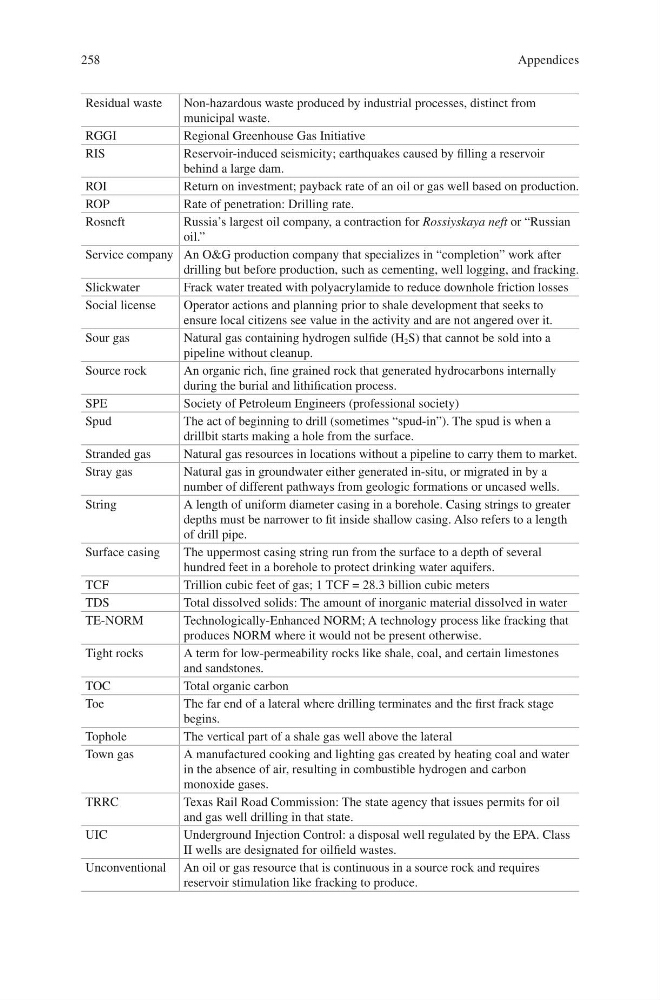
Residual waste
Non-hazardous waste produced by industrial processes, distinct from
municipal waste.
RGGI
Regional Greenhouse Gas Initiative
RIS
Reservoir-induced seismicity; earthquakes caused by filling a reservoir
behind a large dam.
ROI
Return on investment; payback rate of an oil or gas well based on production.
ROP
Rate of penetration: Drilling rate.
Rosneft
Russia’s largest oil company, a contraction for Rossiyskaya neft or “Russian
oil.”
Service company An O&G production company that specializes in “completion” work after
drilling but before production, such as cementing, well logging, and fracking.
Slickwater
Frack water treated with polyacrylamide to reduce downhole friction losses
Social license
Operator actions and planning prior to shale development that seeks to
ensure local citizens see value in the activity and are not angered over it.
Sour gas
Natural gas containing hydrogen sulfide (H 2 S) that cannot be sold into a
pipeline without cleanup.
Source rock
An organic rich, fine grained rock that generated hydrocarbons internally
during the burial and lithification process.
SPE
Society of Petroleum Engineers (professional society)
Spud
The act of beginning to drill (sometimes “spud-in”). The spud is when a
drillbit starts making a hole from the surface.
Stranded gas
Natural gas resources in locations without a pipeline to carry them to market.
Stray gas
Natural gas in groundwater either generated in-situ, or migrated in by a
number of different pathways from geologic formations or uncased wells.
String
A length of uniform diameter casing in a borehole. Casing strings to greater
depths must be narrower to fit inside shallow casing. Also refers to a length
of drill pipe.
Surface casing
The uppermost casing string run from the surface to a depth of several
hundred feet in a borehole to protect drinking water aquifers.
TCF
Trillion cubic feet of gas; 1 TCF = 28.3 billion cubic meters
TDS
Total dissolved solids: The amount of inorganic material dissolved in water
TE-NORM
Technologically-Enhanced NORM; A technology process like fracking that
produces NORM where it would not be present otherwise.
Tight rocks
A term for low-permeability rocks like shale, coal, and certain limestones
and sandstones.
TOC
Total organic carbon
Toe
The far end of a lateral where drilling terminates and the first frack stage
begins.
Tophole
The vertical part of a shale gas well above the lateral
Town gas
A manufactured cooking and lighting gas created by heating coal and water
in the absence of air, resulting in combustible hydrogen and carbon
monoxide gases.
TRRC
Texas Rail Road Commission: The state agency that issues permits for oil
and gas well drilling in that state.
UIC
Underground Injection Control: a disposal well regulated by the EPA. Class
II wells are designated for oilfield wastes.
Unconventional An oil or gas resource that is continuous in a source rock and requires
reservoir stimulation like fracking to produce.
Appendices
Residual waste
Non-hazardous waste produced by industrial processes, distinct from
municipal waste.
RGGI
Regional Greenhouse Gas Initiative
RIS
Reservoir-induced seismicity; earthquakes caused by filling a reservoir
behind a large dam.
ROI
Return on investment; payback rate of an oil or gas well based on production.
ROP
Rate of penetration: Drilling rate.
Rosneft
Russia’s largest oil company, a contraction for Rossiyskaya neft or “Russian
oil.”
Service company An O&G production company that specializes in “completion” work after
drilling but before production, such as cementing, well logging, and fracking.
Slickwater
Frack water treated with polyacrylamide to reduce downhole friction losses
Social license
Operator actions and planning prior to shale development that seeks to
ensure local citizens see value in the activity and are not angered over it.
Sour gas
Natural gas containing hydrogen sulfide (H 2 S) that cannot be sold into a
pipeline without cleanup.
Source rock
An organic rich, fine grained rock that generated hydrocarbons internally
during the burial and lithification process.
SPE
Society of Petroleum Engineers (professional society)
Spud
The act of beginning to drill (sometimes “spud-in”). The spud is when a
drillbit starts making a hole from the surface.
Stranded gas
Natural gas resources in locations without a pipeline to carry them to market.
Stray gas
Natural gas in groundwater either generated in-situ, or migrated in by a
number of different pathways from geologic formations or uncased wells.
String
A length of uniform diameter casing in a borehole. Casing strings to greater
depths must be narrower to fit inside shallow casing. Also refers to a length
of drill pipe.
Surface casing
The uppermost casing string run from the surface to a depth of several
hundred feet in a borehole to protect drinking water aquifers.
TCF
Trillion cubic feet of gas; 1 TCF = 28.3 billion cubic meters
TDS
Total dissolved solids: The amount of inorganic material dissolved in water
TE-NORM
Technologically-Enhanced NORM; A technology process like fracking that
produces NORM where it would not be present otherwise.
Tight rocks
A term for low-permeability rocks like shale, coal, and certain limestones
and sandstones.
TOC
Total organic carbon
Toe
The far end of a lateral where drilling terminates and the first frack stage
begins.
Tophole
The vertical part of a shale gas well above the lateral
Town gas
A manufactured cooking and lighting gas created by heating coal and water
in the absence of air, resulting in combustible hydrogen and carbon
monoxide gases.
TRRC
Texas Rail Road Commission: The state agency that issues permits for oil
and gas well drilling in that state.
UIC
Underground Injection Control: a disposal well regulated by the EPA. Class
II wells are designated for oilfield wastes.
Unconventional An oil or gas resource that is continuous in a source rock and requires
reservoir stimulation like fracking to produce.
Appendices