

234
were needed for some future, unknown technical or engineering application. In the
meantime, isolating the waste deep underground would keep it secure and protect
both the environment and public health.
A national policy to deal with high-level nuclear waste came about in 1982, with
the passage of the Nuclear Waste Policy Act. This law made the U.S. Department of
Energy (DOE) responsible for locating a suitable site and constructing a geologic
repository for nuclear waste. It also moved back the date for the U.S. government to
accept nuclear waste to January 31, 1998. This concerned many nuclear power plant
operators because the waste holding capacity of their facilities had been designed
with the original “early 1980s” waste acceptance date in mind.
DOE initially investigated ten different potential repository locations across the
country, with geology that varied from shale to bedded salt to volcanic rocks. There
were three minimum technical requirements for a repository:
• The site must be remote, stable, and on land either controlled by the government
or easily acquired by the government.
• Groundwater travel times from the nuclear waste storage area to the accessible
environment must be at least 10,000 years and the longer the better.
• The site must contain no existing natural resources of any consequence that
someone might try to drill or mine in the future.
Other factors like accessibility and distance from population centers were also
given some consideration, and by the mid-1980s, DOE had selected three locations
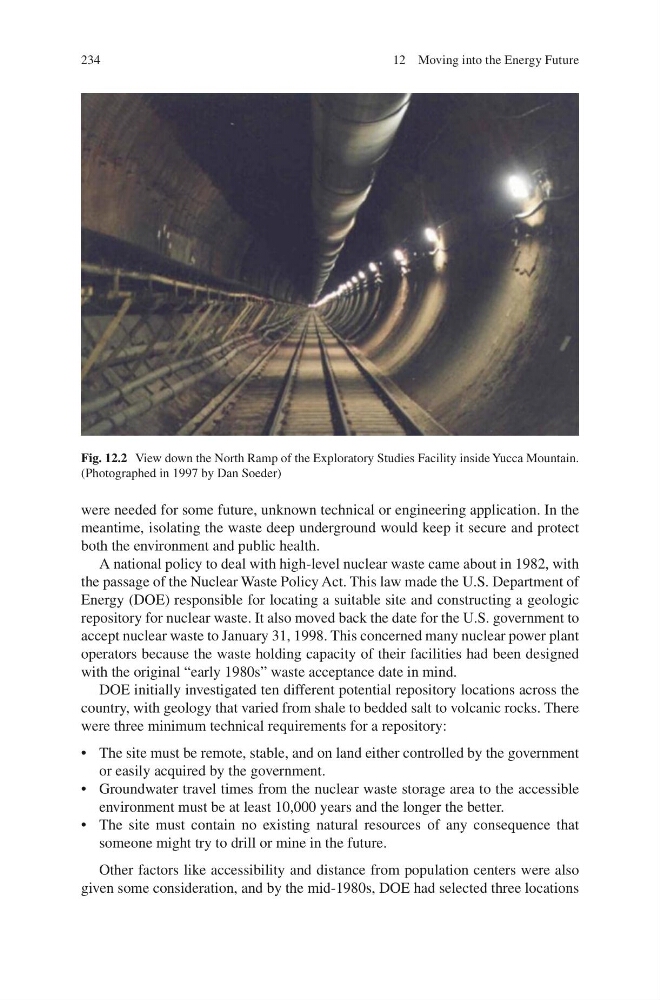
Fig. 12.2 View down the North Ramp of the Exploratory Studies Facility inside Yucca Mountain.
(Photographed in 1997 by Dan Soeder)
12 Moving into the Energy Future
were needed for some future, unknown technical or engineering application. In the
meantime, isolating the waste deep underground would keep it secure and protect
both the environment and public health.
A national policy to deal with high-level nuclear waste came about in 1982, with
the passage of the Nuclear Waste Policy Act. This law made the U.S. Department of
Energy (DOE) responsible for locating a suitable site and constructing a geologic
repository for nuclear waste. It also moved back the date for the U.S. government to
accept nuclear waste to January 31, 1998. This concerned many nuclear power plant
operators because the waste holding capacity of their facilities had been designed
with the original “early 1980s” waste acceptance date in mind.
DOE initially investigated ten different potential repository locations across the
country, with geology that varied from shale to bedded salt to volcanic rocks. There
were three minimum technical requirements for a repository:
• The site must be remote, stable, and on land either controlled by the government
or easily acquired by the government.
• Groundwater travel times from the nuclear waste storage area to the accessible
environment must be at least 10,000 years and the longer the better.
• The site must contain no existing natural resources of any consequence that
someone might try to drill or mine in the future.
Other factors like accessibility and distance from population centers were also
given some consideration, and by the mid-1980s, DOE had selected three locations
Fig. 12.2 View down the North Ramp of the Exploratory Studies Facility inside Yucca Mountain.
(Photographed in 1997 by Dan Soeder)
12 Moving into the Energy Future