

221
Nevertheless, if climate change is to be addressed in a responsible manner, mobile
sources of GHG emissions must be captured as well. The capture technology must
obviously be scaled down to fit into a vehicle.
Fortunately, there are ways to accomplish this that have been known about and
used for decades. Carbon dioxide has been removed from the breathing air in closed
vessels like submarines and spacecraft through the use of chemical absorbents in the
air circulation system that react with the CO 2 and bind to it chemically. Some of
these reactions can be reversed and the absorbent “recharged” for another use.
Perhaps carbon capture on fossil-fueled vehicles can be achieved by adding a chemical absorbent cartridge into the exhaust system. If it can be made robust enough to
absorb the carbon emissions from a single tank of fuel, it can be routinely exchanged
for a fresh one as part of the re-fueling process. The saturated cartridge would be
returned to the factory for recharging or replacement. This is where CNG-fueled
vehicles have another advantage, in that natural gas produces about 25% less carbon
dioxide per Btu than gasoline or diesel fuel (refer back to Fig. 10.1).
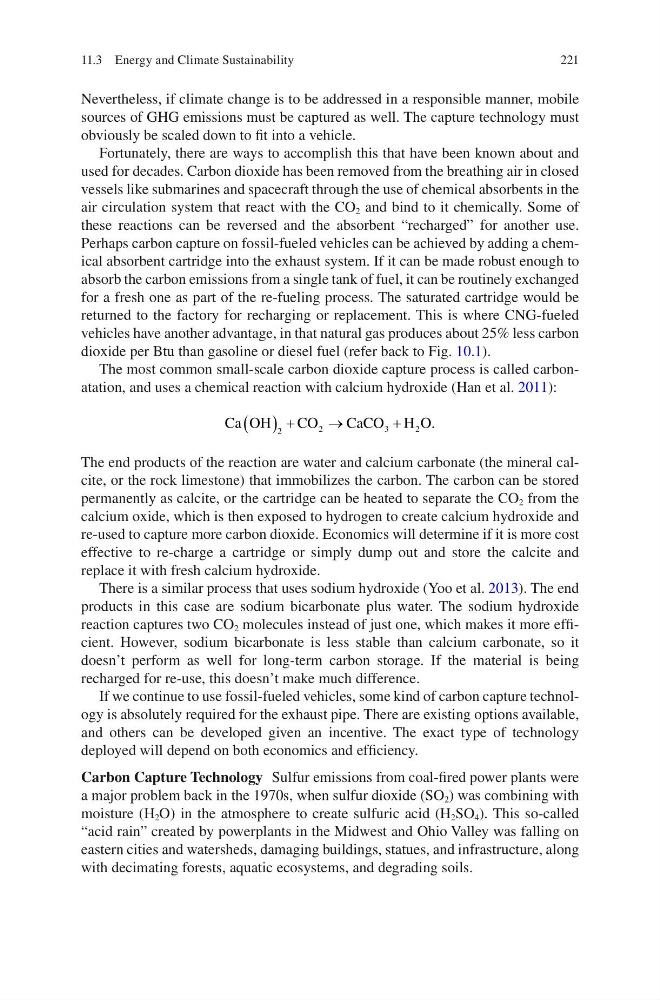
The most common small-scale carbon dioxide capture process is called carbonatation, and uses a chemical reaction with calcium hydroxide (Han et al. 2011):
Ca OH
CO
CaCO H O.
( ) +
®
+
2
2
3
2
The end products of the reaction are water and calcium carbonate (the mineral calcite, or the rock limestone) that immobilizes the carbon. The carbon can be stored
permanently as calcite, or the cartridge can be heated to separate the CO 2 from the
calcium oxide, which is then exposed to hydrogen to create calcium hydroxide and
re-used to capture more carbon dioxide. Economics will determine if it is more cost
effective to re-charge a cartridge or simply dump out and store the calcite and
replace it with fresh calcium hydroxide.
There is a similar process that uses sodium hydroxide (Yoo et al. 2013). The end
products in this case are sodium bicarbonate plus water. The sodium hydroxide
reaction captures two CO 2 molecules instead of just one, which makes it more efficient. However, sodium bicarbonate is less stable than calcium carbonate, so it
doesn’t perform as well for long-term carbon storage. If the material is being
recharged for re-use, this doesn’t make much difference.
If we continue to use fossil-fueled vehicles, some kind of carbon capture technology is absolutely required for the exhaust pipe. There are existing options available,
and others can be developed given an incentive. The exact type of technology
deployed will depend on both economics and efficiency.
Carbon Capture Technology Sulfur emissions from coal-fired power plants were
a major problem back in the 1970s, when sulfur dioxide (SO 2 ) was combining with
moisture (H 2 O) in the atmosphere to create sulfuric acid (H 2 SO 4 ). This so-called
“acid rain” created by powerplants in the Midwest and Ohio Valley was falling on
eastern cities and watersheds, damaging buildings, statues, and infrastructure, along
with decimating forests, aquatic ecosystems, and degrading soils.
11.3 Energy and Climate Sustainability
Nevertheless, if climate change is to be addressed in a responsible manner, mobile
sources of GHG emissions must be captured as well. The capture technology must
obviously be scaled down to fit into a vehicle.
Fortunately, there are ways to accomplish this that have been known about and
used for decades. Carbon dioxide has been removed from the breathing air in closed
vessels like submarines and spacecraft through the use of chemical absorbents in the
air circulation system that react with the CO 2 and bind to it chemically. Some of
these reactions can be reversed and the absorbent “recharged” for another use.
Perhaps carbon capture on fossil-fueled vehicles can be achieved by adding a chemical absorbent cartridge into the exhaust system. If it can be made robust enough to
absorb the carbon emissions from a single tank of fuel, it can be routinely exchanged
for a fresh one as part of the re-fueling process. The saturated cartridge would be
returned to the factory for recharging or replacement. This is where CNG-fueled
vehicles have another advantage, in that natural gas produces about 25% less carbon
dioxide per Btu than gasoline or diesel fuel (refer back to Fig. 10.1).
The most common small-scale carbon dioxide capture process is called carbonatation, and uses a chemical reaction with calcium hydroxide (Han et al. 2011):
Ca OH
CO
CaCO H O.
( ) +
®
+
2
2
3
2
The end products of the reaction are water and calcium carbonate (the mineral calcite, or the rock limestone) that immobilizes the carbon. The carbon can be stored
permanently as calcite, or the cartridge can be heated to separate the CO 2 from the
calcium oxide, which is then exposed to hydrogen to create calcium hydroxide and
re-used to capture more carbon dioxide. Economics will determine if it is more cost
effective to re-charge a cartridge or simply dump out and store the calcite and
replace it with fresh calcium hydroxide.
There is a similar process that uses sodium hydroxide (Yoo et al. 2013). The end
products in this case are sodium bicarbonate plus water. The sodium hydroxide
reaction captures two CO 2 molecules instead of just one, which makes it more efficient. However, sodium bicarbonate is less stable than calcium carbonate, so it
doesn’t perform as well for long-term carbon storage. If the material is being
recharged for re-use, this doesn’t make much difference.
If we continue to use fossil-fueled vehicles, some kind of carbon capture technology is absolutely required for the exhaust pipe. There are existing options available,
and others can be developed given an incentive. The exact type of technology
deployed will depend on both economics and efficiency.
Carbon Capture Technology Sulfur emissions from coal-fired power plants were
a major problem back in the 1970s, when sulfur dioxide (SO 2 ) was combining with
moisture (H 2 O) in the atmosphere to create sulfuric acid (H 2 SO 4 ). This so-called
“acid rain” created by powerplants in the Midwest and Ohio Valley was falling on
eastern cities and watersheds, damaging buildings, statues, and infrastructure, along
with decimating forests, aquatic ecosystems, and degrading soils.
11.3 Energy and Climate Sustainability