

218
energy sources such as gas, coal, nuclear, solar, and wind. OPEX can even vary on
a single source based on factors like percent capacity in use, seasonal factors, or
other reasons (USEIA 2018). These various contributors to cost must be considered
by utilities that make decisions in the real world of electrical supply and power
dispatching.
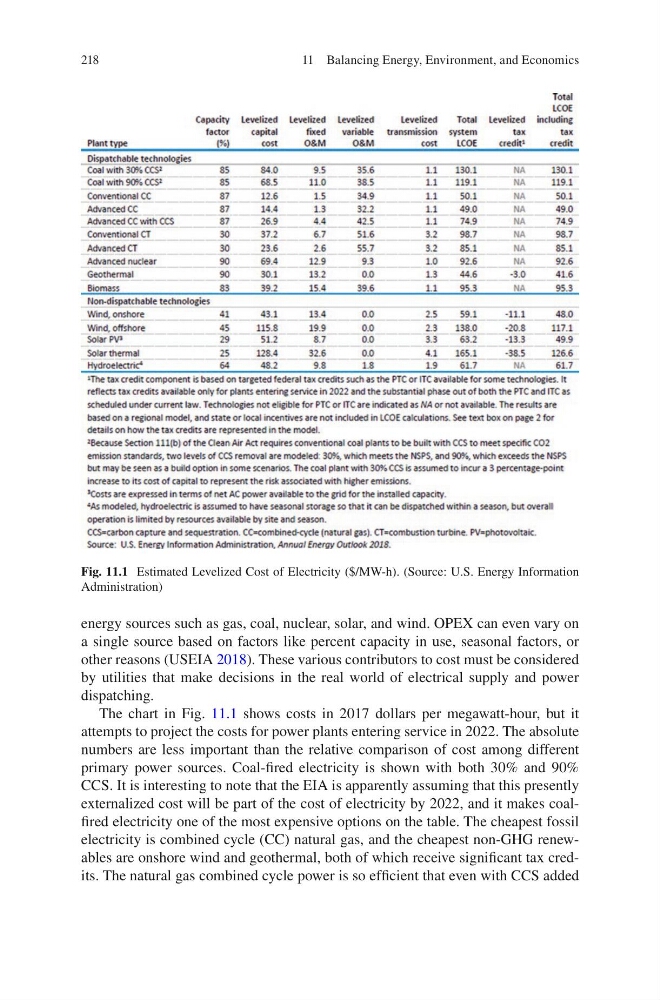
The chart in Fig. 11.1 shows costs in 2017 dollars per megawatt-hour, but it
attempts to project the costs for power plants entering service in 2022. The absolute
numbers are less important than the relative comparison of cost among different
primary power sources. Coal-fired electricity is shown with both 30% and 90%
CCS. It is interesting to note that the EIA is apparently assuming that this presently
externalized cost will be part of the cost of electricity by 2022, and it makes coalfired electricity one of the most expensive options on the table. The cheapest fossil
electricity is combined cycle (CC) natural gas, and the cheapest non-GHG renewables are onshore wind and geothermal, both of which receive significant tax credits. The natural gas combined cycle power is so efficient that even with CCS added
Fig. 11.1 Estimated Levelized Cost of Electricity ($/MW-h). (Source: U.S. Energy Information
Administration)
11 Balancing Energy, Environment, and Economics
energy sources such as gas, coal, nuclear, solar, and wind. OPEX can even vary on
a single source based on factors like percent capacity in use, seasonal factors, or
other reasons (USEIA 2018). These various contributors to cost must be considered
by utilities that make decisions in the real world of electrical supply and power
dispatching.
The chart in Fig. 11.1 shows costs in 2017 dollars per megawatt-hour, but it
attempts to project the costs for power plants entering service in 2022. The absolute
numbers are less important than the relative comparison of cost among different
primary power sources. Coal-fired electricity is shown with both 30% and 90%
CCS. It is interesting to note that the EIA is apparently assuming that this presently
externalized cost will be part of the cost of electricity by 2022, and it makes coalfired electricity one of the most expensive options on the table. The cheapest fossil
electricity is combined cycle (CC) natural gas, and the cheapest non-GHG renewables are onshore wind and geothermal, both of which receive significant tax credits. The natural gas combined cycle power is so efficient that even with CCS added
Fig. 11.1 Estimated Levelized Cost of Electricity ($/MW-h). (Source: U.S. Energy Information
Administration)
11 Balancing Energy, Environment, and Economics