

171
unclear, although it was possibly a combination of carbon dioxide from volcanic
eruptions and methane released from sea floor sediments. Although “abrupt” in a
geological sense, the rise in GHG concentrations that led to the PETM event took
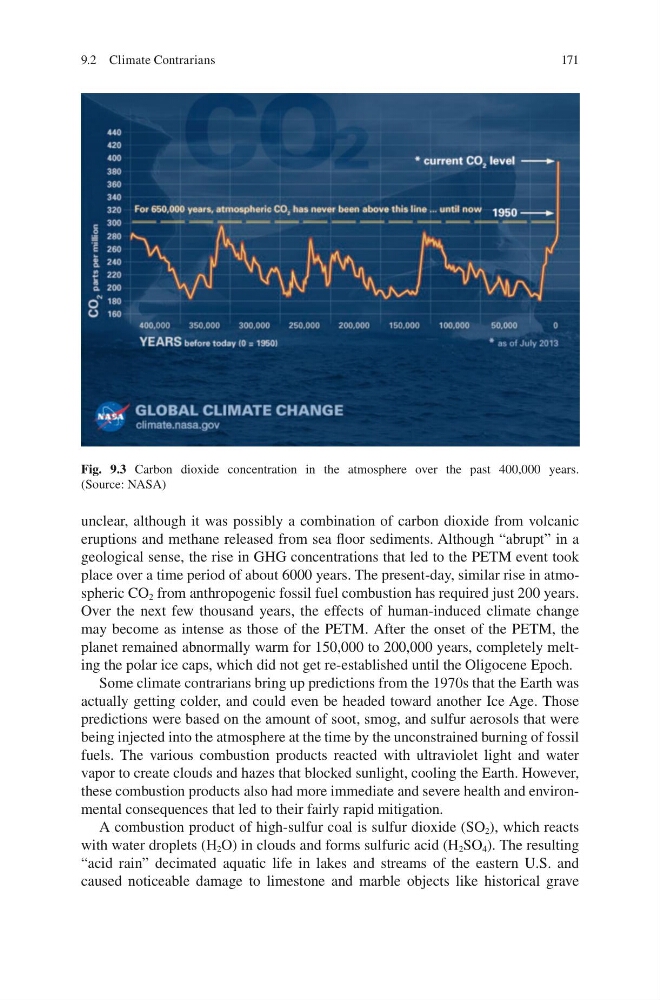
place over a time period of about 6000 years. The present-day, similar rise in atmospheric CO 2 from anthropogenic fossil fuel combustion has required just 200 years.
Over the next few thousand years, the effects of human-induced climate change
may become as intense as those of the PETM. After the onset of the PETM, the
planet remained abnormally warm for 150,000 to 200,000 years, completely melting the polar ice caps, which did not get re-established until the Oligocene Epoch.
Some climate contrarians bring up predictions from the 1970s that the Earth was
actually getting colder, and could even be headed toward another Ice Age. Those
predictions were based on the amount of soot, smog, and sulfur aerosols that were
being injected into the atmosphere at the time by the unconstrained burning of fossil
fuels. The various combustion products reacted with ultraviolet light and water
vapor to create clouds and hazes that blocked sunlight, cooling the Earth. However,
these combustion products also had more immediate and severe health and environmental consequences that led to their fairly rapid mitigation.
A combustion product of high-sulfur coal is sulfur dioxide (SO 2 ), which reacts
with water droplets (H 2 O) in clouds and forms sulfuric acid (H 2 SO 4 ). The resulting
“acid rain” decimated aquatic life in lakes and streams of the eastern U.S. and
caused noticeable damage to limestone and marble objects like historical grave
Fig. 9.3 Carbon dioxide concentration in the atmosphere over the past 400,000 years.
(Source: NASA)
9.2 Climate Contrarians
unclear, although it was possibly a combination of carbon dioxide from volcanic
eruptions and methane released from sea floor sediments. Although “abrupt” in a
geological sense, the rise in GHG concentrations that led to the PETM event took
place over a time period of about 6000 years. The present-day, similar rise in atmospheric CO 2 from anthropogenic fossil fuel combustion has required just 200 years.
Over the next few thousand years, the effects of human-induced climate change
may become as intense as those of the PETM. After the onset of the PETM, the
planet remained abnormally warm for 150,000 to 200,000 years, completely melting the polar ice caps, which did not get re-established until the Oligocene Epoch.
Some climate contrarians bring up predictions from the 1970s that the Earth was
actually getting colder, and could even be headed toward another Ice Age. Those
predictions were based on the amount of soot, smog, and sulfur aerosols that were
being injected into the atmosphere at the time by the unconstrained burning of fossil
fuels. The various combustion products reacted with ultraviolet light and water
vapor to create clouds and hazes that blocked sunlight, cooling the Earth. However,
these combustion products also had more immediate and severe health and environmental consequences that led to their fairly rapid mitigation.
A combustion product of high-sulfur coal is sulfur dioxide (SO 2 ), which reacts
with water droplets (H 2 O) in clouds and forms sulfuric acid (H 2 SO 4 ). The resulting
“acid rain” decimated aquatic life in lakes and streams of the eastern U.S. and
caused noticeable damage to limestone and marble objects like historical grave
Fig. 9.3 Carbon dioxide concentration in the atmosphere over the past 400,000 years.
(Source: NASA)
9.2 Climate Contrarians