

158
responsible for the flood story in the bible and similar tales in other ancient cultures.
Ice dams impounded vast amounts of meltwater in glacial lakes, and the sudden
failure of an ice dam would have released this water into the ocean in a rapid outburst called a “jökulhlaup.” The channeled scablands of western Washington State
are evidence of catastrophic jökulhlaups from a glacial lake located in present-day
Idaho and Montana (Waitt 1984). These “meltwater pulses” would have raised sea
levels by tens of meters, in some cases rather quickly (Fairbanks 1989). For people
living in coastal settlements, the inundation would be seen as a world-wide flood.
Such a disaster would have left a deep impression on human culture, and stories
about the great flood would be passed down for millennia.
Dr. James Hutton realized from the evidence in the rocks that the Earth had to be
much older than the 6000 years stated by “biblical creation,” because the natural
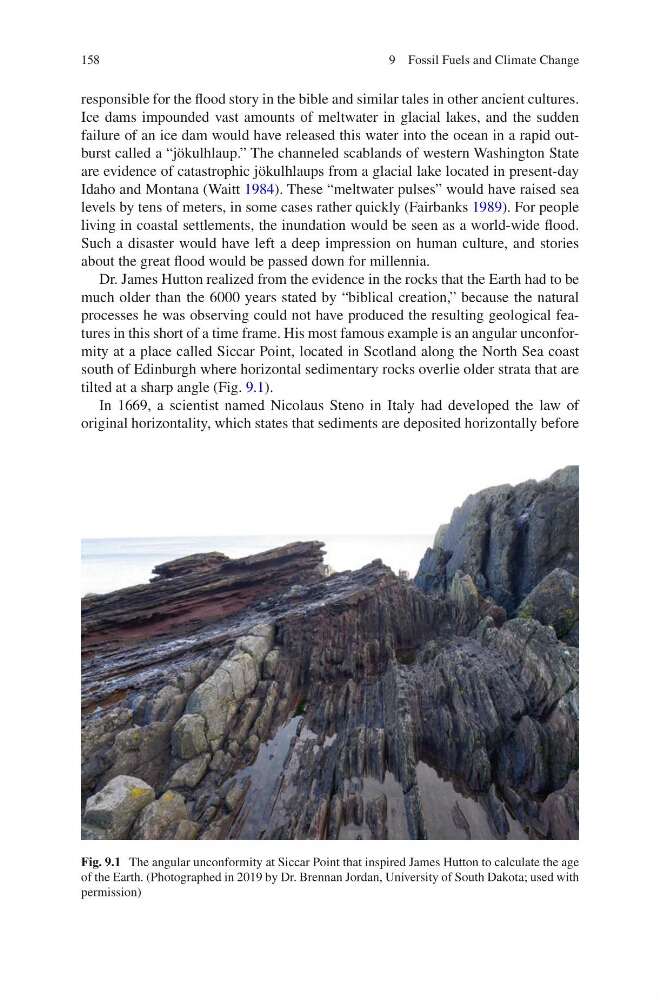
processes he was observing could not have produced the resulting geological features in this short of a time frame. His most famous example is an angular unconformity at a place called Siccar Point, located in Scotland along the North Sea coast
south of Edinburgh where horizontal sedimentary rocks overlie older strata that are
tilted at a sharp angle (Fig. 9.1).
In 1669, a scientist named Nicolaus Steno in Italy had developed the law of
original horizontality, which states that sediments are deposited horizontally before
Fig. 9.1 The angular unconformity at Siccar Point that inspired James Hutton to calculate the age
of the Earth. (Photographed in 2019 by Dr. Brennan Jordan, University of South Dakota; used with
permission)
9 Fossil Fuels and Climate Change
responsible for the flood story in the bible and similar tales in other ancient cultures.
Ice dams impounded vast amounts of meltwater in glacial lakes, and the sudden
failure of an ice dam would have released this water into the ocean in a rapid outburst called a “jökulhlaup.” The channeled scablands of western Washington State
are evidence of catastrophic jökulhlaups from a glacial lake located in present-day
Idaho and Montana (Waitt 1984). These “meltwater pulses” would have raised sea
levels by tens of meters, in some cases rather quickly (Fairbanks 1989). For people
living in coastal settlements, the inundation would be seen as a world-wide flood.
Such a disaster would have left a deep impression on human culture, and stories
about the great flood would be passed down for millennia.
Dr. James Hutton realized from the evidence in the rocks that the Earth had to be
much older than the 6000 years stated by “biblical creation,” because the natural
processes he was observing could not have produced the resulting geological features in this short of a time frame. His most famous example is an angular unconformity at a place called Siccar Point, located in Scotland along the North Sea coast
south of Edinburgh where horizontal sedimentary rocks overlie older strata that are
tilted at a sharp angle (Fig. 9.1).
In 1669, a scientist named Nicolaus Steno in Italy had developed the law of
original horizontality, which states that sediments are deposited horizontally before
Fig. 9.1 The angular unconformity at Siccar Point that inspired James Hutton to calculate the age
of the Earth. (Photographed in 2019 by Dr. Brennan Jordan, University of South Dakota; used with
permission)
9 Fossil Fuels and Climate Change