

302
D. H. M. Aquino et al.
Table 16.1 Interview and
focus group discussion
respondents
ID
Affiliation
G1
Navala Village
P1
Rural Housing Unit—MHCD
P2
Ministry of iTaukei Affairs
P3
Ba Provincial Government
P4
National Disaster Management Office
P5
Habitat for Humanity Fiji
P6
Fiji Red Cross Society
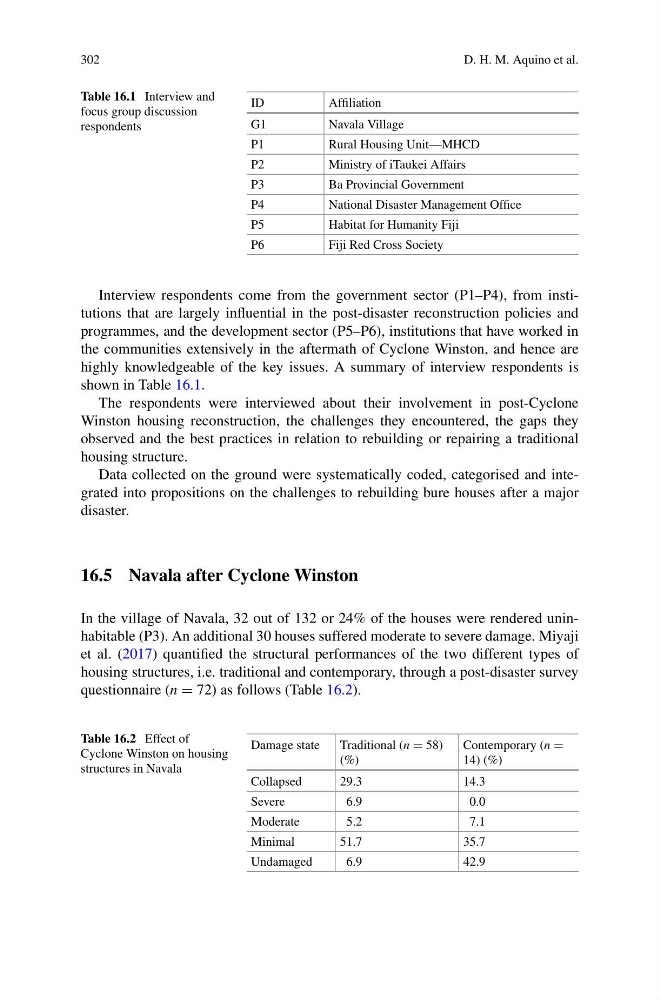
Interview respondents come from the government sector (P1–P4), from institutions that are largely influential in the post-disaster reconstruction policies and
programmes, and the development sector (P5–P6), institutions that have worked in
the communities extensively in the aftermath of Cyclone Winston, and hence are
highly knowledgeable of the key issues. A summary of interview respondents is
shown in Table 16.1.
The respondents were interviewed about their involvement in post-Cyclone
Winston housing reconstruction, the challenges they encountered, the gaps they
observed and the best practices in relation to rebuilding or repairing a traditional
housing structure.
Data collected on the ground were systematically coded, categorised and integrated into propositions on the challenges to rebuilding bure houses after a major
disaster.
16.5 Navala after Cyclone Winston
In the village of Navala, 32 out of 132 or 24% of the houses were rendered uninhabitable (P3). An additional 30 houses suffered moderate to severe damage. Miyaji
et al. (2017) quantified the structural performances of the two different types of
housing structures, i.e. traditional and contemporary, through a post-disaster survey
questionnaire (n = 72) as follows (Table 16.2).
Table 16.2 Effect of
Cyclone Winston on housing
structures in Navala
Damage state
Traditional (n = 58)
(%)
Contemporary (n =
14) (%)
Collapsed
29.3
14.3
Severe
6.9
0.0
Moderate
5.2
7.1
Minimal
51.7
35.7
Undamaged
6.9
42.9
D. H. M. Aquino et al.
Table 16.1 Interview and
focus group discussion
respondents
ID
Affiliation
G1
Navala Village
P1
Rural Housing Unit—MHCD
P2
Ministry of iTaukei Affairs
P3
Ba Provincial Government
P4
National Disaster Management Office
P5
Habitat for Humanity Fiji
P6
Fiji Red Cross Society
Interview respondents come from the government sector (P1–P4), from institutions that are largely influential in the post-disaster reconstruction policies and
programmes, and the development sector (P5–P6), institutions that have worked in
the communities extensively in the aftermath of Cyclone Winston, and hence are
highly knowledgeable of the key issues. A summary of interview respondents is
shown in Table 16.1.
The respondents were interviewed about their involvement in post-Cyclone
Winston housing reconstruction, the challenges they encountered, the gaps they
observed and the best practices in relation to rebuilding or repairing a traditional
housing structure.
Data collected on the ground were systematically coded, categorised and integrated into propositions on the challenges to rebuilding bure houses after a major
disaster.
16.5 Navala after Cyclone Winston
In the village of Navala, 32 out of 132 or 24% of the houses were rendered uninhabitable (P3). An additional 30 houses suffered moderate to severe damage. Miyaji
et al. (2017) quantified the structural performances of the two different types of
housing structures, i.e. traditional and contemporary, through a post-disaster survey
questionnaire (n = 72) as follows (Table 16.2).
Table 16.2 Effect of
Cyclone Winston on housing
structures in Navala
Damage state
Traditional (n = 58)
(%)
Contemporary (n =
14) (%)
Collapsed
29.3
14.3
Severe
6.9
0.0
Moderate
5.2
7.1
Minimal
51.7
35.7
Undamaged
6.9
42.9