

298
D. H. M. Aquino et al.
16.1 The Traditional Housing Structures of Navala Village,
Fiji
Navala is an indigenous Fijian village situated at the bank of Ba River, located in the
province of Ba, in the north-central part of Viti Levu, Fiji’s biggest and most populous
island. It is known to be the sole remaining traditional village in Fiji, having been
able to preserve their traditional housing structures. Until recently, all the houses at
the core of the village were of traditional construction.
The village has a population of 630 and has an average household size of 4.8.
There were 132 houses in the village prior to Cyclone Winston: 99 of which were
traditional houses, while 33 were of modern construction.
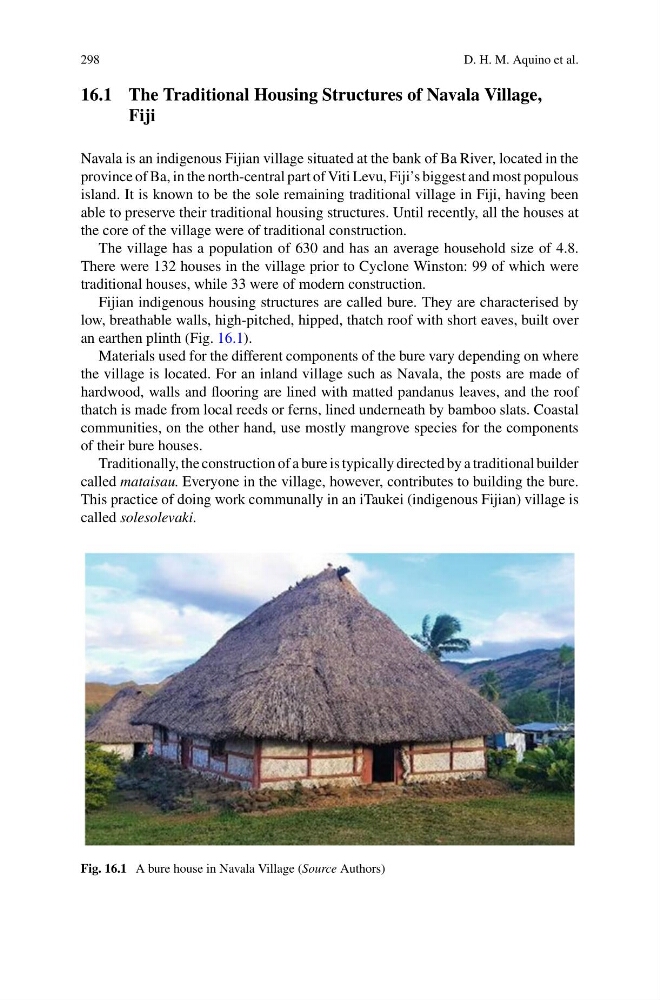
Fijian indigenous housing structures are called bure. They are characterised by
low, breathable walls, high-pitched, hipped, thatch roof with short eaves, built over
an earthen plinth (Fig. 16.1).
Materials used for the different components of the bure vary depending on where
the village is located. For an inland village such as Navala, the posts are made of
hardwood, walls and flooring are lined with matted pandanus leaves, and the roof
thatch is made from local reeds or ferns, lined underneath by bamboo slats. Coastal
communities, on the other hand, use mostly mangrove species for the components
of their bure houses.
Traditionally, the construction of a bure is typically directed by a traditional builder
called mataisau. Everyone in the village, however, contributes to building the bure.
This practice of doing work communally in an iTaukei (indigenous Fijian) village is
called solesolevaki.
Fig. 16.1 A bure house in Navala Village (Source Authors)
D. H. M. Aquino et al.
16.1 The Traditional Housing Structures of Navala Village,
Fiji
Navala is an indigenous Fijian village situated at the bank of Ba River, located in the
province of Ba, in the north-central part of Viti Levu, Fiji’s biggest and most populous
island. It is known to be the sole remaining traditional village in Fiji, having been
able to preserve their traditional housing structures. Until recently, all the houses at
the core of the village were of traditional construction.
The village has a population of 630 and has an average household size of 4.8.
There were 132 houses in the village prior to Cyclone Winston: 99 of which were
traditional houses, while 33 were of modern construction.
Fijian indigenous housing structures are called bure. They are characterised by
low, breathable walls, high-pitched, hipped, thatch roof with short eaves, built over
an earthen plinth (Fig. 16.1).
Materials used for the different components of the bure vary depending on where
the village is located. For an inland village such as Navala, the posts are made of
hardwood, walls and flooring are lined with matted pandanus leaves, and the roof
thatch is made from local reeds or ferns, lined underneath by bamboo slats. Coastal
communities, on the other hand, use mostly mangrove species for the components
of their bure houses.
Traditionally, the construction of a bure is typically directed by a traditional builder
called mataisau. Everyone in the village, however, contributes to building the bure.
This practice of doing work communally in an iTaukei (indigenous Fijian) village is
called solesolevaki.
Fig. 16.1 A bure house in Navala Village (Source Authors)