

5.4.5 Q5: Do You Use Fertilisers or Pesticides?
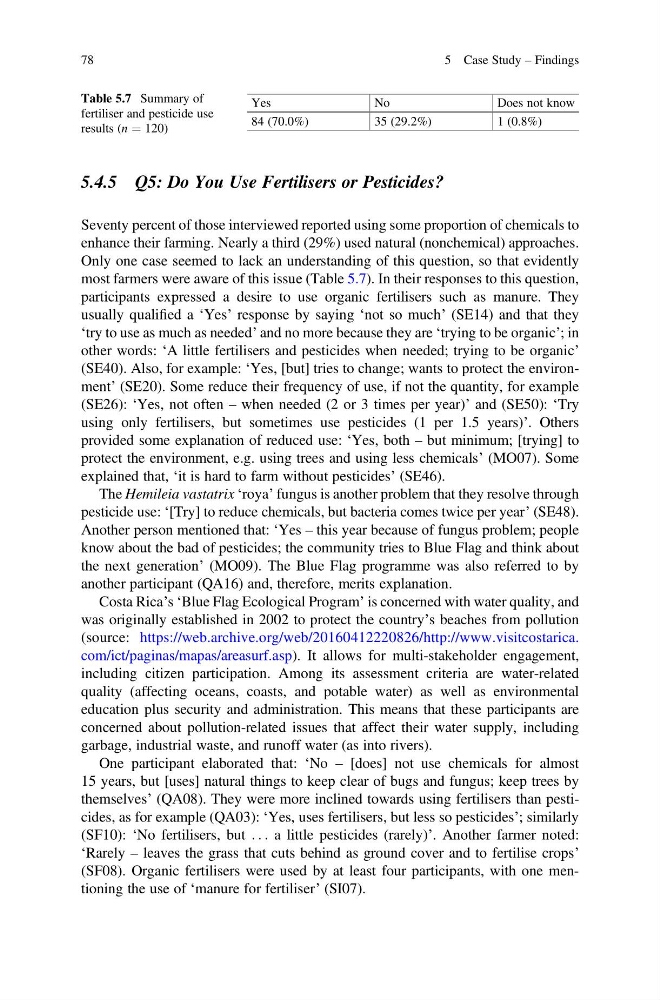
Seventy percent of those interviewed reported using some proportion of chemicals to
enhance their farming. Nearly a third (29%) used natural (nonchemical) approaches.
Only one case seemed to lack an understanding of this question, so that evidently
most farmers were aware of this issue (Table 5.7). In their responses to this question,
participants expressed a desire to use organic fertilisers such as manure. They
usually qualified a ‘Yes’ response by saying ‘not so much’ (SE14) and that they
‘try to use as much as needed’ and no more because they are ‘trying to be organic’; in
other words: ‘A little fertilisers and pesticides when needed; trying to be organic’
(SE40). Also, for example: ‘Yes, [but] tries to change; wants to protect the environment’ (SE20). Some reduce their frequency of use, if not the quantity, for example
(SE26): ‘Yes, not often – when needed (2 or 3 times per year)’ and (SE50): ‘Try
using only fertilisers, but sometimes use pesticides (1 per 1.5 years)’. Others
provided some explanation of reduced use: ‘Yes, both – but minimum; [trying] to
protect the environment, e.g. using trees and using less chemicals’ (MO07). Some
explained that, ‘it is hard to farm without pesticides’ (SE46).
The Hemileia vastatrix ‘roya’ fungus is another problem that they resolve through
pesticide use: ‘[Try] to reduce chemicals, but bacteria comes twice per year’ (SE48).
Another person mentioned that: ‘Yes – this year because of fungus problem; people
know about the bad of pesticides; the community tries to Blue Flag and think about
the next generation’ (MO09). The Blue Flag programme was also referred to by
another participant (QA16) and, therefore, merits explanation.
Costa Rica’s ‘Blue Flag Ecological Program’ is concerned with water quality, and
was originally established in 2002 to protect the country’s beaches from pollution
(source: https://web.archive.org/web/20160412220826/http://www.visitcostarica.
com/ict/paginas/mapas/areasurf.asp). It allows for multi-stakeholder engagement,
including citizen participation. Among its assessment criteria are water-related
quality (affecting oceans, coasts, and potable water) as well as environmental
education plus security and administration. This means that these participants are
concerned about pollution-related issues that affect their water supply, including
garbage, industrial waste, and runoff water (as into rivers).
One participant elaborated that: ‘No – [does] not use chemicals for almost
15 years, but [uses] natural things to keep clear of bugs and fungus; keep trees by
themselves’ (QA08). They were more inclined towards using fertilisers than pesticides, as for example (QA03): ‘Yes, uses fertilisers, but less so pesticides’; similarly
(SF10): ‘No fertilisers, but . . . a little pesticides (rarely)’. Another farmer noted:
‘Rarely – leaves the grass that cuts behind as ground cover and to fertilise crops’
(SF08). Organic fertilisers were used by at least four participants, with one mentioning the use of ‘manure for fertiliser’ (SI07).
Table 5.7 Summary of
fertiliser and pesticide use
results (n ¼ 120)
Yes
No
Does not know
84 (70.0%)
35 (29.2%)
1 (0.8%)
78
5 Case Study – Findings
Seventy percent of those interviewed reported using some proportion of chemicals to
enhance their farming. Nearly a third (29%) used natural (nonchemical) approaches.
Only one case seemed to lack an understanding of this question, so that evidently
most farmers were aware of this issue (Table 5.7). In their responses to this question,
participants expressed a desire to use organic fertilisers such as manure. They
usually qualified a ‘Yes’ response by saying ‘not so much’ (SE14) and that they
‘try to use as much as needed’ and no more because they are ‘trying to be organic’; in
other words: ‘A little fertilisers and pesticides when needed; trying to be organic’
(SE40). Also, for example: ‘Yes, [but] tries to change; wants to protect the environment’ (SE20). Some reduce their frequency of use, if not the quantity, for example
(SE26): ‘Yes, not often – when needed (2 or 3 times per year)’ and (SE50): ‘Try
using only fertilisers, but sometimes use pesticides (1 per 1.5 years)’. Others
provided some explanation of reduced use: ‘Yes, both – but minimum; [trying] to
protect the environment, e.g. using trees and using less chemicals’ (MO07). Some
explained that, ‘it is hard to farm without pesticides’ (SE46).
The Hemileia vastatrix ‘roya’ fungus is another problem that they resolve through
pesticide use: ‘[Try] to reduce chemicals, but bacteria comes twice per year’ (SE48).
Another person mentioned that: ‘Yes – this year because of fungus problem; people
know about the bad of pesticides; the community tries to Blue Flag and think about
the next generation’ (MO09). The Blue Flag programme was also referred to by
another participant (QA16) and, therefore, merits explanation.
Costa Rica’s ‘Blue Flag Ecological Program’ is concerned with water quality, and
was originally established in 2002 to protect the country’s beaches from pollution
(source: https://web.archive.org/web/20160412220826/http://www.visitcostarica.
com/ict/paginas/mapas/areasurf.asp). It allows for multi-stakeholder engagement,
including citizen participation. Among its assessment criteria are water-related
quality (affecting oceans, coasts, and potable water) as well as environmental
education plus security and administration. This means that these participants are
concerned about pollution-related issues that affect their water supply, including
garbage, industrial waste, and runoff water (as into rivers).
One participant elaborated that: ‘No – [does] not use chemicals for almost
15 years, but [uses] natural things to keep clear of bugs and fungus; keep trees by
themselves’ (QA08). They were more inclined towards using fertilisers than pesticides, as for example (QA03): ‘Yes, uses fertilisers, but less so pesticides’; similarly
(SF10): ‘No fertilisers, but . . . a little pesticides (rarely)’. Another farmer noted:
‘Rarely – leaves the grass that cuts behind as ground cover and to fertilise crops’
(SF08). Organic fertilisers were used by at least four participants, with one mentioning the use of ‘manure for fertiliser’ (SI07).
Table 5.7 Summary of
fertiliser and pesticide use
results (n ¼ 120)
Yes
No
Does not know
84 (70.0%)
35 (29.2%)
1 (0.8%)
78
5 Case Study – Findings