

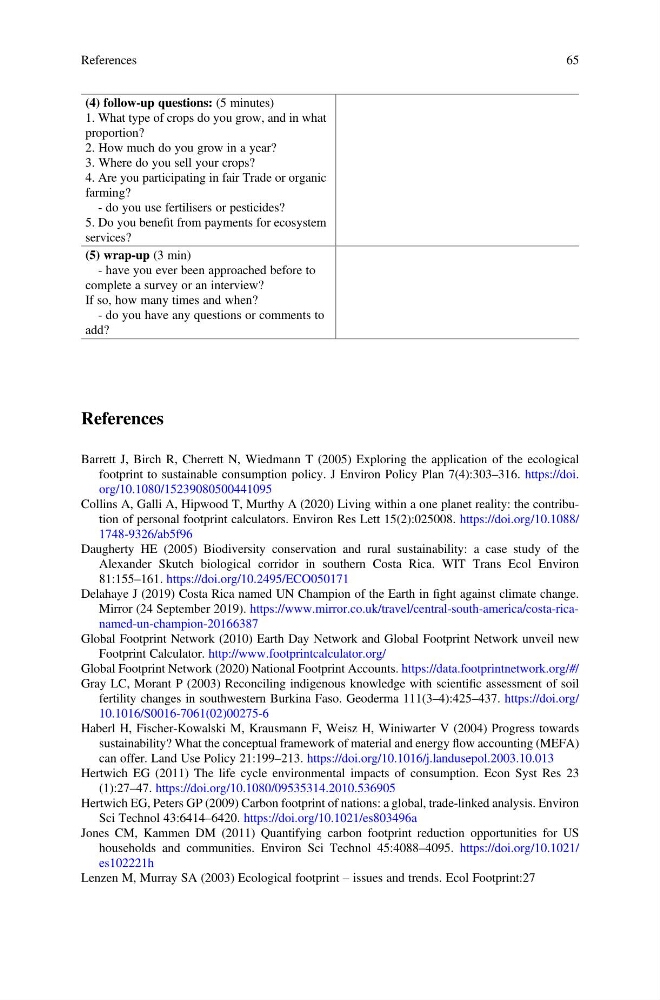
(4) follow-up questions: (5 minutes)
1. What type of crops do you grow, and in what
proportion?
2. How much do you grow in a year?
3. Where do you sell your crops?
4. Are you participating in fair Trade or organic
farming?
- do you use fertilisers or pesticides?
5. Do you benefit from payments for ecosystem
services?
(5) wrap-up (3 min)
- have you ever been approached before to
complete a survey or an interview?
If so, how many times and when?
- do you have any questions or comments to
add?
References
Barrett J, Birch R, Cherrett N, Wiedmann T (2005) Exploring the application of the ecological
footprint to sustainable consumption policy. J Environ Policy Plan 7(4):303–316. https://doi.
org/10.1080/15239080500441095
Collins A, Galli A, Hipwood T, Murthy A (2020) Living within a one planet reality: the contribution of personal footprint calculators. Environ Res Lett 15(2):025008. https://doi.org/10.1088/
1748-9326/ab5f96
Daugherty HE (2005) Biodiversity conservation and rural sustainability: a case study of the
Alexander Skutch biological corridor in southern Costa Rica. WIT Trans Ecol Environ
81:155–161. https://doi.org/10.2495/ECO050171
Delahaye J (2019) Costa Rica named UN Champion of the Earth in fight against climate change.
Mirror (24 September 2019). https://www.mirror.co.uk/travel/central-south-america/costa-ricanamed-un-champion-20166387
Global Footprint Network (2010) Earth Day Network and Global Footprint Network unveil new
Footprint Calculator. http://www.footprintcalculator.org/
Global Footprint Network (2020) National Footprint Accounts. https://data.footprintnetwork.org/#/
Gray LC, Morant P (2003) Reconciling indigenous knowledge with scientific assessment of soil
fertility changes in southwestern Burkina Faso. Geoderma 111(3–4):425–437. https://doi.org/
10.1016/S0016-7061(02)00275-6
Haberl H, Fischer-Kowalski M, Krausmann F, Weisz H, Winiwarter V (2004) Progress towards
sustainability? What the conceptual framework of material and energy flow accounting (MEFA)
can offer. Land Use Policy 21:199–213. https://doi.org/10.1016/j.landusepol.2003.10.013
Hertwich EG (2011) The life cycle environmental impacts of consumption. Econ Syst Res 23
(1):27–47. https://doi.org/10.1080/09535314.2010.536905
Hertwich EG, Peters GP (2009) Carbon footprint of nations: a global, trade-linked analysis. Environ
Sci Technol 43:6414–6420. https://doi.org/10.1021/es803496a
Jones CM, Kammen DM (2011) Quantifying carbon footprint reduction opportunities for US
households and communities. Environ Sci Technol 45:4088–4095. https://doi.org/10.1021/
es102221h
Lenzen M, Murray SA (2003) Ecological footprint – issues and trends. Ecol Footprint:27
References
65
1. What type of crops do you grow, and in what
proportion?
2. How much do you grow in a year?
3. Where do you sell your crops?
4. Are you participating in fair Trade or organic
farming?
- do you use fertilisers or pesticides?
5. Do you benefit from payments for ecosystem
services?
(5) wrap-up (3 min)
- have you ever been approached before to
complete a survey or an interview?
If so, how many times and when?
- do you have any questions or comments to
add?
References
Barrett J, Birch R, Cherrett N, Wiedmann T (2005) Exploring the application of the ecological
footprint to sustainable consumption policy. J Environ Policy Plan 7(4):303–316. https://doi.
org/10.1080/15239080500441095
Collins A, Galli A, Hipwood T, Murthy A (2020) Living within a one planet reality: the contribution of personal footprint calculators. Environ Res Lett 15(2):025008. https://doi.org/10.1088/
1748-9326/ab5f96
Daugherty HE (2005) Biodiversity conservation and rural sustainability: a case study of the
Alexander Skutch biological corridor in southern Costa Rica. WIT Trans Ecol Environ
81:155–161. https://doi.org/10.2495/ECO050171
Delahaye J (2019) Costa Rica named UN Champion of the Earth in fight against climate change.
Mirror (24 September 2019). https://www.mirror.co.uk/travel/central-south-america/costa-ricanamed-un-champion-20166387
Global Footprint Network (2010) Earth Day Network and Global Footprint Network unveil new
Footprint Calculator. http://www.footprintcalculator.org/
Global Footprint Network (2020) National Footprint Accounts. https://data.footprintnetwork.org/#/
Gray LC, Morant P (2003) Reconciling indigenous knowledge with scientific assessment of soil
fertility changes in southwestern Burkina Faso. Geoderma 111(3–4):425–437. https://doi.org/
10.1016/S0016-7061(02)00275-6
Haberl H, Fischer-Kowalski M, Krausmann F, Weisz H, Winiwarter V (2004) Progress towards
sustainability? What the conceptual framework of material and energy flow accounting (MEFA)
can offer. Land Use Policy 21:199–213. https://doi.org/10.1016/j.landusepol.2003.10.013
Hertwich EG (2011) The life cycle environmental impacts of consumption. Econ Syst Res 23
(1):27–47. https://doi.org/10.1080/09535314.2010.536905
Hertwich EG, Peters GP (2009) Carbon footprint of nations: a global, trade-linked analysis. Environ
Sci Technol 43:6414–6420. https://doi.org/10.1021/es803496a
Jones CM, Kammen DM (2011) Quantifying carbon footprint reduction opportunities for US
households and communities. Environ Sci Technol 45:4088–4095. https://doi.org/10.1021/
es102221h
Lenzen M, Murray SA (2003) Ecological footprint – issues and trends. Ecol Footprint:27
References
65