

The entire process of documenting the follow-up interviews involved an analytic
journey (cf. Spencer et al. 2014) based on four stages:
1. design and sampling – where the Footprint Calculator survey was transcribed
from the Global Footprint Network website (https://www.footprintcalculator.org/
) and the study area and towns chosen based on preliminary visits to the corridor
and maps (e.g., Montoya and Martínez 2015, p 17), as well as a calculated lower
limit for sample size to be as evenly as possible (broadly) distributed among the
corridor towns;
2. data generation/collection – during the fieldwork phase, through the execution
of the survey-interviews in Spanish-speaking groups, where responses were
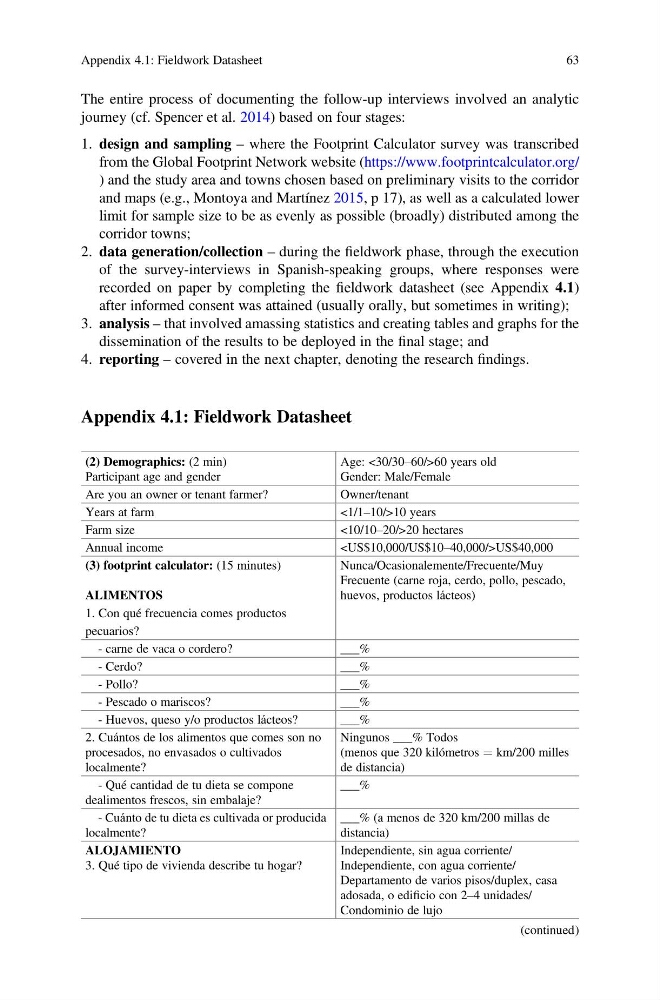
recorded on paper by completing the fieldwork datasheet (see Appendix 4.1)
after informed consent was attained (usually orally, but sometimes in writing);
3. analysis – that involved amassing statistics and creating tables and graphs for the
dissemination of the results to be deployed in the final stage; and
4. reporting – covered in the next chapter, denoting the research findings.
Appendix 4.1: Fieldwork Datasheet
(2) Demographics: (2 min)
Participant age and gender
Age: <30/30–60/>60 years old
Gender: Male/Female
Are you an owner or tenant farmer?
Owner/tenant
Years at farm
<1/1–10/>10 years
Farm size
<10/10–20/>20 hectares
Annual income
(3) footprint calculator: (15 minutes)
ALIMENTOS
1. Con qué frecuencia comes productos
pecuarios?
Nunca/Ocasionalemente/Frecuente/Muy
Frecuente (carne roja, cerdo, pollo, pescado,
huevos, productos lácteos)
- carne de vaca o cordero?
___%
- Cerdo?
___%
- Pollo?
___%
- Pescado o mariscos?
___%
- Huevos, queso y/o productos lácteos?
___%
2. Cuántos de los alimentos que comes son no
procesados, no envasados o cultivados
localmente?
Ningunos ___% Todos
(menos que 320 kilómetros ¼ km/200 milles
de distancia)
- Qué cantidad de tu dieta se compone
dealimentos frescos, sin embalaje?
___%
- Cuánto de tu dieta es cultivada or producida
localmente?
___% (a menos de 320 km/200 millas de
distancia)
ALOJAMIENTO
3. Qué tipo de vivienda describe tu hogar?
Independiente, sin agua corriente/
Independiente, con agua corriente/
Departamento de varios pisos/duplex, casa
adosada, o edificio con 2–4 unidades/
Condominio de lujo
(continued)
Appendix 4.1: Fieldwork Datasheet
63
journey (cf. Spencer et al. 2014) based on four stages:
1. design and sampling – where the Footprint Calculator survey was transcribed
from the Global Footprint Network website (https://www.footprintcalculator.org/
) and the study area and towns chosen based on preliminary visits to the corridor
and maps (e.g., Montoya and Martínez 2015, p 17), as well as a calculated lower
limit for sample size to be as evenly as possible (broadly) distributed among the
corridor towns;
2. data generation/collection – during the fieldwork phase, through the execution
of the survey-interviews in Spanish-speaking groups, where responses were
recorded on paper by completing the fieldwork datasheet (see Appendix 4.1)
after informed consent was attained (usually orally, but sometimes in writing);
3. analysis – that involved amassing statistics and creating tables and graphs for the
dissemination of the results to be deployed in the final stage; and
4. reporting – covered in the next chapter, denoting the research findings.
Appendix 4.1: Fieldwork Datasheet
(2) Demographics: (2 min)
Participant age and gender
Age: <30/30–60/>60 years old
Gender: Male/Female
Are you an owner or tenant farmer?
Owner/tenant
Years at farm
<1/1–10/>10 years
Farm size
<10/10–20/>20 hectares
Annual income
(3) footprint calculator: (15 minutes)
ALIMENTOS
1. Con qué frecuencia comes productos
pecuarios?
Nunca/Ocasionalemente/Frecuente/Muy
Frecuente (carne roja, cerdo, pollo, pescado,
huevos, productos lácteos)
- carne de vaca o cordero?
___%
- Cerdo?
___%
- Pollo?
___%
- Pescado o mariscos?
___%
- Huevos, queso y/o productos lácteos?
___%
2. Cuántos de los alimentos que comes son no
procesados, no envasados o cultivados
localmente?
Ningunos ___% Todos
(menos que 320 kilómetros ¼ km/200 milles
de distancia)
- Qué cantidad de tu dieta se compone
dealimentos frescos, sin embalaje?
___%
- Cuánto de tu dieta es cultivada or producida
localmente?
___% (a menos de 320 km/200 millas de
distancia)
ALOJAMIENTO
3. Qué tipo de vivienda describe tu hogar?
Independiente, sin agua corriente/
Independiente, con agua corriente/
Departamento de varios pisos/duplex, casa
adosada, o edificio con 2–4 unidades/
Condominio de lujo
(continued)
Appendix 4.1: Fieldwork Datasheet
63