

Box 4.1 (continued)
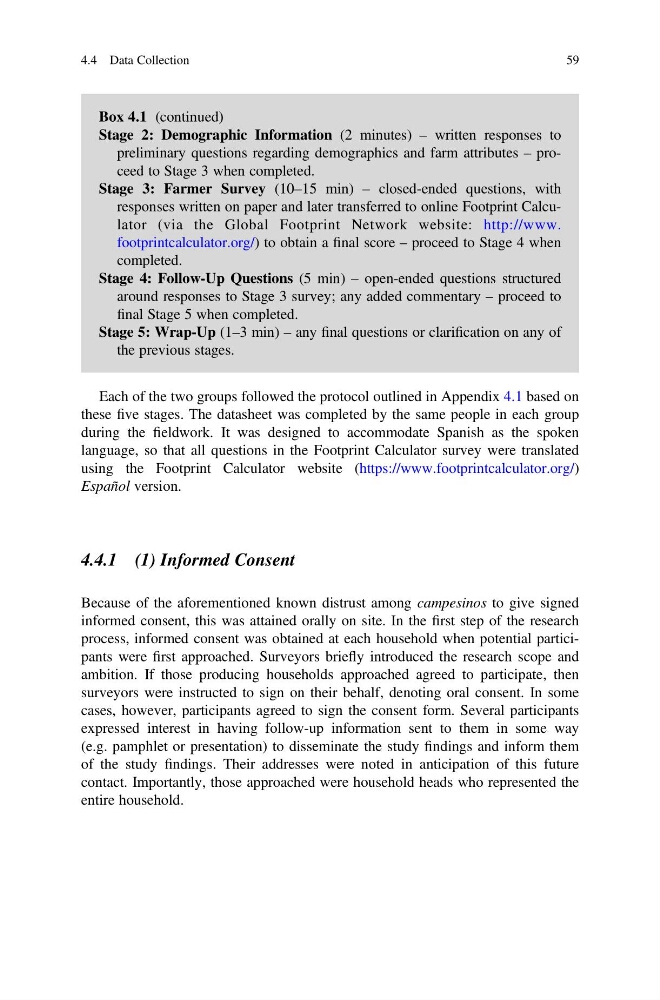
Stage 2: Demographic Information (2 minutes) – written responses to
preliminary questions regarding demographics and farm attributes – proceed to Stage 3 when completed.
Stage 3: Farmer Survey (10–15 min) – closed-ended questions, with
responses written on paper and later transferred to online Footprint Calculator (via the Global Footprint Network website: http://www.
footprintcalculator.org/) to obtain a final score – proceed to Stage 4 when
completed.
Stage 4: Follow-Up Questions (5 min) – open-ended questions structured
around responses to Stage 3 survey; any added commentary – proceed to
final Stage 5 when completed.
Stage 5: Wrap-Up (1–3 min) – any final questions or clarification on any of
the previous stages.
Each of the two groups followed the protocol outlined in Appendix 4.1 based on
these five stages. The datasheet was completed by the same people in each group
during the fieldwork. It was designed to accommodate Spanish as the spoken
language, so that all questions in the Footprint Calculator survey were translated
using the Footprint Calculator website (https://www.footprintcalculator.org/)
Español version.
4.4.1 (1) Informed Consent
Because of the aforementioned known distrust among campesinos to give signed
informed consent, this was attained orally on site. In the first step of the research
process, informed consent was obtained at each household when potential participants were first approached. Surveyors briefly introduced the research scope and
ambition. If those producing households approached agreed to participate, then
surveyors were instructed to sign on their behalf, denoting oral consent. In some
cases, however, participants agreed to sign the consent form. Several participants
expressed interest in having follow-up information sent to them in some way
(e.g. pamphlet or presentation) to disseminate the study findings and inform them
of the study findings. Their addresses were noted in anticipation of this future
contact. Importantly, those approached were household heads who represented the
entire household.
4.4 Data Collection
59
Stage 2: Demographic Information (2 minutes) – written responses to
preliminary questions regarding demographics and farm attributes – proceed to Stage 3 when completed.
Stage 3: Farmer Survey (10–15 min) – closed-ended questions, with
responses written on paper and later transferred to online Footprint Calculator (via the Global Footprint Network website: http://www.
footprintcalculator.org/) to obtain a final score – proceed to Stage 4 when
completed.
Stage 4: Follow-Up Questions (5 min) – open-ended questions structured
around responses to Stage 3 survey; any added commentary – proceed to
final Stage 5 when completed.
Stage 5: Wrap-Up (1–3 min) – any final questions or clarification on any of
the previous stages.
Each of the two groups followed the protocol outlined in Appendix 4.1 based on
these five stages. The datasheet was completed by the same people in each group
during the fieldwork. It was designed to accommodate Spanish as the spoken
language, so that all questions in the Footprint Calculator survey were translated
using the Footprint Calculator website (https://www.footprintcalculator.org/)
Español version.
4.4.1 (1) Informed Consent
Because of the aforementioned known distrust among campesinos to give signed
informed consent, this was attained orally on site. In the first step of the research
process, informed consent was obtained at each household when potential participants were first approached. Surveyors briefly introduced the research scope and
ambition. If those producing households approached agreed to participate, then
surveyors were instructed to sign on their behalf, denoting oral consent. In some
cases, however, participants agreed to sign the consent form. Several participants
expressed interest in having follow-up information sent to them in some way
(e.g. pamphlet or presentation) to disseminate the study findings and inform them
of the study findings. Their addresses were noted in anticipation of this future
contact. Importantly, those approached were household heads who represented the
entire household.
4.4 Data Collection
59