

• (Psamments): These soils are defined as the soils in
which the percentage of sand is more than 85%
throughout soil profiles and the percentage of stones is
less than 35%. In many cases, these soils consist of
Aeolian sands and usually they are homogenous. They
consist of one or two layers covered by an Ochric horizon
on the surface and can be found in most of the Libyan
lands. This type of soil is characterized by a newly
formed soil profile that is not distinguished into subsurface horizons. The texture of this soil is sandy or loamy
sand, and the depth of its profile ranges from deep to
medium depth, although it may be shallow. The structure
of these soils is mainly structureless (single grains). The
degree of reaction tends to be alkaline (pH more than 7),
and the amount of calcium carbonate ranges from low to
medium. In addition, their organic matter content is low.
These soils suffer from a decrease in their ability to hold
water; as it has a high infiltration rate, it also suffers from a
decrease in its nutritional content, especially nitrogen,
phosphorus, and trace elements, and are highly vulnerable to
soil erosion by wind. The total estimated area covered with
these soils is about 2130000 hectares. These soils are classified under the great group level in Libya according to the
dominant Moisture Regime (Table 4.4 and Fig. 4.5) (Ben
Mahmoud 2013).
(This picture was taken from Aziziya area, south of
Tripoli, by Prof. Ben Mahmoud, it is a sandy textured, very
deep, reddish-brown, it has only ochric horizon, land use:
field crops, vegetables, and fruit trees).
• (Orthents): Generally, these soils are shallow or moderately deep and contain the “Ochric” horizon at the
surface followed directly by the rocky bed or by hard
rocky layer. The stone percentage can occasionally reach
more than 35%. Some of these soils are gravelly textured
(containing more than 20% of their dry weight) and
including solid components with diameters greater than
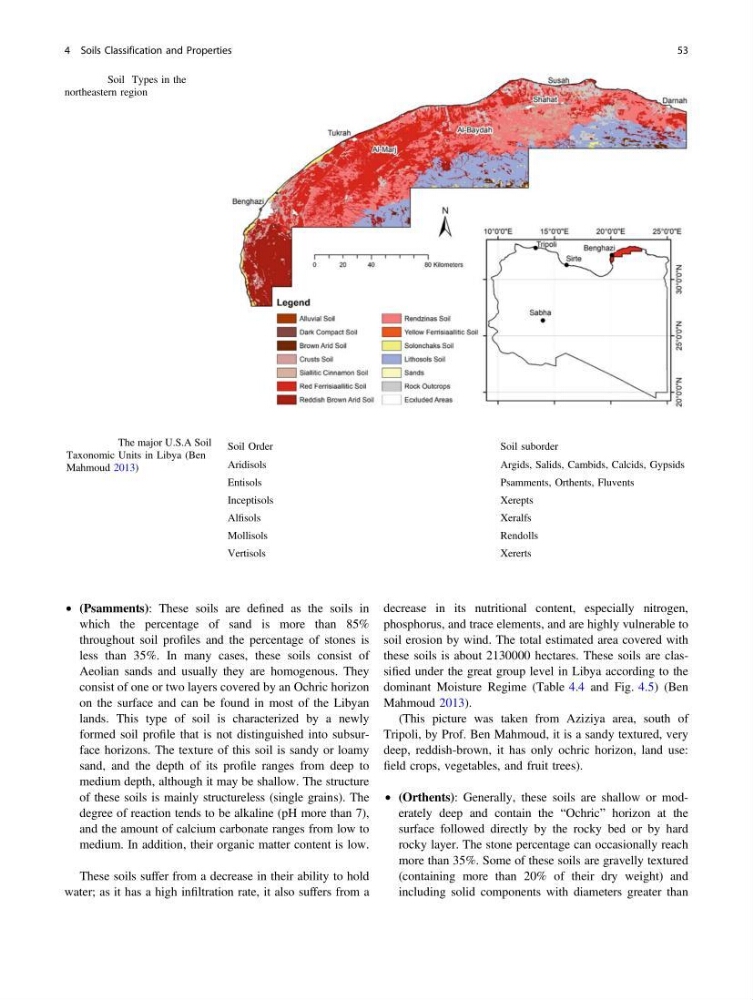
Fig. 4.2 Soil Types in the
northeastern region
Table 4.3 The major U.S.A Soil
Taxonomic Units in Libya (Ben
Mahmoud 2013)
Soil Order
Soil suborder
Aridisols
Argids, Salids, Cambids, Calcids, Gypsids
Entisols
Psamments, Orthents, Fluvents
Inceptisols
Xerepts
Alfisols
Xeralfs
Mollisols
Rendolls
Vertisols
Xererts
4 Soils Classification and Properties
53
which the percentage of sand is more than 85%
throughout soil profiles and the percentage of stones is
less than 35%. In many cases, these soils consist of
Aeolian sands and usually they are homogenous. They
consist of one or two layers covered by an Ochric horizon
on the surface and can be found in most of the Libyan
lands. This type of soil is characterized by a newly
formed soil profile that is not distinguished into subsurface horizons. The texture of this soil is sandy or loamy
sand, and the depth of its profile ranges from deep to
medium depth, although it may be shallow. The structure
of these soils is mainly structureless (single grains). The
degree of reaction tends to be alkaline (pH more than 7),
and the amount of calcium carbonate ranges from low to
medium. In addition, their organic matter content is low.
These soils suffer from a decrease in their ability to hold
water; as it has a high infiltration rate, it also suffers from a
decrease in its nutritional content, especially nitrogen,
phosphorus, and trace elements, and are highly vulnerable to
soil erosion by wind. The total estimated area covered with
these soils is about 2130000 hectares. These soils are classified under the great group level in Libya according to the
dominant Moisture Regime (Table 4.4 and Fig. 4.5) (Ben
Mahmoud 2013).
(This picture was taken from Aziziya area, south of
Tripoli, by Prof. Ben Mahmoud, it is a sandy textured, very
deep, reddish-brown, it has only ochric horizon, land use:
field crops, vegetables, and fruit trees).
• (Orthents): Generally, these soils are shallow or moderately deep and contain the “Ochric” horizon at the
surface followed directly by the rocky bed or by hard
rocky layer. The stone percentage can occasionally reach
more than 35%. Some of these soils are gravelly textured
(containing more than 20% of their dry weight) and
including solid components with diameters greater than
Fig. 4.2 Soil Types in the
northeastern region
Table 4.3 The major U.S.A Soil
Taxonomic Units in Libya (Ben
Mahmoud 2013)
Soil Order
Soil suborder
Aridisols
Argids, Salids, Cambids, Calcids, Gypsids
Entisols
Psamments, Orthents, Fluvents
Inceptisols
Xerepts
Alfisols
Xeralfs
Mollisols
Rendolls
Vertisols
Xererts
4 Soils Classification and Properties
53