

include introduction of soil science, soil physics, soil
chemistry, soil genesis and classification, soil fertility and
plant nutrition, soil microbiology, soil and water conservation, and irrigation science and groundwater hydrology. It
should also be noted that all the faculty Staff members in the
soil and water department were of non-Libyan nationalities
(American, Indian, Iraqi and Egyptian). In addition to this,
the first batch of graduates in the department of soil and
water sciences consisted of 10 graduates in 1970.
Later, other colleges and higher institutes for agriculture
were established in different regions of Libya, which included all the various agricultural fields, including a department
of soil and water. To date, the number of colleges and higher
institutes of agriculture has reached 10.
These colleges and institutes graduate hundreds of graduates specializing in soil and water and working in all relevant state institutions as well as the private sector. Table 2.1
shows institutes and faculties conducting research on soil
and water science.
At the end of the 1980s, the Soil and Water department in
Tripoli was separated into two divisions, namely soil and
water branches. A number of courses were added, which is,
Libyan soils, Soil fertility, Plant nutrition, Reclamation of
Saline soils, and Remote Sensing and GIS.
In addition, the Ministry of Agriculture dispatched several university graduates to international universities,
especially the USA, to obtain master's and doctoral degrees
in agricultural sciences in the late 1950s and early 1960s.
Also, Prof. KhairyAl Saghir was the first graduate student to
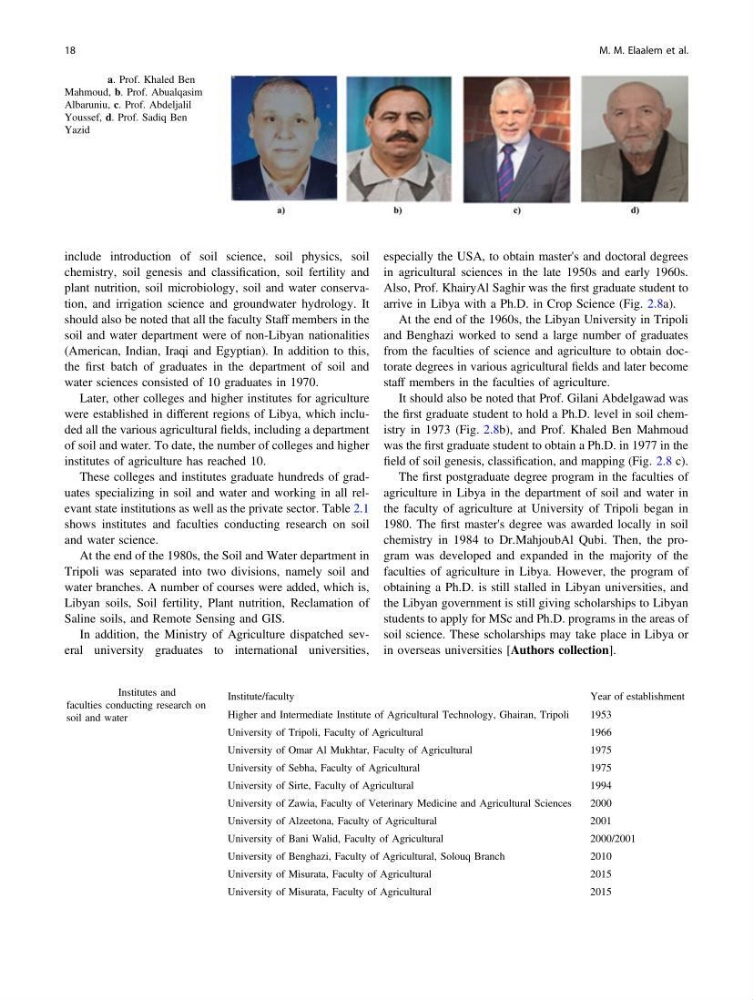
arrive in Libya with a Ph.D. in Crop Science (Fig. 2.8a).
At the end of the 1960s, the Libyan University in Tripoli
and Benghazi worked to send a large number of graduates
from the faculties of science and agriculture to obtain doctorate degrees in various agricultural fields and later become
staff members in the faculties of agriculture.
It should also be noted that Prof. Gilani Abdelgawad was
the first graduate student to hold a Ph.D. level in soil chemistry in 1973 (Fig. 2.8b), and Prof. Khaled Ben Mahmoud
was the first graduate student to obtain a Ph.D. in 1977 in the
field of soil genesis, classification, and mapping (Fig. 2.8 c).
The first postgraduate degree program in the faculties of
agriculture in Libya in the department of soil and water in
the faculty of agriculture at University of Tripoli began in
1980. The first master's degree was awarded locally in soil
chemistry in 1984 to Dr.MahjoubAl Qubi. Then, the program was developed and expanded in the majority of the
faculties of agriculture in Libya. However, the program of
obtaining a Ph.D. is still stalled in Libyan universities, and
the Libyan government is still giving scholarships to Libyan
students to apply for MSc and Ph.D. programs in the areas of
soil science. These scholarships may take place in Libya or
in overseas universities [Authors collection].
Fig. 2.7 a. Prof. Khaled Ben
Mahmoud, b. Prof. Abualqasim
Albaruniu, c. Prof. Abdeljalil
Youssef, d. Prof. Sadiq Ben
Yazid
Table 2.1 Institutes and
faculties conducting research on
soil and water
Institute/faculty
Year of establishment
Higher and Intermediate Institute of Agricultural Technology, Ghairan, Tripoli
1953
University of Tripoli, Faculty of Agricultural
1966
University of Omar Al Mukhtar, Faculty of Agricultural
1975
University of Sebha, Faculty of Agricultural
1975
University of Sirte, Faculty of Agricultural
1994
University of Zawia, Faculty of Veterinary Medicine and Agricultural Sciences
2000
University of Alzeetona, Faculty of Agricultural
2001
University of Bani Walid, Faculty of Agricultural
2000/2001
University of Benghazi, Faculty of Agricultural, Solouq Branch
2010
University of Misurata, Faculty of Agricultural
2015
University of Misurata, Faculty of Agricultural
2015
18
M. M. Elaalem et al.
chemistry, soil genesis and classification, soil fertility and
plant nutrition, soil microbiology, soil and water conservation, and irrigation science and groundwater hydrology. It
should also be noted that all the faculty Staff members in the
soil and water department were of non-Libyan nationalities
(American, Indian, Iraqi and Egyptian). In addition to this,
the first batch of graduates in the department of soil and
water sciences consisted of 10 graduates in 1970.
Later, other colleges and higher institutes for agriculture
were established in different regions of Libya, which included all the various agricultural fields, including a department
of soil and water. To date, the number of colleges and higher
institutes of agriculture has reached 10.
These colleges and institutes graduate hundreds of graduates specializing in soil and water and working in all relevant state institutions as well as the private sector. Table 2.1
shows institutes and faculties conducting research on soil
and water science.
At the end of the 1980s, the Soil and Water department in
Tripoli was separated into two divisions, namely soil and
water branches. A number of courses were added, which is,
Libyan soils, Soil fertility, Plant nutrition, Reclamation of
Saline soils, and Remote Sensing and GIS.
In addition, the Ministry of Agriculture dispatched several university graduates to international universities,
especially the USA, to obtain master's and doctoral degrees
in agricultural sciences in the late 1950s and early 1960s.
Also, Prof. KhairyAl Saghir was the first graduate student to
arrive in Libya with a Ph.D. in Crop Science (Fig. 2.8a).
At the end of the 1960s, the Libyan University in Tripoli
and Benghazi worked to send a large number of graduates
from the faculties of science and agriculture to obtain doctorate degrees in various agricultural fields and later become
staff members in the faculties of agriculture.
It should also be noted that Prof. Gilani Abdelgawad was
the first graduate student to hold a Ph.D. level in soil chemistry in 1973 (Fig. 2.8b), and Prof. Khaled Ben Mahmoud
was the first graduate student to obtain a Ph.D. in 1977 in the
field of soil genesis, classification, and mapping (Fig. 2.8 c).
The first postgraduate degree program in the faculties of
agriculture in Libya in the department of soil and water in
the faculty of agriculture at University of Tripoli began in
1980. The first master's degree was awarded locally in soil
chemistry in 1984 to Dr.MahjoubAl Qubi. Then, the program was developed and expanded in the majority of the
faculties of agriculture in Libya. However, the program of
obtaining a Ph.D. is still stalled in Libyan universities, and
the Libyan government is still giving scholarships to Libyan
students to apply for MSc and Ph.D. programs in the areas of
soil science. These scholarships may take place in Libya or
in overseas universities [Authors collection].
Fig. 2.7 a. Prof. Khaled Ben
Mahmoud, b. Prof. Abualqasim
Albaruniu, c. Prof. Abdeljalil
Youssef, d. Prof. Sadiq Ben
Yazid
Table 2.1 Institutes and
faculties conducting research on
soil and water
Institute/faculty
Year of establishment
Higher and Intermediate Institute of Agricultural Technology, Ghairan, Tripoli
1953
University of Tripoli, Faculty of Agricultural
1966
University of Omar Al Mukhtar, Faculty of Agricultural
1975
University of Sebha, Faculty of Agricultural
1975
University of Sirte, Faculty of Agricultural
1994
University of Zawia, Faculty of Veterinary Medicine and Agricultural Sciences
2000
University of Alzeetona, Faculty of Agricultural
2001
University of Bani Walid, Faculty of Agricultural
2000/2001
University of Benghazi, Faculty of Agricultural, Solouq Branch
2010
University of Misurata, Faculty of Agricultural
2015
University of Misurata, Faculty of Agricultural
2015
18
M. M. Elaalem et al.