

surveys. Some of these studies may be found in the Italian
government libraries. The agricultural survey was done for
the territory of Tripolitania and Cyrenaica, including
groundwater studies and land suitability for cultivation in
these two regions.
In these two regions, the processing of the farms settled
no more than 455 Italian families brought from Italy, a total
of about 1,780 farmers in the regions of Tripolitania. The
number tripled by the end of 1933 to 1,500 families, or
7,000 farmers. For the region of Cyrenaica, the situation was
completely different; with only 429 Italian farmers there, due
to the safety situation in the 1920s and early 1930s. They
planted olive trees, fruit trees, and cultivated tobacco,
especially in the Coastal areas such as Bianki, Zahra, Tripoli,
Al Gharaboli, Al Khumis, Gharian, Tarhona. In other areas
where water and good soils are available, they planted olive
trees, grapes. almonds and many fruit trees surrounded by
wind brake trees, which still stand in these areas.
In this experiment, the Libyans were briefed for the first
time on modern farming methods, from dividing the farm to
a rainfed section and irrigated section. In the rainfed section (75% of the area of the farm), olive or other trees were
planted at large distances, which were devoted to the cultivation of wheat and barley crops (Fig. 2.6).
In the irrigated section, deep wells were dug for the first
time, providing the infrastructure of the irrigation systems
that were followed in that period. These later switched from
flood irrigation to sprinkler irrigation and in each farm,
attention was also paid to animal production; especially cattle
breeding for meat and milk production. This area served as
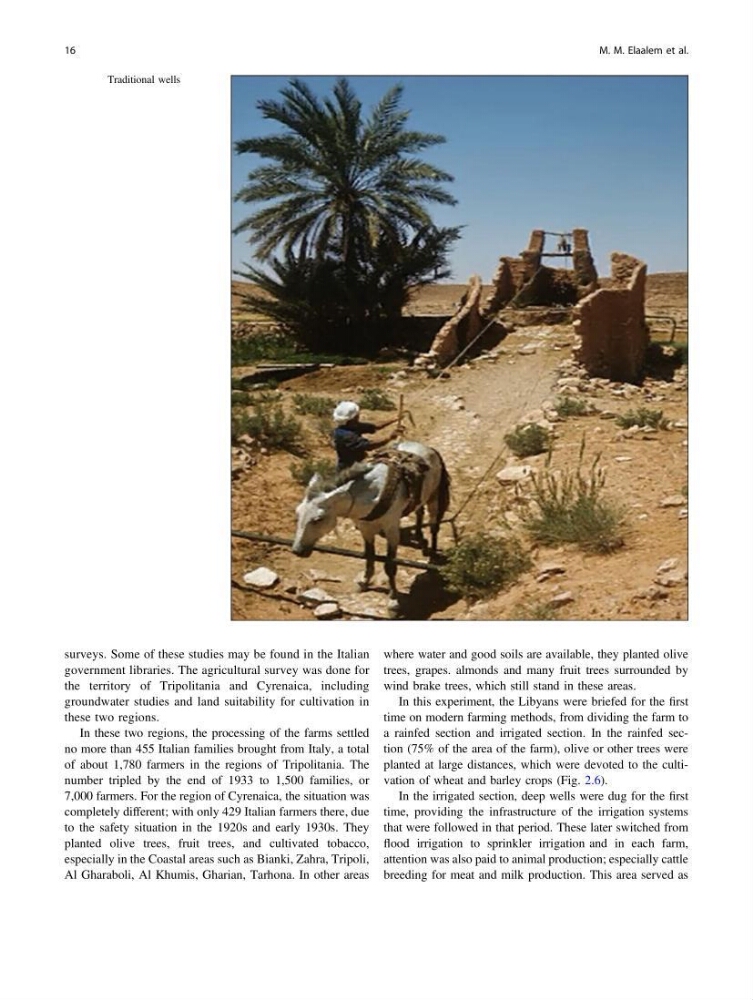
Fig. 2.4 Traditional wells
16
M. M. Elaalem et al.
government libraries. The agricultural survey was done for
the territory of Tripolitania and Cyrenaica, including
groundwater studies and land suitability for cultivation in
these two regions.
In these two regions, the processing of the farms settled
no more than 455 Italian families brought from Italy, a total
of about 1,780 farmers in the regions of Tripolitania. The
number tripled by the end of 1933 to 1,500 families, or
7,000 farmers. For the region of Cyrenaica, the situation was
completely different; with only 429 Italian farmers there, due
to the safety situation in the 1920s and early 1930s. They
planted olive trees, fruit trees, and cultivated tobacco,
especially in the Coastal areas such as Bianki, Zahra, Tripoli,
Al Gharaboli, Al Khumis, Gharian, Tarhona. In other areas
where water and good soils are available, they planted olive
trees, grapes. almonds and many fruit trees surrounded by
wind brake trees, which still stand in these areas.
In this experiment, the Libyans were briefed for the first
time on modern farming methods, from dividing the farm to
a rainfed section and irrigated section. In the rainfed section (75% of the area of the farm), olive or other trees were
planted at large distances, which were devoted to the cultivation of wheat and barley crops (Fig. 2.6).
In the irrigated section, deep wells were dug for the first
time, providing the infrastructure of the irrigation systems
that were followed in that period. These later switched from
flood irrigation to sprinkler irrigation and in each farm,
attention was also paid to animal production; especially cattle
breeding for meat and milk production. This area served as
Fig. 2.4 Traditional wells
16
M. M. Elaalem et al.