

foreign companies and consulting offices to carry out
inventory and mapping studies of soil and lands, and from
the 1980s until now, Libyan experts have taken over the
development of institutions working in the field of soil
resources. In this chapter, we review the historical development of soil studies, mapping and scientific research in
Libya.
2.2 History of Soil Knowledge, Education,
and Research
2.2.1 Ancient History of Soil Knowledge
Over the past years, old Libyans have accumulated considerable knowledge and experience in the selection of land
suitable for rainfed agriculture, in the organization of
grazing craft, in water harvesting techniques, in the search
for groundwater presence, hand-dug wells, how to extract
water from these wells and in choosing the appropriate
irrigation system, and in the selection of crops to suit all
the different regions in Libya, each according to the prevailing environment. This knowledge and experience were
acquired through trial and error and through the transfer of
experiences from other people who colonized and settled in
Libya throughout history. Here are some of these
experiences:
a. Grazing in the life of the Libyan man over many centuries was not only a profession but also a nature of life
and a major source of livelihood. Pastoralist communities, despite their illiteracy, realized that grazing was not
only a process of grazing by livestock but also a kind of
coexistence and mutual benefit between humans, animals, plants, and land. The best evidence of pastoral
communities’ keenness on providing food for animals
was their success in producing breeds of livestock with
good characteristics that can be formed only in the conditions of availability of pastures. These strains remain a
challenge to this day. The inhabitants of the Bawadi
instinctively concluded that the availability of pastures
led to the prosperity of cattle, their livelihoods, and glory.
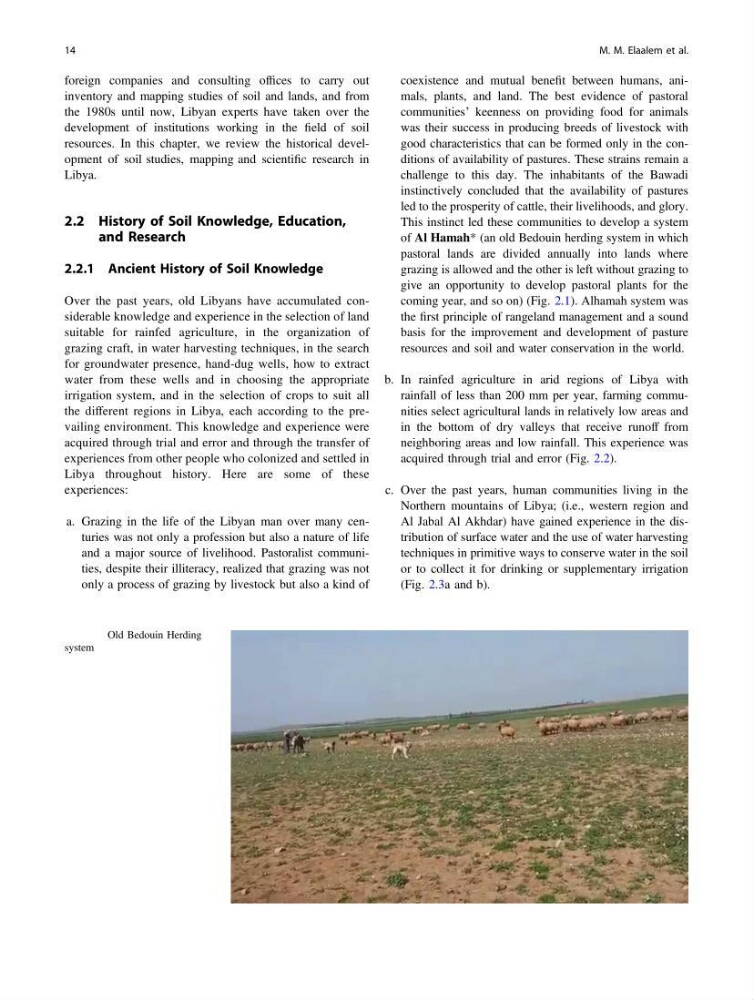
This instinct led these communities to develop a system
of Al Hamah* (an old Bedouin herding system in which
pastoral lands are divided annually into lands where
grazing is allowed and the other is left without grazing to
give an opportunity to develop pastoral plants for the
coming year, and so on) (Fig. 2.1). Alhamah system was
the first principle of rangeland management and a sound
basis for the improvement and development of pasture
resources and soil and water conservation in the world.
b. In rainfed agriculture in arid regions of Libya with
rainfall of less than 200 mm per year, farming communities select agricultural lands in relatively low areas and
in the bottom of dry valleys that receive runoff from
neighboring areas and low rainfall. This experience was
acquired through trial and error (Fig. 2.2).
c. Over the past years, human communities living in the
Northern mountains of Libya; (i.e., western region and
Al Jabal Al Akhdar) have gained experience in the distribution of surface water and the use of water harvesting
techniques in primitive ways to conserve water in the soil
or to collect it for drinking or supplementary irrigation
(Fig. 2.3a and b).
Fig. 2.1 Old Bedouin Herding
system
14
M. M. Elaalem et al.
inventory and mapping studies of soil and lands, and from
the 1980s until now, Libyan experts have taken over the
development of institutions working in the field of soil
resources. In this chapter, we review the historical development of soil studies, mapping and scientific research in
Libya.
2.2 History of Soil Knowledge, Education,
and Research
2.2.1 Ancient History of Soil Knowledge
Over the past years, old Libyans have accumulated considerable knowledge and experience in the selection of land
suitable for rainfed agriculture, in the organization of
grazing craft, in water harvesting techniques, in the search
for groundwater presence, hand-dug wells, how to extract
water from these wells and in choosing the appropriate
irrigation system, and in the selection of crops to suit all
the different regions in Libya, each according to the prevailing environment. This knowledge and experience were
acquired through trial and error and through the transfer of
experiences from other people who colonized and settled in
Libya throughout history. Here are some of these
experiences:
a. Grazing in the life of the Libyan man over many centuries was not only a profession but also a nature of life
and a major source of livelihood. Pastoralist communities, despite their illiteracy, realized that grazing was not
only a process of grazing by livestock but also a kind of
coexistence and mutual benefit between humans, animals, plants, and land. The best evidence of pastoral
communities’ keenness on providing food for animals
was their success in producing breeds of livestock with
good characteristics that can be formed only in the conditions of availability of pastures. These strains remain a
challenge to this day. The inhabitants of the Bawadi
instinctively concluded that the availability of pastures
led to the prosperity of cattle, their livelihoods, and glory.
This instinct led these communities to develop a system
of Al Hamah* (an old Bedouin herding system in which
pastoral lands are divided annually into lands where
grazing is allowed and the other is left without grazing to
give an opportunity to develop pastoral plants for the
coming year, and so on) (Fig. 2.1). Alhamah system was
the first principle of rangeland management and a sound
basis for the improvement and development of pasture
resources and soil and water conservation in the world.
b. In rainfed agriculture in arid regions of Libya with
rainfall of less than 200 mm per year, farming communities select agricultural lands in relatively low areas and
in the bottom of dry valleys that receive runoff from
neighboring areas and low rainfall. This experience was
acquired through trial and error (Fig. 2.2).
c. Over the past years, human communities living in the
Northern mountains of Libya; (i.e., western region and
Al Jabal Al Akhdar) have gained experience in the distribution of surface water and the use of water harvesting
techniques in primitive ways to conserve water in the soil
or to collect it for drinking or supplementary irrigation
(Fig. 2.3a and b).
Fig. 2.1 Old Bedouin Herding
system
14
M. M. Elaalem et al.