

4.1.3 Consideration of Human-Made Soils
from the Viewpoint of International
Classification Systems
(1) Categorization of Human-made soils
The concept of soils under intensive human activity is
probably largely divergent between different national soil
classification systems. Such difference can be found in the
position of the soil category in each classification system.
Human-made soils are placed as the highest category as a
soil great group and are placed in the first position among
soil great groups in the Soil Classification System of Japan.
In the WRB classification system, the corresponding soils
are also placed as the highest category of reference soil
group, being given the name Technosols, which are mainly
defined by the contents of artifacts in a soil horizon and are
placed in the third position following the organic soils
Histosols and the human-impacted agricultural soils
Anthrosols (IUSS Working Group WRB 2015). Both the
Japanese and WRB classification systems recognize the
specificity of human impacts on soils. In particular, the
WRB system considers human activity as a soil formation
factor (IUSS Working Group WRB 2006), together with
“Climate,” “Parent materials,” “Land form,” “Organisms,”
and “Time.”
On the other hand, in the USDA classification system (Soil
Survey Staff 2014), human-impacted soils can consist of
original soils that contain anthropogenic materials and/or
possess characteristics arising from modification of the soils
by human activities. Soils with these qualifying properties at
lower levels can be called “human-altered and humantransported” (HAHT) soils in the USDA classification system. Qualifiers signifying Artifactual influences can be added
at lower subgroup levels in the classification system.
(2) Translation of Human-made soils between international classification systems
Information regarding anthropogenic impacts on soils cannot
be confirmed in the soil names of the soil great group under
the USDA soil classification system, whereas the soil name
of Technosols in the WRB classification system does not
preserve information on the original soil name and properties
unless supplementary qualifiers are added. Supplementary
qualifiers are included in the WRB classification system to
provide information about the properties of the original soils.
As in the WRB classification system, soil names with subgroup categories of Human-made soils contain no information about the original soil under the Japanese classification
system. Information regarding the original soil can be added
to express soil phases in the Japanese classification system.
The differences in the technical terms used to express
anthropogenic properties in soil names among USDA, the
WRB, and the Japanese classification systems make it difficult to translate soil names between the systems. To solve
this translation issue, every classification system will be
required to fit the definition of artifacts, the position of a soil
surface, and soils that they classify. Upgrading the HAHT
soils to the first category in the USDA classification system
is now being considered to achieve compatibility between
the various soil classification systems (Galbraith 2018).
(3) Soils beneath constructions or in pots
Since the Japanese classification system excludes soils
beneath constructions such as roads and buildings, soils
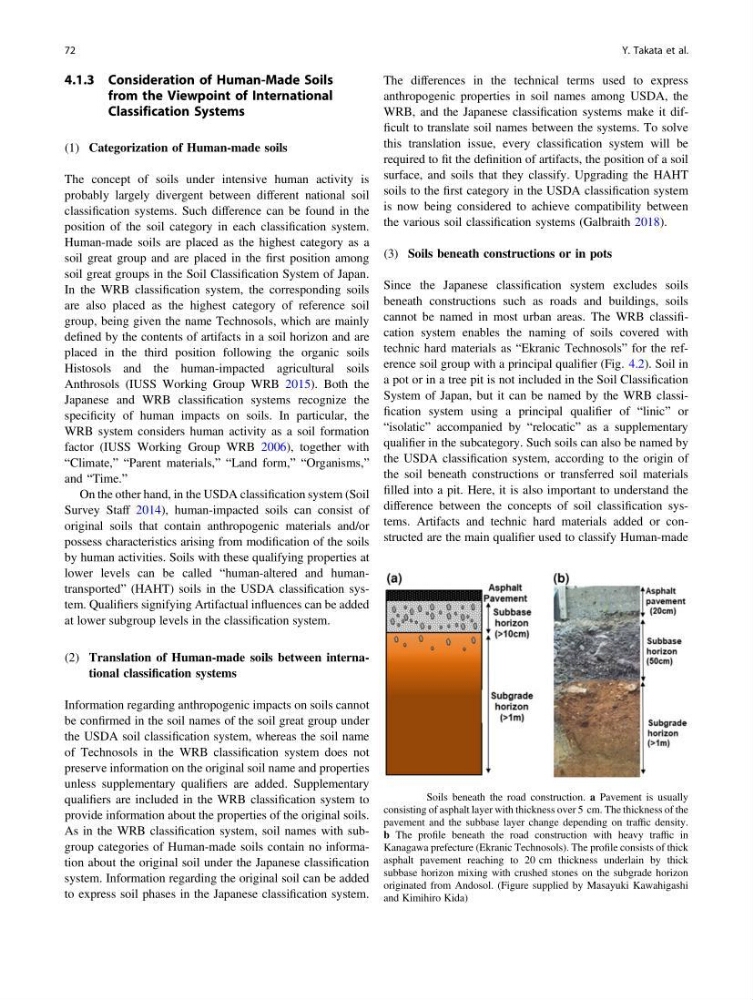
cannot be named in most urban areas. The WRB classification system enables the naming of soils covered with
technic hard materials as “Ekranic Technosols” for the reference soil group with a principal qualifier (Fig. 4.2). Soil in
a pot or in a tree pit is not included in the Soil Classification
System of Japan, but it can be named by the WRB classification system using a principal qualifier of “linic” or
“isolatic” accompanied by “relocatic” as a supplementary
qualifier in the subcategory. Such soils can also be named by
the USDA classification system, according to the origin of
the soil beneath constructions or transferred soil materials
filled into a pit. Here, it is also important to understand the
difference between the concepts of soil classification systems. Artifacts and technic hard materials added or constructed are the main qualifier used to classify Human-made
Fig. 4.2 Soils beneath the road construction. a Pavement is usually
consisting of asphalt layer with thickness over 5 cm. The thickness of the
pavement and the subbase layer change depending on traffic density.
b The profile beneath the road construction with heavy traffic in
Kanagawa prefecture (Ekranic Technosols). The profile consists of thick
asphalt pavement reaching to 20 cm thickness underlain by thick
subbase horizon mixing with crushed stones on the subgrade horizon
originated from Andosol. (Figure supplied by Masayuki Kawahigashi
and Kimihiro Kida)
72
Y. Takata et al.
from the Viewpoint of International
Classification Systems
(1) Categorization of Human-made soils
The concept of soils under intensive human activity is
probably largely divergent between different national soil
classification systems. Such difference can be found in the
position of the soil category in each classification system.
Human-made soils are placed as the highest category as a
soil great group and are placed in the first position among
soil great groups in the Soil Classification System of Japan.
In the WRB classification system, the corresponding soils
are also placed as the highest category of reference soil
group, being given the name Technosols, which are mainly
defined by the contents of artifacts in a soil horizon and are
placed in the third position following the organic soils
Histosols and the human-impacted agricultural soils
Anthrosols (IUSS Working Group WRB 2015). Both the
Japanese and WRB classification systems recognize the
specificity of human impacts on soils. In particular, the
WRB system considers human activity as a soil formation
factor (IUSS Working Group WRB 2006), together with
“Climate,” “Parent materials,” “Land form,” “Organisms,”
and “Time.”
On the other hand, in the USDA classification system (Soil
Survey Staff 2014), human-impacted soils can consist of
original soils that contain anthropogenic materials and/or
possess characteristics arising from modification of the soils
by human activities. Soils with these qualifying properties at
lower levels can be called “human-altered and humantransported” (HAHT) soils in the USDA classification system. Qualifiers signifying Artifactual influences can be added
at lower subgroup levels in the classification system.
(2) Translation of Human-made soils between international classification systems
Information regarding anthropogenic impacts on soils cannot
be confirmed in the soil names of the soil great group under
the USDA soil classification system, whereas the soil name
of Technosols in the WRB classification system does not
preserve information on the original soil name and properties
unless supplementary qualifiers are added. Supplementary
qualifiers are included in the WRB classification system to
provide information about the properties of the original soils.
As in the WRB classification system, soil names with subgroup categories of Human-made soils contain no information about the original soil under the Japanese classification
system. Information regarding the original soil can be added
to express soil phases in the Japanese classification system.
The differences in the technical terms used to express
anthropogenic properties in soil names among USDA, the
WRB, and the Japanese classification systems make it difficult to translate soil names between the systems. To solve
this translation issue, every classification system will be
required to fit the definition of artifacts, the position of a soil
surface, and soils that they classify. Upgrading the HAHT
soils to the first category in the USDA classification system
is now being considered to achieve compatibility between
the various soil classification systems (Galbraith 2018).
(3) Soils beneath constructions or in pots
Since the Japanese classification system excludes soils
beneath constructions such as roads and buildings, soils
cannot be named in most urban areas. The WRB classification system enables the naming of soils covered with
technic hard materials as “Ekranic Technosols” for the reference soil group with a principal qualifier (Fig. 4.2). Soil in
a pot or in a tree pit is not included in the Soil Classification
System of Japan, but it can be named by the WRB classification system using a principal qualifier of “linic” or
“isolatic” accompanied by “relocatic” as a supplementary
qualifier in the subcategory. Such soils can also be named by
the USDA classification system, according to the origin of
the soil beneath constructions or transferred soil materials
filled into a pit. Here, it is also important to understand the
difference between the concepts of soil classification systems. Artifacts and technic hard materials added or constructed are the main qualifier used to classify Human-made
Fig. 4.2 Soils beneath the road construction. a Pavement is usually
consisting of asphalt layer with thickness over 5 cm. The thickness of the
pavement and the subbase layer change depending on traffic density.
b The profile beneath the road construction with heavy traffic in
Kanagawa prefecture (Ekranic Technosols). The profile consists of thick
asphalt pavement reaching to 20 cm thickness underlain by thick
subbase horizon mixing with crushed stones on the subgrade horizon
originated from Andosol. (Figure supplied by Masayuki Kawahigashi
and Kimihiro Kida)
72
Y. Takata et al.