

materials. The soils form through anthropogenic activities,
especially in anthropized areas such as urban, industrial,
traffic, mining, and waste disposal areas. Generally, soils
under agricultural management, such as paddy fields, are
excluded from the definition of Human-made soils, despite
the anthropogenic land reformation on these agricultural
fields. The central concept of Human-made soils is characterized by a soil profile that has been drastically changed
with an unexpected soil pedon differing from any profiles of
natural soils. Soils having features of pedogenic processes,
such as mottle formation, clay accumulation, soil reduction,
podzolization, should be classified into another soil great
group characterized by specific soil formation processes.
Human-made soils are further divided into the Artifactual
soil group and the Reformed soil group. Artifactual soils are
usually identified by the contents of artifacts and their
position in depth, while Reformed soils are covered with
intentionally transported soil materials. Both of these soil
groups are intentionally or occasionally formed mainly due
to land-forming processes and infrastructure constructions
commonly using powerful heavy machinery.
(2) Definition and properties of artifacts
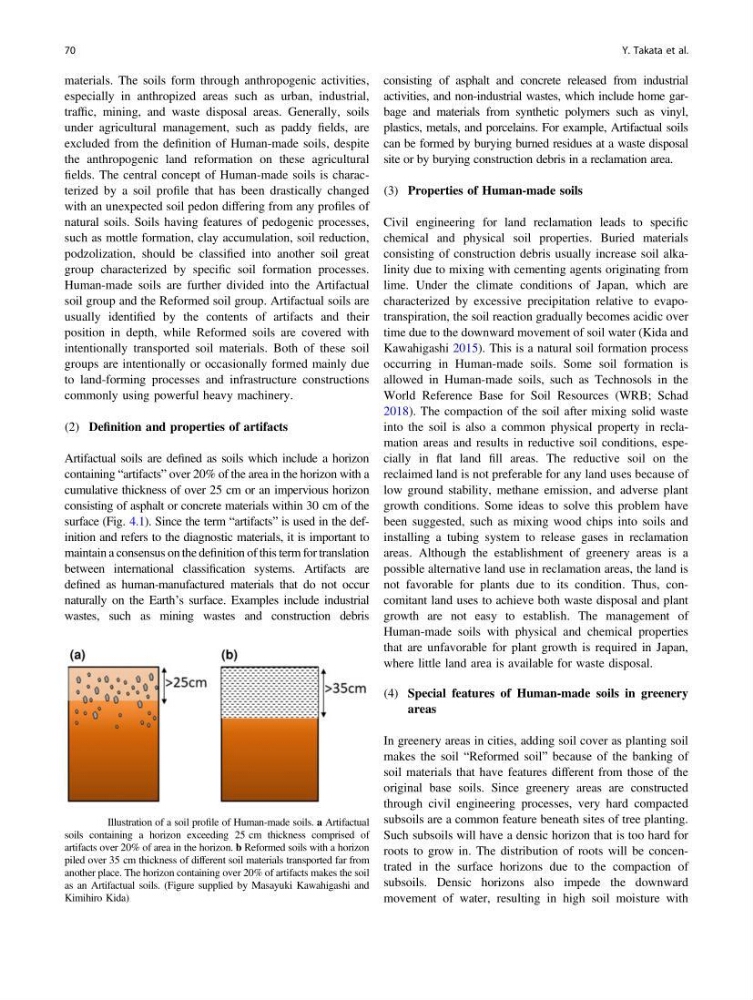
Artifactual soils are defined as soils which include a horizon
containing “artifacts” over 20% of the area in the horizon with a
cumulative thickness of over 25 cm or an impervious horizon
consisting of asphalt or concrete materials within 30 cm of the
surface (Fig. 4.1). Since the term “artifacts” is used in the definition and refers to the diagnostic materials, it is important to
maintain a consensus on the definition of this term for translation
between international classification systems. Artifacts are
defined as human-manufactured materials that do not occur
naturally on the Earth’s surface. Examples include industrial
wastes, such as mining wastes and construction debris
consisting of asphalt and concrete released from industrial
activities, and non-industrial wastes, which include home garbage and materials from synthetic polymers such as vinyl,
plastics, metals, and porcelains. For example, Artifactual soils
can be formed by burying burned residues at a waste disposal
site or by burying construction debris in a reclamation area.
(3) Properties of Human-made soils
Civil engineering for land reclamation leads to specific
chemical and physical soil properties. Buried materials
consisting of construction debris usually increase soil alkalinity due to mixing with cementing agents originating from
lime. Under the climate conditions of Japan, which are
characterized by excessive precipitation relative to evapotranspiration, the soil reaction gradually becomes acidic over
time due to the downward movement of soil water (Kida and
Kawahigashi 2015). This is a natural soil formation process
occurring in Human-made soils. Some soil formation is
allowed in Human-made soils, such as Technosols in the
World Reference Base for Soil Resources (WRB; Schad
2018). The compaction of the soil after mixing solid waste
into the soil is also a common physical property in reclamation areas and results in reductive soil conditions, especially in flat land fill areas. The reductive soil on the
reclaimed land is not preferable for any land uses because of
low ground stability, methane emission, and adverse plant
growth conditions. Some ideas to solve this problem have
been suggested, such as mixing wood chips into soils and
installing a tubing system to release gases in reclamation
areas. Although the establishment of greenery areas is a
possible alternative land use in reclamation areas, the land is
not favorable for plants due to its condition. Thus, concomitant land uses to achieve both waste disposal and plant
growth are not easy to establish. The management of
Human-made soils with physical and chemical properties
that are unfavorable for plant growth is required in Japan,
where little land area is available for waste disposal.
(4) Special features of Human-made soils in greenery
areas
In greenery areas in cities, adding soil cover as planting soil
makes the soil “Reformed soil” because of the banking of
soil materials that have features different from those of the
original base soils. Since greenery areas are constructed
through civil engineering processes, very hard compacted
subsoils are a common feature beneath sites of tree planting.
Such subsoils will have a densic horizon that is too hard for
roots to grow in. The distribution of roots will be concentrated in the surface horizons due to the compaction of
subsoils. Densic horizons also impede the downward
movement of water, resulting in high soil moisture with
Fig. 4.1 Illustration of a soil profile of Human-made soils. a Artifactual
soils containing a horizon exceeding 25 cm thickness comprised of
artifacts over 20% of area in the horizon. b Reformed soils with a horizon
piled over 35 cm thickness of different soil materials transported far from
another place. The horizon containing over 20% of artifacts makes the soil
as an Artifactual soils. (Figure supplied by Masayuki Kawahigashi and
Kimihiro Kida)
70
Y. Takata et al.
especially in anthropized areas such as urban, industrial,
traffic, mining, and waste disposal areas. Generally, soils
under agricultural management, such as paddy fields, are
excluded from the definition of Human-made soils, despite
the anthropogenic land reformation on these agricultural
fields. The central concept of Human-made soils is characterized by a soil profile that has been drastically changed
with an unexpected soil pedon differing from any profiles of
natural soils. Soils having features of pedogenic processes,
such as mottle formation, clay accumulation, soil reduction,
podzolization, should be classified into another soil great
group characterized by specific soil formation processes.
Human-made soils are further divided into the Artifactual
soil group and the Reformed soil group. Artifactual soils are
usually identified by the contents of artifacts and their
position in depth, while Reformed soils are covered with
intentionally transported soil materials. Both of these soil
groups are intentionally or occasionally formed mainly due
to land-forming processes and infrastructure constructions
commonly using powerful heavy machinery.
(2) Definition and properties of artifacts
Artifactual soils are defined as soils which include a horizon
containing “artifacts” over 20% of the area in the horizon with a
cumulative thickness of over 25 cm or an impervious horizon
consisting of asphalt or concrete materials within 30 cm of the
surface (Fig. 4.1). Since the term “artifacts” is used in the definition and refers to the diagnostic materials, it is important to
maintain a consensus on the definition of this term for translation
between international classification systems. Artifacts are
defined as human-manufactured materials that do not occur
naturally on the Earth’s surface. Examples include industrial
wastes, such as mining wastes and construction debris
consisting of asphalt and concrete released from industrial
activities, and non-industrial wastes, which include home garbage and materials from synthetic polymers such as vinyl,
plastics, metals, and porcelains. For example, Artifactual soils
can be formed by burying burned residues at a waste disposal
site or by burying construction debris in a reclamation area.
(3) Properties of Human-made soils
Civil engineering for land reclamation leads to specific
chemical and physical soil properties. Buried materials
consisting of construction debris usually increase soil alkalinity due to mixing with cementing agents originating from
lime. Under the climate conditions of Japan, which are
characterized by excessive precipitation relative to evapotranspiration, the soil reaction gradually becomes acidic over
time due to the downward movement of soil water (Kida and
Kawahigashi 2015). This is a natural soil formation process
occurring in Human-made soils. Some soil formation is
allowed in Human-made soils, such as Technosols in the
World Reference Base for Soil Resources (WRB; Schad
2018). The compaction of the soil after mixing solid waste
into the soil is also a common physical property in reclamation areas and results in reductive soil conditions, especially in flat land fill areas. The reductive soil on the
reclaimed land is not preferable for any land uses because of
low ground stability, methane emission, and adverse plant
growth conditions. Some ideas to solve this problem have
been suggested, such as mixing wood chips into soils and
installing a tubing system to release gases in reclamation
areas. Although the establishment of greenery areas is a
possible alternative land use in reclamation areas, the land is
not favorable for plants due to its condition. Thus, concomitant land uses to achieve both waste disposal and plant
growth are not easy to establish. The management of
Human-made soils with physical and chemical properties
that are unfavorable for plant growth is required in Japan,
where little land area is available for waste disposal.
(4) Special features of Human-made soils in greenery
areas
In greenery areas in cities, adding soil cover as planting soil
makes the soil “Reformed soil” because of the banking of
soil materials that have features different from those of the
original base soils. Since greenery areas are constructed
through civil engineering processes, very hard compacted
subsoils are a common feature beneath sites of tree planting.
Such subsoils will have a densic horizon that is too hard for
roots to grow in. The distribution of roots will be concentrated in the surface horizons due to the compaction of
subsoils. Densic horizons also impede the downward
movement of water, resulting in high soil moisture with
Fig. 4.1 Illustration of a soil profile of Human-made soils. a Artifactual
soils containing a horizon exceeding 25 cm thickness comprised of
artifacts over 20% of area in the horizon. b Reformed soils with a horizon
piled over 35 cm thickness of different soil materials transported far from
another place. The horizon containing over 20% of artifacts makes the soil
as an Artifactual soils. (Figure supplied by Masayuki Kawahigashi and
Kimihiro Kida)
70
Y. Takata et al.