

rocks are deeply weathered (10–30 m), and innumerable
landslides in weathered granites have occurred in Japan. In
these areas, Masado (Granitic Terrestrial Regosols) are
recognized.
The distribution area of podzols is very small in Japan (2%
of the Japanese territory), and this soil is recognized in only
high mountainous areas, except in the northern part of Hokkaido. Organic soils cover only 1% of Japan’s land area and
are mainly distributed in the Hokkaido, Tohoku, and Kanto
regions. Stagnic soils and Eutrosols account for less than 1%.
Stagnic soils are mainly used as terraced paddy field.
3.2.2 Status of Cultivated Soil Resources
Japan’s total land area is about 378,000 km
2
. About 72% of
this land area is mountainous, and rivers are characterized by
their steep gradients and relatively short lengths. About
two-thirds of the total land area consists of forest, while plains
cover about 28% of the total land area. Most plains are located
along the seacoast. Cultivated land accounts for 12.1% of the
total land surface and is mainly distributed in the plains.
Table 2.2 in Chapter 2 shows the summarized extent of
soil great groups in Japanese cultivated land. Fluvic soils
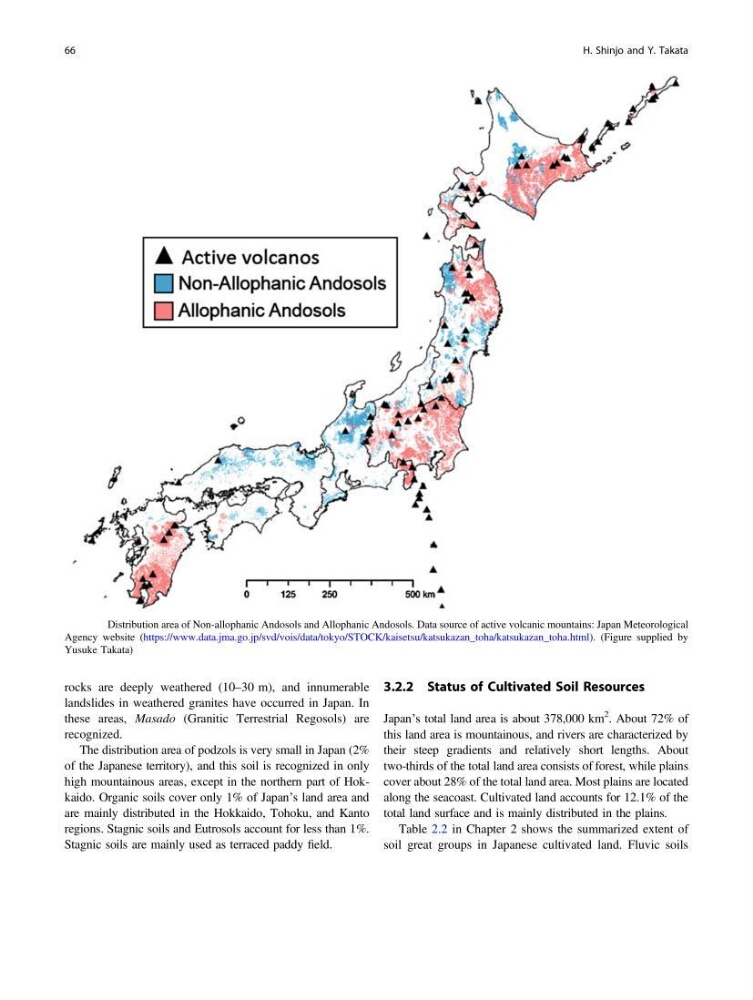
Fig. 3.4 Distribution area of Non-allophanic Andosols and Allophanic Andosols. Data source of active volcanic mountains: Japan Meteorological
Agency website (https://www.data.jma.go.jp/svd/vois/data/tokyo/STOCK/kaisetsu/katsukazan_toha/katsukazan_toha.html). (Figure supplied by
Yusuke Takata)
66
H. Shinjo and Y. Takata
landslides in weathered granites have occurred in Japan. In
these areas, Masado (Granitic Terrestrial Regosols) are
recognized.
The distribution area of podzols is very small in Japan (2%
of the Japanese territory), and this soil is recognized in only
high mountainous areas, except in the northern part of Hokkaido. Organic soils cover only 1% of Japan’s land area and
are mainly distributed in the Hokkaido, Tohoku, and Kanto
regions. Stagnic soils and Eutrosols account for less than 1%.
Stagnic soils are mainly used as terraced paddy field.
3.2.2 Status of Cultivated Soil Resources
Japan’s total land area is about 378,000 km
2
. About 72% of
this land area is mountainous, and rivers are characterized by
their steep gradients and relatively short lengths. About
two-thirds of the total land area consists of forest, while plains
cover about 28% of the total land area. Most plains are located
along the seacoast. Cultivated land accounts for 12.1% of the
total land surface and is mainly distributed in the plains.
Table 2.2 in Chapter 2 shows the summarized extent of
soil great groups in Japanese cultivated land. Fluvic soils
Fig. 3.4 Distribution area of Non-allophanic Andosols and Allophanic Andosols. Data source of active volcanic mountains: Japan Meteorological
Agency website (https://www.data.jma.go.jp/svd/vois/data/tokyo/STOCK/kaisetsu/katsukazan_toha/katsukazan_toha.html). (Figure supplied by
Yusuke Takata)
66
H. Shinjo and Y. Takata