

water. The materials should contain 12% or more of organic
carbon and should not show andic soil properties.
Pro-thionic materials: Materials that are under saturated
conditions if not drained and that show strong acidity once
oxidized.
Volcanogenous materials: Pyroclastic materials including
volcanic ash, lapilli, pumice, scoria, and sediments deposited
by pyroclastic flow.
3.1.3 Classification of a Soil
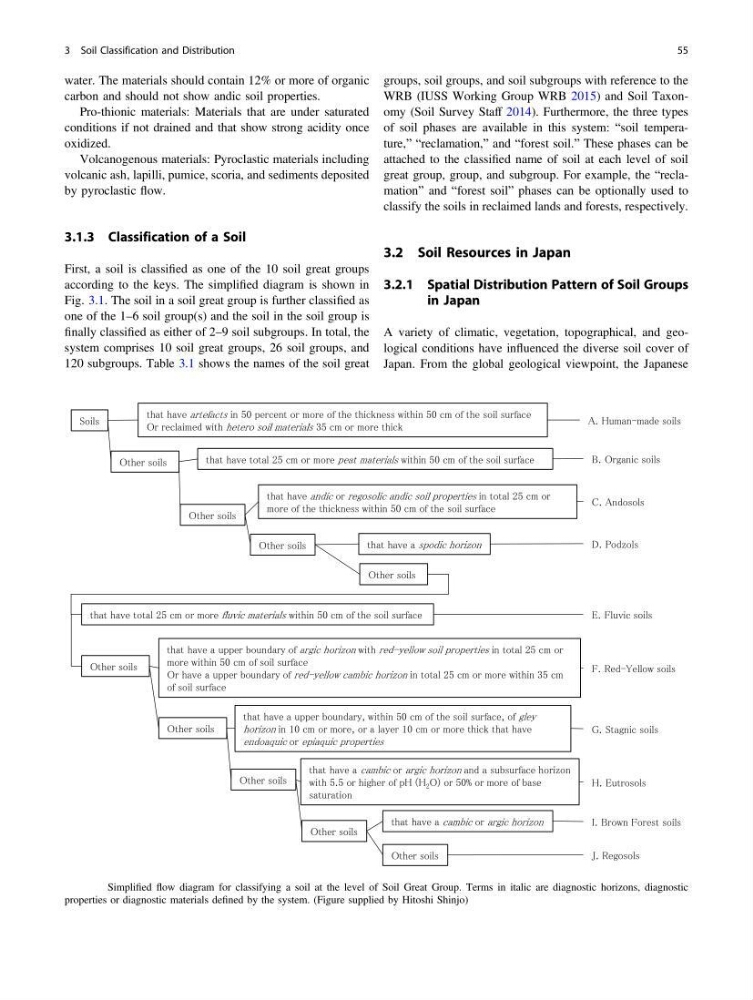
First, a soil is classified as one of the 10 soil great groups
according to the keys. The simplified diagram is shown in
Fig. 3.1. The soil in a soil great group is further classified as
one of the 1–6 soil group(s) and the soil in the soil group is
finally classified as either of 2–9 soil subgroups. In total, the
system comprises 10 soil great groups, 26 soil groups, and
120 subgroups. Table 3.1 shows the names of the soil great
groups, soil groups, and soil subgroups with reference to the
WRB (IUSS Working Group WRB 2015) and Soil Taxonomy (Soil Survey Staff 2014). Furthermore, the three types
of soil phases are available in this system: “soil temperature,” “reclamation,” and “forest soil.” These phases can be
attached to the classified name of soil at each level of soil
great group, group, and subgroup. For example, the “reclamation” and “forest soil” phases can be optionally used to
classify the soils in reclaimed lands and forests, respectively.
3.2 Soil Resources in Japan
3.2.1 Spatial Distribution Pattern of Soil Groups
in Japan
A variety of climatic, vegetation, topographical, and geological conditions have influenced the diverse soil cover of
Japan. From the global geological viewpoint, the Japanese
Fig. 3.1 Simplified flow diagram for classifying a soil at the level of Soil Great Group. Terms in italic are diagnostic horizons, diagnostic
properties or diagnostic materials defined by the system. (Figure supplied by Hitoshi Shinjo)
3 Soil Classification and Distribution
55
carbon and should not show andic soil properties.
Pro-thionic materials: Materials that are under saturated
conditions if not drained and that show strong acidity once
oxidized.
Volcanogenous materials: Pyroclastic materials including
volcanic ash, lapilli, pumice, scoria, and sediments deposited
by pyroclastic flow.
3.1.3 Classification of a Soil
First, a soil is classified as one of the 10 soil great groups
according to the keys. The simplified diagram is shown in
Fig. 3.1. The soil in a soil great group is further classified as
one of the 1–6 soil group(s) and the soil in the soil group is
finally classified as either of 2–9 soil subgroups. In total, the
system comprises 10 soil great groups, 26 soil groups, and
120 subgroups. Table 3.1 shows the names of the soil great
groups, soil groups, and soil subgroups with reference to the
WRB (IUSS Working Group WRB 2015) and Soil Taxonomy (Soil Survey Staff 2014). Furthermore, the three types
of soil phases are available in this system: “soil temperature,” “reclamation,” and “forest soil.” These phases can be
attached to the classified name of soil at each level of soil
great group, group, and subgroup. For example, the “reclamation” and “forest soil” phases can be optionally used to
classify the soils in reclaimed lands and forests, respectively.
3.2 Soil Resources in Japan
3.2.1 Spatial Distribution Pattern of Soil Groups
in Japan
A variety of climatic, vegetation, topographical, and geological conditions have influenced the diverse soil cover of
Japan. From the global geological viewpoint, the Japanese
Fig. 3.1 Simplified flow diagram for classifying a soil at the level of Soil Great Group. Terms in italic are diagnostic horizons, diagnostic
properties or diagnostic materials defined by the system. (Figure supplied by Hitoshi Shinjo)
3 Soil Classification and Distribution
55