

It is well known that soil derived from volcanic ash has a
very high organic carbon content and the color of the surface
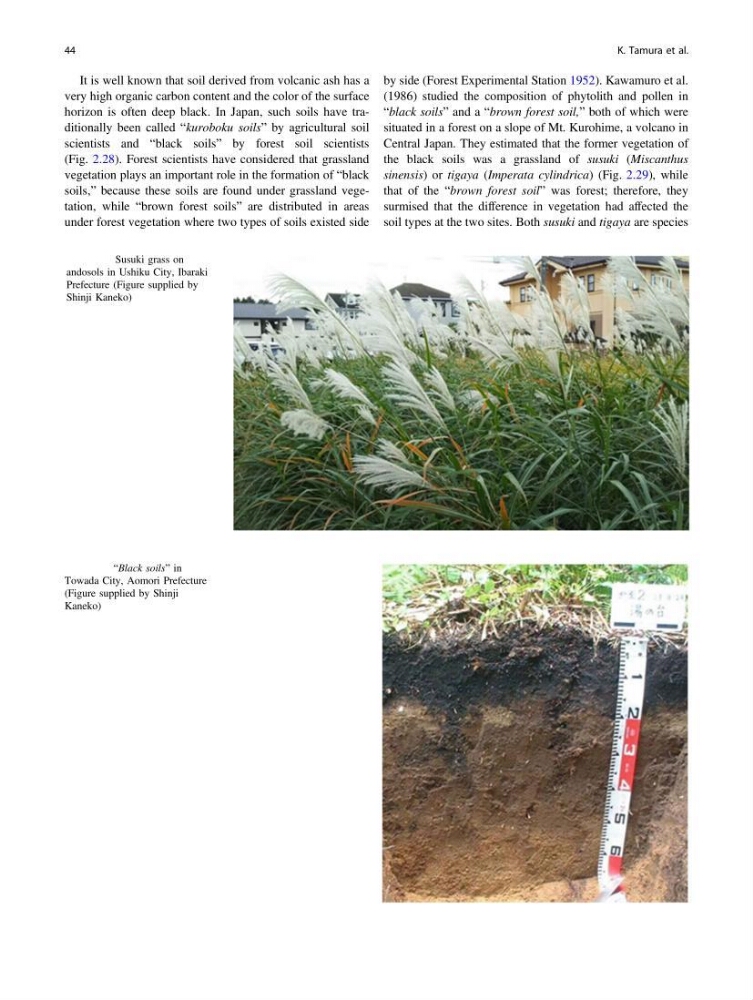
horizon is often deep black. In Japan, such soils have traditionally been called “kuroboku soils” by agricultural soil
scientists and “black soils” by forest soil scientists
(Fig. 2.28). Forest scientists have considered that grassland
vegetation plays an important role in the formation of “black
soils,” because these soils are found under grassland vegetation, while “brown forest soils” are distributed in areas
under forest vegetation where two types of soils existed side
by side (Forest Experimental Station 1952). Kawamuro et al.
(1986) studied the composition of phytolith and pollen in
“black soils” and a “brown forest soil,” both of which were
situated in a forest on a slope of Mt. Kurohime, a volcano in
Central Japan. They estimated that the former vegetation of
the black soils was a grassland of susuki (Miscanthus
sinensis) or tigaya (Imperata cylindrica) (Fig. 2.29), while
that of the “brown forest soil” was forest; therefore, they
surmised that the difference in vegetation had affected the
soil types at the two sites. Both susuki and tigaya are species
Fig. 2.28 Susuki grass on
andosols in Ushiku City, Ibaraki
Prefecture (Figure supplied by
Shinji Kaneko)
Fig. 2.29 “Black soils” in
Towada City, Aomori Prefecture
(Figure supplied by Shinji
Kaneko)
44
K. Tamura et al.
very high organic carbon content and the color of the surface
horizon is often deep black. In Japan, such soils have traditionally been called “kuroboku soils” by agricultural soil
scientists and “black soils” by forest soil scientists
(Fig. 2.28). Forest scientists have considered that grassland
vegetation plays an important role in the formation of “black
soils,” because these soils are found under grassland vegetation, while “brown forest soils” are distributed in areas
under forest vegetation where two types of soils existed side
by side (Forest Experimental Station 1952). Kawamuro et al.
(1986) studied the composition of phytolith and pollen in
“black soils” and a “brown forest soil,” both of which were
situated in a forest on a slope of Mt. Kurohime, a volcano in
Central Japan. They estimated that the former vegetation of
the black soils was a grassland of susuki (Miscanthus
sinensis) or tigaya (Imperata cylindrica) (Fig. 2.29), while
that of the “brown forest soil” was forest; therefore, they
surmised that the difference in vegetation had affected the
soil types at the two sites. Both susuki and tigaya are species
Fig. 2.28 Susuki grass on
andosols in Ushiku City, Ibaraki
Prefecture (Figure supplied by
Shinji Kaneko)
Fig. 2.29 “Black soils” in
Towada City, Aomori Prefecture
(Figure supplied by Shinji
Kaneko)
44
K. Tamura et al.