

1. Subtropical evergreen broad-leaved forest zone
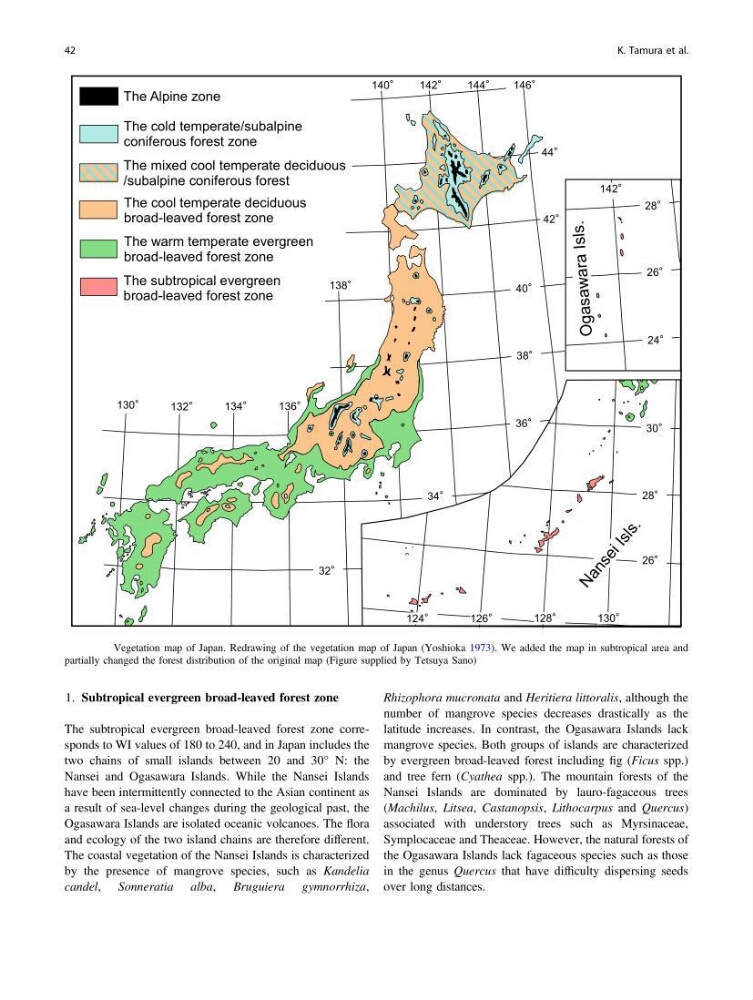
The subtropical evergreen broad-leaved forest zone corresponds to WI values of 180 to 240, and in Japan includes the
two chains of small islands between 20 and 30° N: the
Nansei and Ogasawara Islands. While the Nansei Islands
have been intermittently connected to the Asian continent as
a result of sea-level changes during the geological past, the
Ogasawara Islands are isolated oceanic volcanoes. The flora
and ecology of the two island chains are therefore different.
The coastal vegetation of the Nansei Islands is characterized
by the presence of mangrove species, such as Kandelia
candel, Sonneratia alba, Bruguiera gymnorrhiza,
Rhizophora mucronata and Heritiera littoralis, although the
number of mangrove species decreases drastically as the
latitude increases. In contrast, the Ogasawara Islands lack
mangrove species. Both groups of islands are characterized
by evergreen broad-leaved forest including fig (Ficus spp.)
and tree fern (Cyathea spp.). The mountain forests of the
Nansei Islands are dominated by lauro-fagaceous trees
(Machilus, Litsea, Castanopsis, Lithocarpus and Quercus)
associated with understory trees such as Myrsinaceae,
Symplocaceae and Theaceae. However, the natural forests of
the Ogasawara Islands lack fagaceous species such as those
in the genus Quercus that have difficulty dispersing seeds
over long distances.
The Alpine zone
. s l s I a r a w a s a g O
N a n s e i I s l s .
The subtropical evergreen
broad-leaved forest zone
The warm temperate evergreen
broad-leaved forest zone
The cool temperate deciduous
broad-leaved forest zone
The mixed cool temperate deciduous
/subalpine coniferous forest
The cold temperate/subalpine
coniferous forest zone
130
132
134
136
138
140
142
144
146
44
40
42
38
36
34
32
142
28
26
24
30
28
26
130
128
126
124
Fig. 2.27 Vegetation map of Japan. Redrawing of the vegetation map of Japan (Yoshioka 1973). We added the map in subtropical area and
partially changed the forest distribution of the original map (Figure supplied by Tetsuya Sano)
42
K. Tamura et al.
The subtropical evergreen broad-leaved forest zone corresponds to WI values of 180 to 240, and in Japan includes the
two chains of small islands between 20 and 30° N: the
Nansei and Ogasawara Islands. While the Nansei Islands
have been intermittently connected to the Asian continent as
a result of sea-level changes during the geological past, the
Ogasawara Islands are isolated oceanic volcanoes. The flora
and ecology of the two island chains are therefore different.
The coastal vegetation of the Nansei Islands is characterized
by the presence of mangrove species, such as Kandelia
candel, Sonneratia alba, Bruguiera gymnorrhiza,
Rhizophora mucronata and Heritiera littoralis, although the
number of mangrove species decreases drastically as the
latitude increases. In contrast, the Ogasawara Islands lack
mangrove species. Both groups of islands are characterized
by evergreen broad-leaved forest including fig (Ficus spp.)
and tree fern (Cyathea spp.). The mountain forests of the
Nansei Islands are dominated by lauro-fagaceous trees
(Machilus, Litsea, Castanopsis, Lithocarpus and Quercus)
associated with understory trees such as Myrsinaceae,
Symplocaceae and Theaceae. However, the natural forests of
the Ogasawara Islands lack fagaceous species such as those
in the genus Quercus that have difficulty dispersing seeds
over long distances.
The Alpine zone
. s l s I a r a w a s a g O
N a n s e i I s l s .
The subtropical evergreen
broad-leaved forest zone
The warm temperate evergreen
broad-leaved forest zone
The cool temperate deciduous
broad-leaved forest zone
The mixed cool temperate deciduous
/subalpine coniferous forest
The cold temperate/subalpine
coniferous forest zone
130
132
134
136
138
140
142
144
146
44
40
42
38
36
34
32
142
28
26
24
30
28
26
130
128
126
124
Fig. 2.27 Vegetation map of Japan. Redrawing of the vegetation map of Japan (Yoshioka 1973). We added the map in subtropical area and
partially changed the forest distribution of the original map (Figure supplied by Tetsuya Sano)
42
K. Tamura et al.