

accounts for about 40% of domestic tea production (production year of 2016).
Livestock farming (dairy farming and meat production) is
the largest agricultural sector in Kyushu (Kyushu Regional
Agriculture Administration Office 2017a). In Kagoshima and
Miyazaki Prefectures, in southern Kyushu, the agricultural
output from the livestock farming sector exceeds 60% of the
total prefectural agricultural output. The total number of beef
cattle, pork pigs, and broiler chickens is higher in Kyushu
than in other regions in Japan.
10.3.2 Paddy Farming System in Northern
Kyushu
The ratio of paddy field to arable land is 58% in the whole of
Kyushu, but about 80% in Saga and Fukuoka Prefectures, in
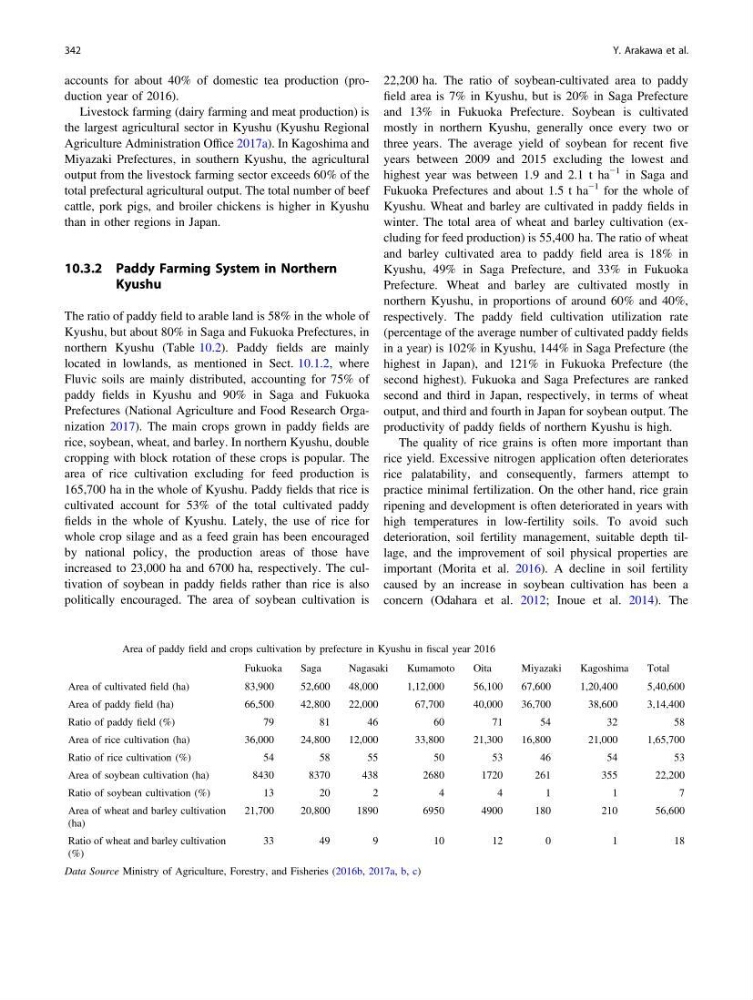
northern Kyushu (Table 10.2). Paddy fields are mainly
located in lowlands, as mentioned in Sect. 10.1.2, where
Fluvic soils are mainly distributed, accounting for 75% of
paddy fields in Kyushu and 90% in Saga and Fukuoka
Prefectures (National Agriculture and Food Research Organization 2017). The main crops grown in paddy fields are
rice, soybean, wheat, and barley. In northern Kyushu, double
cropping with block rotation of these crops is popular. The
area of rice cultivation excluding for feed production is
165,700 ha in the whole of Kyushu. Paddy fields that rice is
cultivated account for 53% of the total cultivated paddy
fields in the whole of Kyushu. Lately, the use of rice for
whole crop silage and as a feed grain has been encouraged
by national policy, the production areas of those have
increased to 23,000 ha and 6700 ha, respectively. The cultivation of soybean in paddy fields rather than rice is also
politically encouraged. The area of soybean cultivation is
22,200 ha. The ratio of soybean-cultivated area to paddy
field area is 7% in Kyushu, but is 20% in Saga Prefecture
and 13% in Fukuoka Prefecture. Soybean is cultivated
mostly in northern Kyushu, generally once every two or
three years. The average yield of soybean for recent five
years between 2009 and 2015 excluding the lowest and
highest year was between 1.9 and 2.1 t ha
−1 in Saga and
Fukuoka Prefectures and about 1.5 t ha
−1 for the whole of
Kyushu. Wheat and barley are cultivated in paddy fields in
winter. The total area of wheat and barley cultivation (excluding for feed production) is 55,400 ha. The ratio of wheat
and barley cultivated area to paddy field area is 18% in
Kyushu, 49% in Saga Prefecture, and 33% in Fukuoka
Prefecture. Wheat and barley are cultivated mostly in
northern Kyushu, in proportions of around 60% and 40%,
respectively. The paddy field cultivation utilization rate
(percentage of the average number of cultivated paddy fields
in a year) is 102% in Kyushu, 144% in Saga Prefecture (the
highest in Japan), and 121% in Fukuoka Prefecture (the
second highest). Fukuoka and Saga Prefectures are ranked
second and third in Japan, respectively, in terms of wheat
output, and third and fourth in Japan for soybean output. The
productivity of paddy fields of northern Kyushu is high.
The quality of rice grains is often more important than
rice yield. Excessive nitrogen application often deteriorates
rice palatability, and consequently, farmers attempt to
practice minimal fertilization. On the other hand, rice grain
ripening and development is often deteriorated in years with
high temperatures in low-fertility soils. To avoid such
deterioration, soil fertility management, suitable depth tillage, and the improvement of soil physical properties are
important (Morita et al. 2016). A decline in soil fertility
caused by an increase in soybean cultivation has been a
concern (Odahara et al. 2012; Inoue et al. 2014). The
Table 10.2 Area of paddy field and crops cultivation by prefecture in Kyushu in fiscal year 2016
Fukuoka
Saga
Nagasaki
Kumamoto
Oita
Miyazaki
Kagoshima
Total
Area of cultivated field (ha)
83,900
52,600
48,000
1,12,000
56,100
67,600
1,20,400
5,40,600
Area of paddy field (ha)
66,500
42,800
22,000
67,700
40,000
36,700
38,600
3,14,400
Ratio of paddy field (%)
79
81
46
60
71
54
32
58
Area of rice cultivation (ha)
36,000
24,800
12,000
33,800
21,300
16,800
21,000
1,65,700
Ratio of rice cultivation (%)
54
58
55
50
53
46
54
53
Area of soybean cultivation (ha)
8430
8370
438
2680
1720
261
355
22,200
Ratio of soybean cultivation (%)
13
20
2
4
4
1
1
7
Area of wheat and barley cultivation
(ha)
21,700
20,800
1890
6950
4900
180
210
56,600
Ratio of wheat and barley cultivation
(%)
33
49
9
10
12
0
1
18
Data Source Ministry of Agriculture, Forestry, and Fisheries (2016b, 2017a, b, c)
342
Y. Arakawa et al.
Livestock farming (dairy farming and meat production) is
the largest agricultural sector in Kyushu (Kyushu Regional
Agriculture Administration Office 2017a). In Kagoshima and
Miyazaki Prefectures, in southern Kyushu, the agricultural
output from the livestock farming sector exceeds 60% of the
total prefectural agricultural output. The total number of beef
cattle, pork pigs, and broiler chickens is higher in Kyushu
than in other regions in Japan.
10.3.2 Paddy Farming System in Northern
Kyushu
The ratio of paddy field to arable land is 58% in the whole of
Kyushu, but about 80% in Saga and Fukuoka Prefectures, in
northern Kyushu (Table 10.2). Paddy fields are mainly
located in lowlands, as mentioned in Sect. 10.1.2, where
Fluvic soils are mainly distributed, accounting for 75% of
paddy fields in Kyushu and 90% in Saga and Fukuoka
Prefectures (National Agriculture and Food Research Organization 2017). The main crops grown in paddy fields are
rice, soybean, wheat, and barley. In northern Kyushu, double
cropping with block rotation of these crops is popular. The
area of rice cultivation excluding for feed production is
165,700 ha in the whole of Kyushu. Paddy fields that rice is
cultivated account for 53% of the total cultivated paddy
fields in the whole of Kyushu. Lately, the use of rice for
whole crop silage and as a feed grain has been encouraged
by national policy, the production areas of those have
increased to 23,000 ha and 6700 ha, respectively. The cultivation of soybean in paddy fields rather than rice is also
politically encouraged. The area of soybean cultivation is
22,200 ha. The ratio of soybean-cultivated area to paddy
field area is 7% in Kyushu, but is 20% in Saga Prefecture
and 13% in Fukuoka Prefecture. Soybean is cultivated
mostly in northern Kyushu, generally once every two or
three years. The average yield of soybean for recent five
years between 2009 and 2015 excluding the lowest and
highest year was between 1.9 and 2.1 t ha
−1 in Saga and
Fukuoka Prefectures and about 1.5 t ha
−1 for the whole of
Kyushu. Wheat and barley are cultivated in paddy fields in
winter. The total area of wheat and barley cultivation (excluding for feed production) is 55,400 ha. The ratio of wheat
and barley cultivated area to paddy field area is 18% in
Kyushu, 49% in Saga Prefecture, and 33% in Fukuoka
Prefecture. Wheat and barley are cultivated mostly in
northern Kyushu, in proportions of around 60% and 40%,
respectively. The paddy field cultivation utilization rate
(percentage of the average number of cultivated paddy fields
in a year) is 102% in Kyushu, 144% in Saga Prefecture (the
highest in Japan), and 121% in Fukuoka Prefecture (the
second highest). Fukuoka and Saga Prefectures are ranked
second and third in Japan, respectively, in terms of wheat
output, and third and fourth in Japan for soybean output. The
productivity of paddy fields of northern Kyushu is high.
The quality of rice grains is often more important than
rice yield. Excessive nitrogen application often deteriorates
rice palatability, and consequently, farmers attempt to
practice minimal fertilization. On the other hand, rice grain
ripening and development is often deteriorated in years with
high temperatures in low-fertility soils. To avoid such
deterioration, soil fertility management, suitable depth tillage, and the improvement of soil physical properties are
important (Morita et al. 2016). A decline in soil fertility
caused by an increase in soybean cultivation has been a
concern (Odahara et al. 2012; Inoue et al. 2014). The
Table 10.2 Area of paddy field and crops cultivation by prefecture in Kyushu in fiscal year 2016
Fukuoka
Saga
Nagasaki
Kumamoto
Oita
Miyazaki
Kagoshima
Total
Area of cultivated field (ha)
83,900
52,600
48,000
1,12,000
56,100
67,600
1,20,400
5,40,600
Area of paddy field (ha)
66,500
42,800
22,000
67,700
40,000
36,700
38,600
3,14,400
Ratio of paddy field (%)
79
81
46
60
71
54
32
58
Area of rice cultivation (ha)
36,000
24,800
12,000
33,800
21,300
16,800
21,000
1,65,700
Ratio of rice cultivation (%)
54
58
55
50
53
46
54
53
Area of soybean cultivation (ha)
8430
8370
438
2680
1720
261
355
22,200
Ratio of soybean cultivation (%)
13
20
2
4
4
1
1
7
Area of wheat and barley cultivation
(ha)
21,700
20,800
1890
6950
4900
180
210
56,600
Ratio of wheat and barley cultivation
(%)
33
49
9
10
12
0
1
18
Data Source Ministry of Agriculture, Forestry, and Fisheries (2016b, 2017a, b, c)
342
Y. Arakawa et al.