

rotation system (rice, wheat, soybean) in the paddy–upland
rotation fields.
(2) Trend of livestock manure
In Japan, about 79 Tg of livestock excreta is generated per
year, the nitrogen content of which is almost the same as the
total annual nitrogen input from the application of chemical
fertilizer. It is estimated that about 160 kg ha
−1 of the
nitrogen generated from livestock excreta is equally input
into Japanese agricultural land. However, it is estimated that
the input of nitrogen exceeded 300 kg ha
−1 in some major
livestock prefectures. In Mie Prefecture, the nitrogen input
from livestock excreta exceeded 300 kg ha
−1 in some
counties. These counties have difficulty in finding alternative
fields for avoiding excess nitrogen input from livestock
excreta, and there is growing concern about related environmental problems such as nitrate pollution in groundwater.
With the price of chemical fertilizer increasing, livestock
excreta is again attracting attention as a low-price precursor
for the production of fertilizer. However, there are some
barriers to the application of livestock manure, for example,
the need for specific equipment for field application, the
difficulty of manure transportation, and the difficulty of
quality control for the livestock manure.
(3) Pelleting of livestock manure
The Mie Prefecture Agricultural Research Institute has
developed the pelleting of livestock manure using extrusion
molding in order to improve the operation of machine
spraying and the properties of manure transportation and to
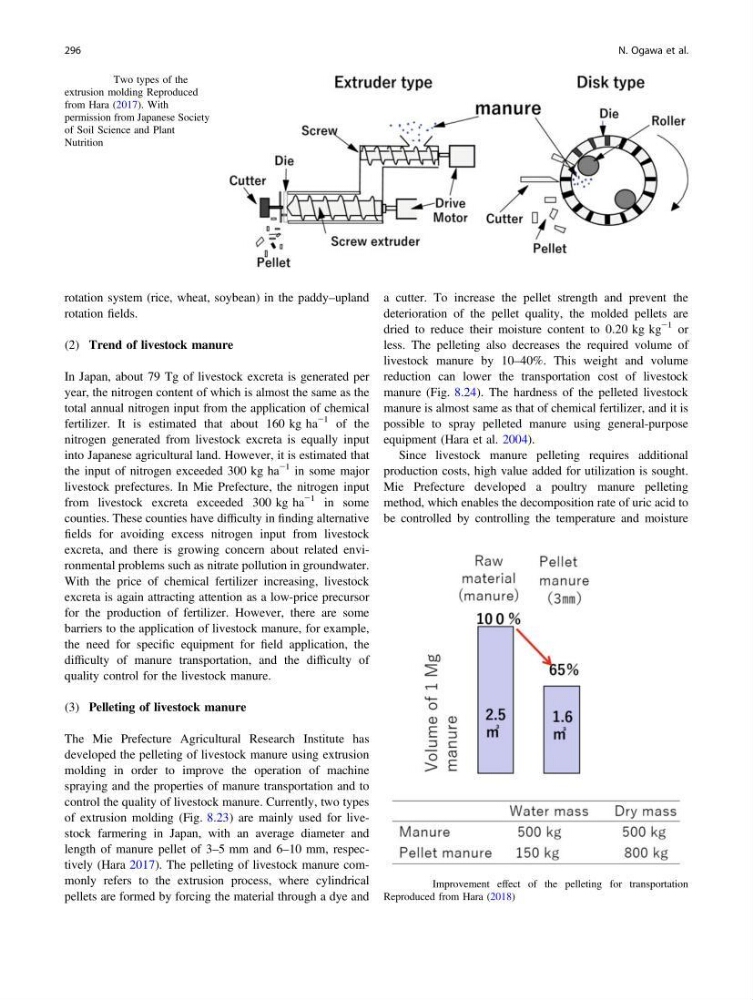
control the quality of livestock manure. Currently, two types
of extrusion molding (Fig. 8.23) are mainly used for livestock farmering in Japan, with an average diameter and
length of manure pellet of 3–5 mm and 6–10 mm, respectively (Hara 2017). The pelleting of livestock manure commonly refers to the extrusion process, where cylindrical
pellets are formed by forcing the material through a dye and
a cutter. To increase the pellet strength and prevent the
deterioration of the pellet quality, the molded pellets are
dried to reduce their moisture content to 0.20 kg kg
−1 or
less. The pelleting also decreases the required volume of
livestock manure by 10–40%. This weight and volume
reduction can lower the transportation cost of livestock
manure (Fig. 8.24). The hardness of the pelleted livestock
manure is almost same as that of chemical fertilizer, and it is
possible to spray pelleted manure using general-purpose
equipment (Hara et al. 2004).
Since livestock manure pelleting requires additional
production costs, high value added for utilization is sought.
Mie Prefecture developed a poultry manure pelleting
method, which enables the decomposition rate of uric acid to
be controlled by controlling the temperature and moisture
Fig. 8.23 Two types of the
extrusion molding Reproduced
from Hara (2017). With
permission from Japanese Society
of Soil Science and Plant
Nutrition
Fig. 8.24 Improvement effect of the pelleting for transportation
Reproduced from Hara (2018)
296
N. Ogawa et al.
rotation fields.
(2) Trend of livestock manure
In Japan, about 79 Tg of livestock excreta is generated per
year, the nitrogen content of which is almost the same as the
total annual nitrogen input from the application of chemical
fertilizer. It is estimated that about 160 kg ha
−1 of the
nitrogen generated from livestock excreta is equally input
into Japanese agricultural land. However, it is estimated that
the input of nitrogen exceeded 300 kg ha
−1 in some major
livestock prefectures. In Mie Prefecture, the nitrogen input
from livestock excreta exceeded 300 kg ha
−1 in some
counties. These counties have difficulty in finding alternative
fields for avoiding excess nitrogen input from livestock
excreta, and there is growing concern about related environmental problems such as nitrate pollution in groundwater.
With the price of chemical fertilizer increasing, livestock
excreta is again attracting attention as a low-price precursor
for the production of fertilizer. However, there are some
barriers to the application of livestock manure, for example,
the need for specific equipment for field application, the
difficulty of manure transportation, and the difficulty of
quality control for the livestock manure.
(3) Pelleting of livestock manure
The Mie Prefecture Agricultural Research Institute has
developed the pelleting of livestock manure using extrusion
molding in order to improve the operation of machine
spraying and the properties of manure transportation and to
control the quality of livestock manure. Currently, two types
of extrusion molding (Fig. 8.23) are mainly used for livestock farmering in Japan, with an average diameter and
length of manure pellet of 3–5 mm and 6–10 mm, respectively (Hara 2017). The pelleting of livestock manure commonly refers to the extrusion process, where cylindrical
pellets are formed by forcing the material through a dye and
a cutter. To increase the pellet strength and prevent the
deterioration of the pellet quality, the molded pellets are
dried to reduce their moisture content to 0.20 kg kg
−1 or
less. The pelleting also decreases the required volume of
livestock manure by 10–40%. This weight and volume
reduction can lower the transportation cost of livestock
manure (Fig. 8.24). The hardness of the pelleted livestock
manure is almost same as that of chemical fertilizer, and it is
possible to spray pelleted manure using general-purpose
equipment (Hara et al. 2004).
Since livestock manure pelleting requires additional
production costs, high value added for utilization is sought.
Mie Prefecture developed a poultry manure pelleting
method, which enables the decomposition rate of uric acid to
be controlled by controlling the temperature and moisture
Fig. 8.23 Two types of the
extrusion molding Reproduced
from Hara (2017). With
permission from Japanese Society
of Soil Science and Plant
Nutrition
Fig. 8.24 Improvement effect of the pelleting for transportation
Reproduced from Hara (2018)
296
N. Ogawa et al.