

7.2 Agricultural Features and Soil Properties
7.2.1 Production Status of Major Vegetables
and Livestock Products
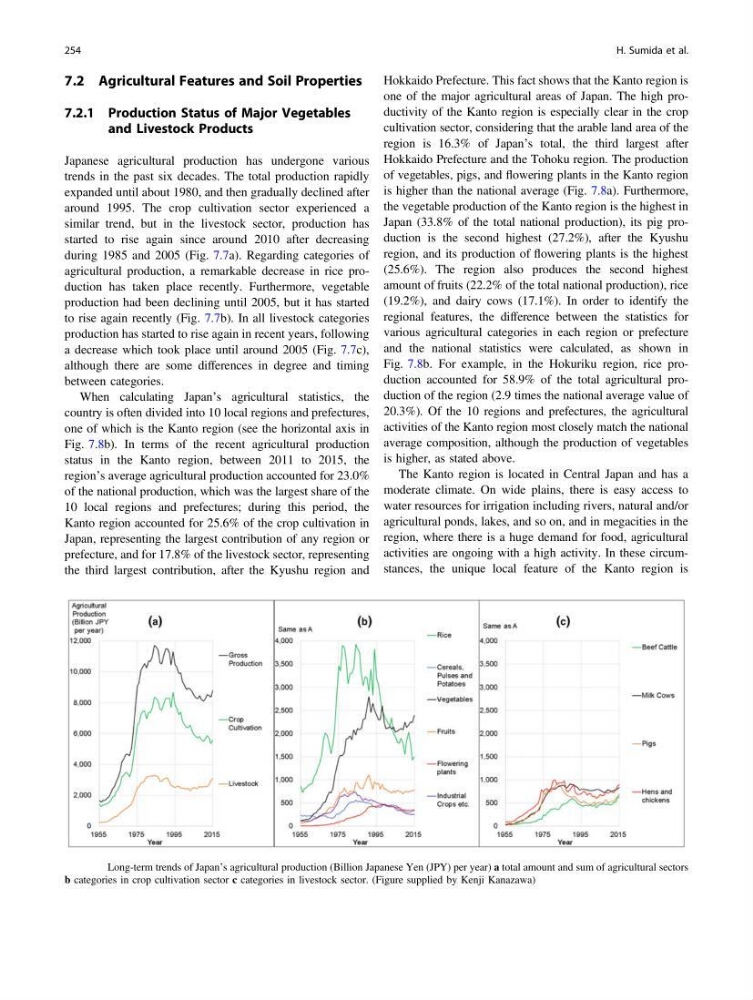
Japanese agricultural production has undergone various
trends in the past six decades. The total production rapidly
expanded until about 1980, and then gradually declined after
around 1995. The crop cultivation sector experienced a
similar trend, but in the livestock sector, production has
started to rise again since around 2010 after decreasing
during 1985 and 2005 (Fig. 7.7a). Regarding categories of
agricultural production, a remarkable decrease in rice production has taken place recently. Furthermore, vegetable
production had been declining until 2005, but it has started
to rise again recently (Fig. 7.7b). In all livestock categories
production has started to rise again in recent years, following
a decrease which took place until around 2005 (Fig. 7.7c),
although there are some differences in degree and timing
between categories.
When calculating Japan’s agricultural statistics, the
country is often divided into 10 local regions and prefectures,
one of which is the Kanto region (see the horizontal axis in
Fig. 7.8b). In terms of the recent agricultural production
status in the Kanto region, between 2011 to 2015, the
region’s average agricultural production accounted for 23.0%
of the national production, which was the largest share of the
10 local regions and prefectures; during this period, the
Kanto region accounted for 25.6% of the crop cultivation in
Japan, representing the largest contribution of any region or
prefecture, and for 17.8% of the livestock sector, representing
the third largest contribution, after the Kyushu region and
Hokkaido Prefecture. This fact shows that the Kanto region is
one of the major agricultural areas of Japan. The high productivity of the Kanto region is especially clear in the crop
cultivation sector, considering that the arable land area of the
region is 16.3% of Japan’s total, the third largest after
Hokkaido Prefecture and the Tohoku region. The production
of vegetables, pigs, and flowering plants in the Kanto region
is higher than the national average (Fig. 7.8a). Furthermore,
the vegetable production of the Kanto region is the highest in
Japan (33.8% of the total national production), its pig production is the second highest (27.2%), after the Kyushu
region, and its production of flowering plants is the highest
(25.6%). The region also produces the second highest
amount of fruits (22.2% of the total national production), rice
(19.2%), and dairy cows (17.1%). In order to identify the
regional features, the difference between the statistics for
various agricultural categories in each region or prefecture
and the national statistics were calculated, as shown in
Fig. 7.8b. For example, in the Hokuriku region, rice production accounted for 58.9% of the total agricultural production of the region (2.9 times the national average value of
20.3%). Of the 10 regions and prefectures, the agricultural
activities of the Kanto region most closely match the national
average composition, although the production of vegetables
is higher, as stated above.
The Kanto region is located in Central Japan and has a
moderate climate. On wide plains, there is easy access to
water resources for irrigation including rivers, natural and/or
agricultural ponds, lakes, and so on, and in megacities in the
region, where there is a huge demand for food, agricultural
activities are ongoing with a high activity. In these circumstances, the unique local feature of the Kanto region is
Fig. 7.7 Long-term trends of Japan’s agricultural production (Billion Japanese Yen (JPY) per year) a total amount and sum of agricultural sectors
b categories in crop cultivation sector c categories in livestock sector. (Figure supplied by Kenji Kanazawa)
254
H. Sumida et al.
7.2.1 Production Status of Major Vegetables
and Livestock Products
Japanese agricultural production has undergone various
trends in the past six decades. The total production rapidly
expanded until about 1980, and then gradually declined after
around 1995. The crop cultivation sector experienced a
similar trend, but in the livestock sector, production has
started to rise again since around 2010 after decreasing
during 1985 and 2005 (Fig. 7.7a). Regarding categories of
agricultural production, a remarkable decrease in rice production has taken place recently. Furthermore, vegetable
production had been declining until 2005, but it has started
to rise again recently (Fig. 7.7b). In all livestock categories
production has started to rise again in recent years, following
a decrease which took place until around 2005 (Fig. 7.7c),
although there are some differences in degree and timing
between categories.
When calculating Japan’s agricultural statistics, the
country is often divided into 10 local regions and prefectures,
one of which is the Kanto region (see the horizontal axis in
Fig. 7.8b). In terms of the recent agricultural production
status in the Kanto region, between 2011 to 2015, the
region’s average agricultural production accounted for 23.0%
of the national production, which was the largest share of the
10 local regions and prefectures; during this period, the
Kanto region accounted for 25.6% of the crop cultivation in
Japan, representing the largest contribution of any region or
prefecture, and for 17.8% of the livestock sector, representing
the third largest contribution, after the Kyushu region and
Hokkaido Prefecture. This fact shows that the Kanto region is
one of the major agricultural areas of Japan. The high productivity of the Kanto region is especially clear in the crop
cultivation sector, considering that the arable land area of the
region is 16.3% of Japan’s total, the third largest after
Hokkaido Prefecture and the Tohoku region. The production
of vegetables, pigs, and flowering plants in the Kanto region
is higher than the national average (Fig. 7.8a). Furthermore,
the vegetable production of the Kanto region is the highest in
Japan (33.8% of the total national production), its pig production is the second highest (27.2%), after the Kyushu
region, and its production of flowering plants is the highest
(25.6%). The region also produces the second highest
amount of fruits (22.2% of the total national production), rice
(19.2%), and dairy cows (17.1%). In order to identify the
regional features, the difference between the statistics for
various agricultural categories in each region or prefecture
and the national statistics were calculated, as shown in
Fig. 7.8b. For example, in the Hokuriku region, rice production accounted for 58.9% of the total agricultural production of the region (2.9 times the national average value of
20.3%). Of the 10 regions and prefectures, the agricultural
activities of the Kanto region most closely match the national
average composition, although the production of vegetables
is higher, as stated above.
The Kanto region is located in Central Japan and has a
moderate climate. On wide plains, there is easy access to
water resources for irrigation including rivers, natural and/or
agricultural ponds, lakes, and so on, and in megacities in the
region, where there is a huge demand for food, agricultural
activities are ongoing with a high activity. In these circumstances, the unique local feature of the Kanto region is
Fig. 7.7 Long-term trends of Japan’s agricultural production (Billion Japanese Yen (JPY) per year) a total amount and sum of agricultural sectors
b categories in crop cultivation sector c categories in livestock sector. (Figure supplied by Kenji Kanazawa)
254
H. Sumida et al.