

There was no significant difference in the number of panicles
per plant and in brown rice yield among the different
treatments.
In the Murayama area of Yamagata Prefecture, the crop
index values relative to the average yield (crop index = 100)
for the trials from 2011, 2012, and 2013 were 102, 101, and
105, respectively. For this reason, although the number of
tillers increased in response to fall-shallow tillage, this was
not reflected in an increase in the number of panicles per
plant or the brown rice yield in the control plots (rice
application and spring tillage), indicating that stem density
in the control plots was already optimal for maximum yield.
However, stressful weather conditions, such as a cold summer, could result in sub-optimal tillers populations in the
control treatment. Furthermore, the increased tillers number achieved following shallow fall tillage could result in
higher and more stable grain yields as a consequence of
avoiding the growth suppression associated with spring
tillage.
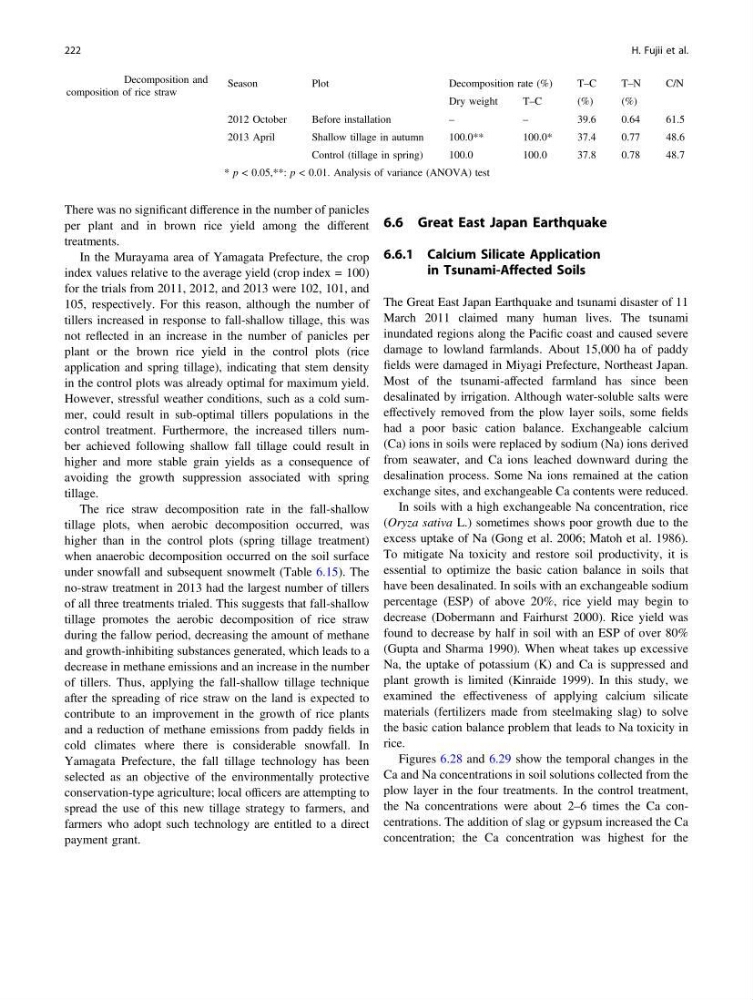
The rice straw decomposition rate in the fall-shallow
tillage plots, when aerobic decomposition occurred, was
higher than in the control plots (spring tillage treatment)
when anaerobic decomposition occurred on the soil surface
under snowfall and subsequent snowmelt (Table 6.15). The
no-straw treatment in 2013 had the largest number of tillers
of all three treatments trialed. This suggests that fall-shallow
tillage promotes the aerobic decomposition of rice straw
during the fallow period, decreasing the amount of methane
and growth-inhibiting substances generated, which leads to a
decrease in methane emissions and an increase in the number
of tillers. Thus, applying the fall-shallow tillage technique
after the spreading of rice straw on the land is expected to
contribute to an improvement in the growth of rice plants
and a reduction of methane emissions from paddy fields in
cold climates where there is considerable snowfall. In
Yamagata Prefecture, the fall tillage technology has been
selected as an objective of the environmentally protective
conservation-type agriculture; local officers are attempting to
spread the use of this new tillage strategy to farmers, and
farmers who adopt such technology are entitled to a direct
payment grant.
6.6 Great East Japan Earthquake
6.6.1 Calcium Silicate Application
in Tsunami-Affected Soils
The Great East Japan Earthquake and tsunami disaster of 11
March 2011 claimed many human lives. The tsunami
inundated regions along the Pacific coast and caused severe
damage to lowland farmlands. About 15,000 ha of paddy
fields were damaged in Miyagi Prefecture, Northeast Japan.
Most of the tsunami-affected farmland has since been
desalinated by irrigation. Although water-soluble salts were
effectively removed from the plow layer soils, some fields
had a poor basic cation balance. Exchangeable calcium
(Ca) ions in soils were replaced by sodium (Na) ions derived
from seawater, and Ca ions leached downward during the
desalination process. Some Na ions remained at the cation
exchange sites, and exchangeable Ca contents were reduced.
In soils with a high exchangeable Na concentration, rice
(Oryza sativa L.) sometimes shows poor growth due to the
excess uptake of Na (Gong et al. 2006; Matoh et al. 1986).
To mitigate Na toxicity and restore soil productivity, it is
essential to optimize the basic cation balance in soils that
have been desalinated. In soils with an exchangeable sodium
percentage (ESP) of above 20%, rice yield may begin to
decrease (Dobermann and Fairhurst 2000). Rice yield was
found to decrease by half in soil with an ESP of over 80%
(Gupta and Sharma 1990). When wheat takes up excessive
Na, the uptake of potassium (K) and Ca is suppressed and
plant growth is limited (Kinraide 1999). In this study, we
examined the effectiveness of applying calcium silicate
materials (fertilizers made from steelmaking slag) to solve
the basic cation balance problem that leads to Na toxicity in
rice.
Figures 6.28 and 6.29 show the temporal changes in the
Ca and Na concentrations in soil solutions collected from the
plow layer in the four treatments. In the control treatment,
the Na concentrations were about 2–6 times the Ca concentrations. The addition of slag or gypsum increased the Ca
concentration; the Ca concentration was highest for the
Table 6.15 Decomposition and
composition of rice straw
Season
Plot
Decomposition rate (%)
T–C
T–N
C/N
Dry weight
T–C
(%)
(%)
2012 October
Before installation
–
–
39.6
0.64
61.5
2013 April
Shallow tillage in autumn
100.0**
100.0*
37.4
0.77
48.6
Control (tillage in spring)
100.0
100.0
37.8
0.78
48.7
* p < 0.05,**: p < 0.01. Analysis of variance (ANOVA) test
222
H. Fujii et al.
per plant and in brown rice yield among the different
treatments.
In the Murayama area of Yamagata Prefecture, the crop
index values relative to the average yield (crop index = 100)
for the trials from 2011, 2012, and 2013 were 102, 101, and
105, respectively. For this reason, although the number of
tillers increased in response to fall-shallow tillage, this was
not reflected in an increase in the number of panicles per
plant or the brown rice yield in the control plots (rice
application and spring tillage), indicating that stem density
in the control plots was already optimal for maximum yield.
However, stressful weather conditions, such as a cold summer, could result in sub-optimal tillers populations in the
control treatment. Furthermore, the increased tillers number achieved following shallow fall tillage could result in
higher and more stable grain yields as a consequence of
avoiding the growth suppression associated with spring
tillage.
The rice straw decomposition rate in the fall-shallow
tillage plots, when aerobic decomposition occurred, was
higher than in the control plots (spring tillage treatment)
when anaerobic decomposition occurred on the soil surface
under snowfall and subsequent snowmelt (Table 6.15). The
no-straw treatment in 2013 had the largest number of tillers
of all three treatments trialed. This suggests that fall-shallow
tillage promotes the aerobic decomposition of rice straw
during the fallow period, decreasing the amount of methane
and growth-inhibiting substances generated, which leads to a
decrease in methane emissions and an increase in the number
of tillers. Thus, applying the fall-shallow tillage technique
after the spreading of rice straw on the land is expected to
contribute to an improvement in the growth of rice plants
and a reduction of methane emissions from paddy fields in
cold climates where there is considerable snowfall. In
Yamagata Prefecture, the fall tillage technology has been
selected as an objective of the environmentally protective
conservation-type agriculture; local officers are attempting to
spread the use of this new tillage strategy to farmers, and
farmers who adopt such technology are entitled to a direct
payment grant.
6.6 Great East Japan Earthquake
6.6.1 Calcium Silicate Application
in Tsunami-Affected Soils
The Great East Japan Earthquake and tsunami disaster of 11
March 2011 claimed many human lives. The tsunami
inundated regions along the Pacific coast and caused severe
damage to lowland farmlands. About 15,000 ha of paddy
fields were damaged in Miyagi Prefecture, Northeast Japan.
Most of the tsunami-affected farmland has since been
desalinated by irrigation. Although water-soluble salts were
effectively removed from the plow layer soils, some fields
had a poor basic cation balance. Exchangeable calcium
(Ca) ions in soils were replaced by sodium (Na) ions derived
from seawater, and Ca ions leached downward during the
desalination process. Some Na ions remained at the cation
exchange sites, and exchangeable Ca contents were reduced.
In soils with a high exchangeable Na concentration, rice
(Oryza sativa L.) sometimes shows poor growth due to the
excess uptake of Na (Gong et al. 2006; Matoh et al. 1986).
To mitigate Na toxicity and restore soil productivity, it is
essential to optimize the basic cation balance in soils that
have been desalinated. In soils with an exchangeable sodium
percentage (ESP) of above 20%, rice yield may begin to
decrease (Dobermann and Fairhurst 2000). Rice yield was
found to decrease by half in soil with an ESP of over 80%
(Gupta and Sharma 1990). When wheat takes up excessive
Na, the uptake of potassium (K) and Ca is suppressed and
plant growth is limited (Kinraide 1999). In this study, we
examined the effectiveness of applying calcium silicate
materials (fertilizers made from steelmaking slag) to solve
the basic cation balance problem that leads to Na toxicity in
rice.
Figures 6.28 and 6.29 show the temporal changes in the
Ca and Na concentrations in soil solutions collected from the
plow layer in the four treatments. In the control treatment,
the Na concentrations were about 2–6 times the Ca concentrations. The addition of slag or gypsum increased the Ca
concentration; the Ca concentration was highest for the
Table 6.15 Decomposition and
composition of rice straw
Season
Plot
Decomposition rate (%)
T–C
T–N
C/N
Dry weight
T–C
(%)
(%)
2012 October
Before installation
–
–
39.6
0.64
61.5
2013 April
Shallow tillage in autumn
100.0**
100.0*
37.4
0.77
48.6
Control (tillage in spring)
100.0
100.0
37.8
0.78
48.7
* p < 0.05,**: p < 0.01. Analysis of variance (ANOVA) test
222
H. Fujii et al.