

climatic factors, have helped to make a major producer of
good-tasting watermelons in Kitamurayama area (Kikuchi
2009).
There are two main methods of watermelon cultivation in
Kitamurayama: “row cover/vine repositioning” and “row
cover/cover repositioning”. The vines are planted in late
April and in May and are harvested in late July and in
August.
Nevertheless, in both methods, it is important that the soil
is kept warm after planting out and that the vines are pollinated when their flowers open. Plastic mulch and row
covers perform an important role in cultivation by preserving
soil heat and protecting the vines from rainfall during
flowering. In the Kitamurayama area, snow covers the
ground for around 120 days of the year and can reach 1–2 m
in depth. Since the snow does not melt until April, there may
not be enough time in spring to complete all the work
required for watermelon cultivation. Moreover, because the
soil temperature in spring does not increase once the ground
is tilled and covered with plastic mulch, there is no guarantee
that the planted vines will achieve the necessary initial
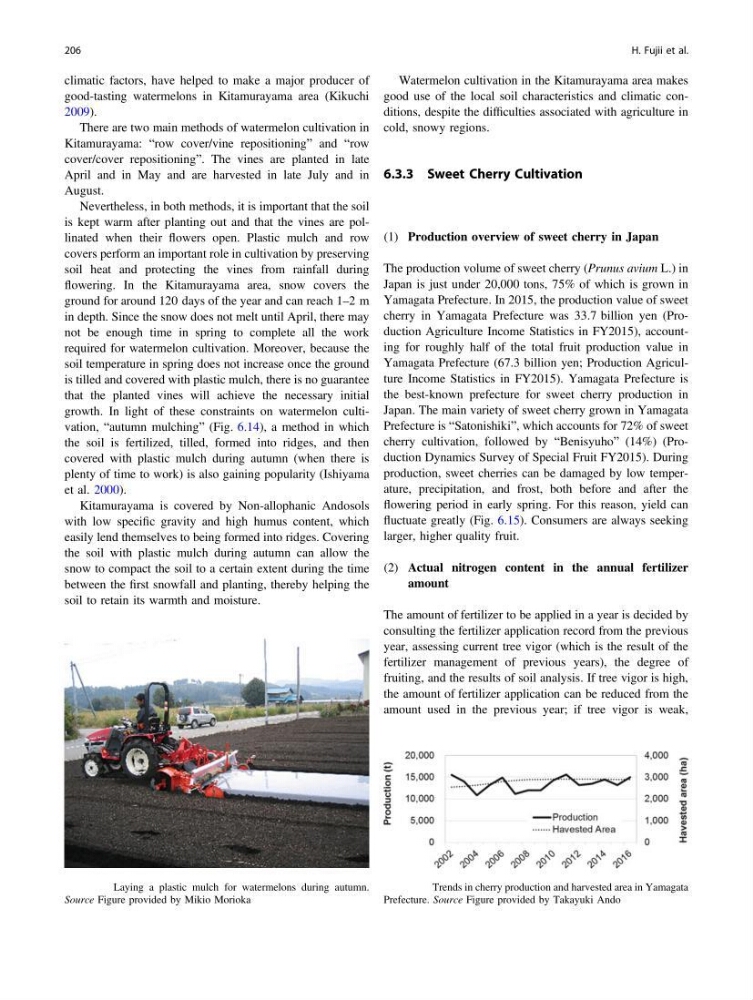
growth. In light of these constraints on watermelon cultivation, “autumn mulching” (Fig. 6.14), a method in which
the soil is fertilized, tilled, formed into ridges, and then
covered with plastic mulch during autumn (when there is
plenty of time to work) is also gaining popularity (Ishiyama
et al. 2000).
Kitamurayama is covered by Non-allophanic Andosols
with low specific gravity and high humus content, which
easily lend themselves to being formed into ridges. Covering
the soil with plastic mulch during autumn can allow the
snow to compact the soil to a certain extent during the time
between the first snowfall and planting, thereby helping the
soil to retain its warmth and moisture.
Watermelon cultivation in the Kitamurayama area makes
good use of the local soil characteristics and climatic conditions, despite the difficulties associated with agriculture in
cold, snowy regions.
6.3.3 Sweet Cherry Cultivation
(1) Production overview of sweet cherry in Japan
The production volume of sweet cherry (Prunus avium L.) in
Japan is just under 20,000 tons, 75% of which is grown in
Yamagata Prefecture. In 2015, the production value of sweet
cherry in Yamagata Prefecture was 33.7 billion yen (Production Agriculture Income Statistics in FY2015), accounting for roughly half of the total fruit production value in
Yamagata Prefecture (67.3 billion yen; Production Agriculture Income Statistics in FY2015). Yamagata Prefecture is
the best-known prefecture for sweet cherry production in
Japan. The main variety of sweet cherry grown in Yamagata
Prefecture is “Satonishiki”, which accounts for 72% of sweet
cherry cultivation, followed by “Benisyuho” (14%) (Production Dynamics Survey of Special Fruit FY2015). During
production, sweet cherries can be damaged by low temperature, precipitation, and frost, both before and after the
flowering period in early spring. For this reason, yield can
fluctuate greatly (Fig. 6.15). Consumers are always seeking
larger, higher quality fruit.
(2) Actual nitrogen content in the annual fertilizer
amount
The amount of fertilizer to be applied in a year is decided by
consulting the fertilizer application record from the previous
year, assessing current tree vigor (which is the result of the
fertilizer management of previous years), the degree of
fruiting, and the results of soil analysis. If tree vigor is high,
the amount of fertilizer application can be reduced from the
amount used in the previous year; if tree vigor is weak,
Fig. 6.14 Laying a plastic mulch for watermelons during autumn.
Source Figure provided by Mikio Morioka
Fig. 6.15 Trends in cherry production and harvested area in Yamagata
Prefecture. Source Figure provided by Takayuki Ando
206
H. Fujii et al.
good-tasting watermelons in Kitamurayama area (Kikuchi
2009).
There are two main methods of watermelon cultivation in
Kitamurayama: “row cover/vine repositioning” and “row
cover/cover repositioning”. The vines are planted in late
April and in May and are harvested in late July and in
August.
Nevertheless, in both methods, it is important that the soil
is kept warm after planting out and that the vines are pollinated when their flowers open. Plastic mulch and row
covers perform an important role in cultivation by preserving
soil heat and protecting the vines from rainfall during
flowering. In the Kitamurayama area, snow covers the
ground for around 120 days of the year and can reach 1–2 m
in depth. Since the snow does not melt until April, there may
not be enough time in spring to complete all the work
required for watermelon cultivation. Moreover, because the
soil temperature in spring does not increase once the ground
is tilled and covered with plastic mulch, there is no guarantee
that the planted vines will achieve the necessary initial
growth. In light of these constraints on watermelon cultivation, “autumn mulching” (Fig. 6.14), a method in which
the soil is fertilized, tilled, formed into ridges, and then
covered with plastic mulch during autumn (when there is
plenty of time to work) is also gaining popularity (Ishiyama
et al. 2000).
Kitamurayama is covered by Non-allophanic Andosols
with low specific gravity and high humus content, which
easily lend themselves to being formed into ridges. Covering
the soil with plastic mulch during autumn can allow the
snow to compact the soil to a certain extent during the time
between the first snowfall and planting, thereby helping the
soil to retain its warmth and moisture.
Watermelon cultivation in the Kitamurayama area makes
good use of the local soil characteristics and climatic conditions, despite the difficulties associated with agriculture in
cold, snowy regions.
6.3.3 Sweet Cherry Cultivation
(1) Production overview of sweet cherry in Japan
The production volume of sweet cherry (Prunus avium L.) in
Japan is just under 20,000 tons, 75% of which is grown in
Yamagata Prefecture. In 2015, the production value of sweet
cherry in Yamagata Prefecture was 33.7 billion yen (Production Agriculture Income Statistics in FY2015), accounting for roughly half of the total fruit production value in
Yamagata Prefecture (67.3 billion yen; Production Agriculture Income Statistics in FY2015). Yamagata Prefecture is
the best-known prefecture for sweet cherry production in
Japan. The main variety of sweet cherry grown in Yamagata
Prefecture is “Satonishiki”, which accounts for 72% of sweet
cherry cultivation, followed by “Benisyuho” (14%) (Production Dynamics Survey of Special Fruit FY2015). During
production, sweet cherries can be damaged by low temperature, precipitation, and frost, both before and after the
flowering period in early spring. For this reason, yield can
fluctuate greatly (Fig. 6.15). Consumers are always seeking
larger, higher quality fruit.
(2) Actual nitrogen content in the annual fertilizer
amount
The amount of fertilizer to be applied in a year is decided by
consulting the fertilizer application record from the previous
year, assessing current tree vigor (which is the result of the
fertilizer management of previous years), the degree of
fruiting, and the results of soil analysis. If tree vigor is high,
the amount of fertilizer application can be reduced from the
amount used in the previous year; if tree vigor is weak,
Fig. 6.14 Laying a plastic mulch for watermelons during autumn.
Source Figure provided by Mikio Morioka
Fig. 6.15 Trends in cherry production and harvested area in Yamagata
Prefecture. Source Figure provided by Takayuki Ando
206
H. Fujii et al.