

retained in the topsoil, about 3 g m
−2 of which was absorbed
by the rice plants, and the remainder (about 6.5 g m
−2 ) was
lost. When the application rate of RSC was higher than
2 kg m
−2 , the rice yield plateaued (at a yield 20% higher
than that without RSC), and the N absorbed by the rice
plants decreased and then N loss increased. About 5 g m
−2
of the N from LMC applied at 17 g N m
−2 was retained in
the topsoil, about 6 g m
−2 of was absorbed by the rice
plants, and the remainder (about 6 g m
−2 ) was lost.
Temporal changes in the natural abundance of
15 N (as
expressed by d
15 N), the ratio of
15 N to
14 N in the soils and in
the RSC and LMC used in these long-term field experiments
were investigated by Nishida et al. (2007). The d
15 N values
of LMC composted prior to 1983 were around +6–7‰. The
values of LMC composted between 1984 and 1997 were
approximately +11–12‰ and those after 1998 were about
+17–18‰. The d
15 N values of RSC were almost constant
and averaged +5.5‰. The variation in the d
15 N values of
LMC reflects the degree of maturity of composting and the
type of livestock manure composted. The LMC produced
before 1983 was created by piling cattle manure on a concrete pad in the open air without turning and was not well
composted. However, the LMC produced from 1984 to 1997
was created by piling cattle manure in a compost house and
turning it, and was relatively better composted than LMC
produced before 1983. After 1998, LMC was produced
using three types of livestock manure, namely, cattle manure, swine manure, and poultry manure, which were stirred
with a rotary mixer under forced aeration in a compost
house. This composting method ensured sufficient maturity
of composting. The addition of swine and poultry manure
promoted ammonium volatilization which decreased the
amount of
14
N. The stability of the d
15 N values of RSC
might have resulted from the rice straw being collected from
nearby and the consistent composting method, which
involved piling and occasional turning in a compost house.
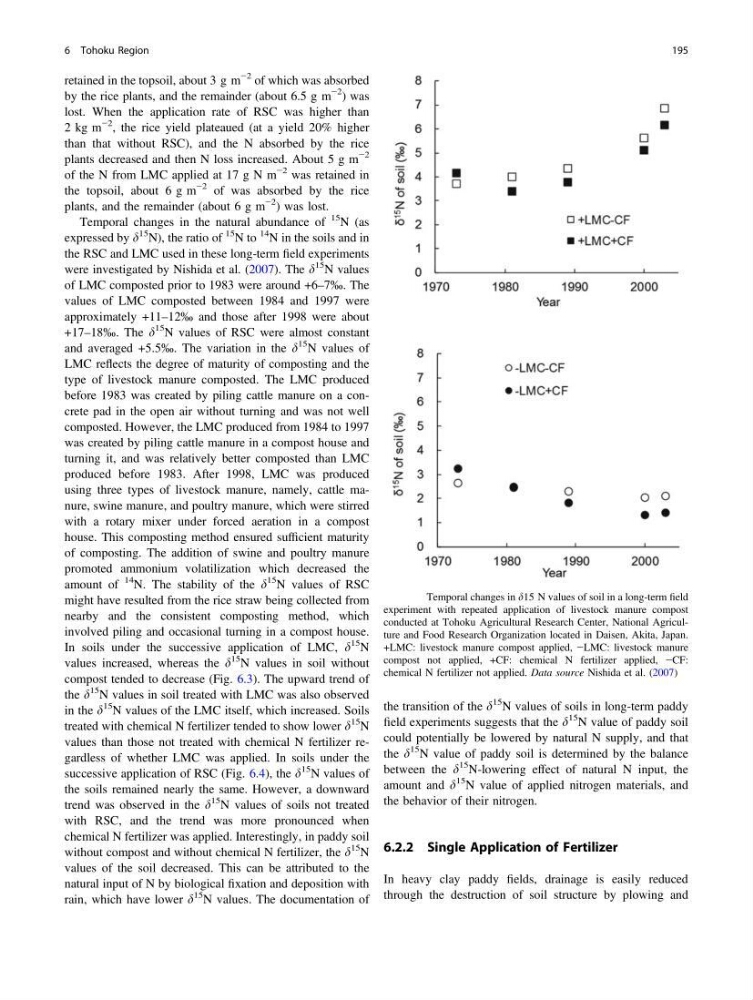
In soils under the successive application of LMC, d
15 N
values increased, whereas the d
15 N values in soil without
compost tended to decrease (Fig. 6.3). The upward trend of
the d
15 N values in soil treated with LMC was also observed
in the d
15 N values of the LMC itself, which increased. Soils
treated with chemical N fertilizer tended to show lower d
15
N
values than those not treated with chemical N fertilizer regardless of whether LMC was applied. In soils under the
successive application of RSC (Fig. 6.4), the d
15 N values of
the soils remained nearly the same. However, a downward
trend was observed in the d
15 N values of soils not treated
with RSC, and the trend was more pronounced when
chemical N fertilizer was applied. Interestingly, in paddy soil
without compost and without chemical N fertilizer, the d
15
N
values of the soil decreased. This can be attributed to the
natural input of N by biological fixation and deposition with
rain, which have lower d
15 N values. The documentation of
the transition of the d
15 N values of soils in long-term paddy
field experiments suggests that the d
15 N value of paddy soil
could potentially be lowered by natural N supply, and that
the d
15 N value of paddy soil is determined by the balance
between the d
15 N-lowering effect of natural N input, the
amount and d
15 N value of applied nitrogen materials, and
the behavior of their nitrogen.
6.2.2 Single Application of Fertilizer
In heavy clay paddy fields, drainage is easily reduced
through the destruction of soil structure by plowing and
Fig. 6.3 Temporal changes in d15 N values of soil in a long-term field
experiment with repeated application of livestock manure compost
conducted at Tohoku Agricultural Research Center, National Agriculture and Food Research Organization located in Daisen, Akita, Japan.
+LMC: livestock manure compost applied, −LMC: livestock manure
compost not applied, +CF: chemical N fertilizer applied, −CF:
chemical N fertilizer not applied. Data source Nishida et al. (2007)
6 Tohoku Region
195
−2 of which was absorbed
by the rice plants, and the remainder (about 6.5 g m
−2 ) was
lost. When the application rate of RSC was higher than
2 kg m
−2 , the rice yield plateaued (at a yield 20% higher
than that without RSC), and the N absorbed by the rice
plants decreased and then N loss increased. About 5 g m
−2
of the N from LMC applied at 17 g N m
−2 was retained in
the topsoil, about 6 g m
−2 of was absorbed by the rice
plants, and the remainder (about 6 g m
−2 ) was lost.
Temporal changes in the natural abundance of
15 N (as
expressed by d
15 N), the ratio of
15 N to
14 N in the soils and in
the RSC and LMC used in these long-term field experiments
were investigated by Nishida et al. (2007). The d
15 N values
of LMC composted prior to 1983 were around +6–7‰. The
values of LMC composted between 1984 and 1997 were
approximately +11–12‰ and those after 1998 were about
+17–18‰. The d
15 N values of RSC were almost constant
and averaged +5.5‰. The variation in the d
15 N values of
LMC reflects the degree of maturity of composting and the
type of livestock manure composted. The LMC produced
before 1983 was created by piling cattle manure on a concrete pad in the open air without turning and was not well
composted. However, the LMC produced from 1984 to 1997
was created by piling cattle manure in a compost house and
turning it, and was relatively better composted than LMC
produced before 1983. After 1998, LMC was produced
using three types of livestock manure, namely, cattle manure, swine manure, and poultry manure, which were stirred
with a rotary mixer under forced aeration in a compost
house. This composting method ensured sufficient maturity
of composting. The addition of swine and poultry manure
promoted ammonium volatilization which decreased the
amount of
14
N. The stability of the d
15 N values of RSC
might have resulted from the rice straw being collected from
nearby and the consistent composting method, which
involved piling and occasional turning in a compost house.
In soils under the successive application of LMC, d
15 N
values increased, whereas the d
15 N values in soil without
compost tended to decrease (Fig. 6.3). The upward trend of
the d
15 N values in soil treated with LMC was also observed
in the d
15 N values of the LMC itself, which increased. Soils
treated with chemical N fertilizer tended to show lower d
15
N
values than those not treated with chemical N fertilizer regardless of whether LMC was applied. In soils under the
successive application of RSC (Fig. 6.4), the d
15 N values of
the soils remained nearly the same. However, a downward
trend was observed in the d
15 N values of soils not treated
with RSC, and the trend was more pronounced when
chemical N fertilizer was applied. Interestingly, in paddy soil
without compost and without chemical N fertilizer, the d
15
N
values of the soil decreased. This can be attributed to the
natural input of N by biological fixation and deposition with
rain, which have lower d
15 N values. The documentation of
the transition of the d
15 N values of soils in long-term paddy
field experiments suggests that the d
15 N value of paddy soil
could potentially be lowered by natural N supply, and that
the d
15 N value of paddy soil is determined by the balance
between the d
15 N-lowering effect of natural N input, the
amount and d
15 N value of applied nitrogen materials, and
the behavior of their nitrogen.
6.2.2 Single Application of Fertilizer
In heavy clay paddy fields, drainage is easily reduced
through the destruction of soil structure by plowing and
Fig. 6.3 Temporal changes in d15 N values of soil in a long-term field
experiment with repeated application of livestock manure compost
conducted at Tohoku Agricultural Research Center, National Agriculture and Food Research Organization located in Daisen, Akita, Japan.
+LMC: livestock manure compost applied, −LMC: livestock manure
compost not applied, +CF: chemical N fertilizer applied, −CF:
chemical N fertilizer not applied. Data source Nishida et al. (2007)
6 Tohoku Region
195