

(5) Following the land reclamation, the soil has become
highly consistent, with a plasticity index exceeding
100%. Since the soil’s water content is equal to the
liquid limit, it is rather fluid. Additionally, due to its
high clay content, the soil contracts and expands significantly through repeated drying and wetting cycles.
A soil mass that is dry and consolidated in summer may
crumble and revert to mud when exposed to water
accumulated during winter.
(6) The soil has an extremely low saturated hydraulic
conductivity of 10
−9 cm s
−1 , perhaps due to the presence of few coarse pores. A large volume of water is
retained at a low suction pressure of −0.1 MPa or
below, and a considerable proportion of water is
strongly adsorbed into the soil and is hence unavailable
to crops.
These properties are attributed to the presence of the
expansible clay mineral 2:1 smectite and the fact that this
reclamation land area was once a brackish lake with a
lakebed sedimentary environment highly susceptible to
marine water.
(2) Productivity of paddy rice in heavy clay soil
Using the data from the nitrogen–phosphorus–potassium
ratio (NPK ratio) experiments conducted on paddy rice over
three decades at the Ogata farm of the Akita Agricultural
Experiment Station (hereinafter referred to as “Ogata”) and
the Niida farm of the former Akita Agricultural Experiment
Station (hereinafter referred to as “Niida”), we evaluated the
productivity of paddy rice at Ogata.
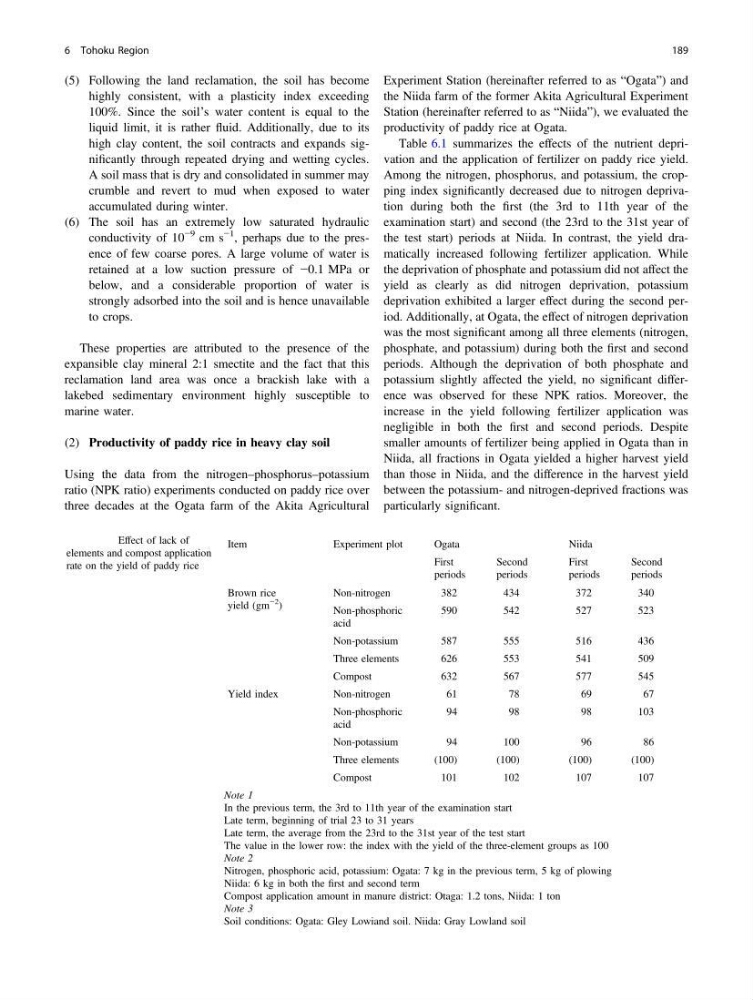
Table 6.1 summarizes the effects of the nutrient deprivation and the application of fertilizer on paddy rice yield.
Among the nitrogen, phosphorus, and potassium, the cropping index significantly decreased due to nitrogen deprivation during both the first (the 3rd to 11th year of the
examination start) and second (the 23rd to the 31st year of
the test start) periods at Niida. In contrast, the yield dramatically increased following fertilizer application. While
the deprivation of phosphate and potassium did not affect the
yield as clearly as did nitrogen deprivation, potassium
deprivation exhibited a larger effect during the second period. Additionally, at Ogata, the effect of nitrogen deprivation
was the most significant among all three elements (nitrogen,
phosphate, and potassium) during both the first and second
periods. Although the deprivation of both phosphate and
potassium slightly affected the yield, no significant difference was observed for these NPK ratios. Moreover, the
increase in the yield following fertilizer application was
negligible in both the first and second periods. Despite
smaller amounts of fertilizer being applied in Ogata than in
Niida, all fractions in Ogata yielded a higher harvest yield
than those in Niida, and the difference in the harvest yield
between the potassium- and nitrogen-deprived fractions was
particularly significant.
Table 6.1 Effect of lack of
elements and compost application
rate on the yield of paddy rice
Item
Experiment plot
Ogata
Niida
First
periods
Second
periods
First
periods
Second
periods
Brown rice
yield (gm
−2
)
Non-nitrogen
382
434
372
340
Non-phosphoric
acid
590
542
527
523
Non-potassium
587
555
516
436
Three elements
626
553
541
509
Compost
632
567
577
545
Yield index
Non-nitrogen
61
78
69
67
Non-phosphoric
acid
94
98
98
103
Non-potassium
94
100
96
86
Three elements
(100)
(100)
(100)
(100)
Compost
101
102
107
107
Note 1
In the previous term, the 3rd to 11th year of the examination start
Late term, beginning of trial 23 to 31 years
Late term, the average from the 23rd to the 31st year of the test start
The value in the lower row: the index with the yield of the three-element groups as 100
Note 2
Nitrogen, phosphoric acid, potassium: Ogata: 7 kg in the previous term, 5 kg of plowing
Niida: 6 kg in both the first and second term
Compost application amount in manure district: Otaga: 1.2 tons, Niida: 1 ton
Note 3
Soil conditions: Ogata: Gley Lowiand soil. Niida: Gray Lowland soil
6 Tohoku Region
189
highly consistent, with a plasticity index exceeding
100%. Since the soil’s water content is equal to the
liquid limit, it is rather fluid. Additionally, due to its
high clay content, the soil contracts and expands significantly through repeated drying and wetting cycles.
A soil mass that is dry and consolidated in summer may
crumble and revert to mud when exposed to water
accumulated during winter.
(6) The soil has an extremely low saturated hydraulic
conductivity of 10
−9 cm s
−1 , perhaps due to the presence of few coarse pores. A large volume of water is
retained at a low suction pressure of −0.1 MPa or
below, and a considerable proportion of water is
strongly adsorbed into the soil and is hence unavailable
to crops.
These properties are attributed to the presence of the
expansible clay mineral 2:1 smectite and the fact that this
reclamation land area was once a brackish lake with a
lakebed sedimentary environment highly susceptible to
marine water.
(2) Productivity of paddy rice in heavy clay soil
Using the data from the nitrogen–phosphorus–potassium
ratio (NPK ratio) experiments conducted on paddy rice over
three decades at the Ogata farm of the Akita Agricultural
Experiment Station (hereinafter referred to as “Ogata”) and
the Niida farm of the former Akita Agricultural Experiment
Station (hereinafter referred to as “Niida”), we evaluated the
productivity of paddy rice at Ogata.
Table 6.1 summarizes the effects of the nutrient deprivation and the application of fertilizer on paddy rice yield.
Among the nitrogen, phosphorus, and potassium, the cropping index significantly decreased due to nitrogen deprivation during both the first (the 3rd to 11th year of the
examination start) and second (the 23rd to the 31st year of
the test start) periods at Niida. In contrast, the yield dramatically increased following fertilizer application. While
the deprivation of phosphate and potassium did not affect the
yield as clearly as did nitrogen deprivation, potassium
deprivation exhibited a larger effect during the second period. Additionally, at Ogata, the effect of nitrogen deprivation
was the most significant among all three elements (nitrogen,
phosphate, and potassium) during both the first and second
periods. Although the deprivation of both phosphate and
potassium slightly affected the yield, no significant difference was observed for these NPK ratios. Moreover, the
increase in the yield following fertilizer application was
negligible in both the first and second periods. Despite
smaller amounts of fertilizer being applied in Ogata than in
Niida, all fractions in Ogata yielded a higher harvest yield
than those in Niida, and the difference in the harvest yield
between the potassium- and nitrogen-deprived fractions was
particularly significant.
Table 6.1 Effect of lack of
elements and compost application
rate on the yield of paddy rice
Item
Experiment plot
Ogata
Niida
First
periods
Second
periods
First
periods
Second
periods
Brown rice
yield (gm
−2
)
Non-nitrogen
382
434
372
340
Non-phosphoric
acid
590
542
527
523
Non-potassium
587
555
516
436
Three elements
626
553
541
509
Compost
632
567
577
545
Yield index
Non-nitrogen
61
78
69
67
Non-phosphoric
acid
94
98
98
103
Non-potassium
94
100
96
86
Three elements
(100)
(100)
(100)
(100)
Compost
101
102
107
107
Note 1
In the previous term, the 3rd to 11th year of the examination start
Late term, beginning of trial 23 to 31 years
Late term, the average from the 23rd to the 31st year of the test start
The value in the lower row: the index with the yield of the three-element groups as 100
Note 2
Nitrogen, phosphoric acid, potassium: Ogata: 7 kg in the previous term, 5 kg of plowing
Niida: 6 kg in both the first and second term
Compost application amount in manure district: Otaga: 1.2 tons, Niida: 1 ton
Note 3
Soil conditions: Ogata: Gley Lowiand soil. Niida: Gray Lowland soil
6 Tohoku Region
189