

most abundant groups, while millipedes show the
second-highest abundance (Nakamura et al. 1970).
(2) Environmental factors and soil fauna in Hokkaido
Forest ecosystems establish on more complex abiotic environments than do other ecosystems, such as
agro-environmental systems, and these complex environments influence the soil faunal distribution. For example, the
abundance of earthworm communities is lower in alpine
dwarf pine forests and subalpine broad-leaved forests compared with lowland forests. The distribution of soil fauna is
influenced not only by the elevation, but also the topography.
In Eastern Hokkaido, the density and biomass of earthworm
communities are higher on north-facing slopes (Hishi et al.
2014, and related studies). Specifically, the abundance of
Enchytraeidae communities is negatively correlated with the
depth of the A0 layer and the soil C/N ratio, which vary with
slope direction; this suggests that Encytraeidae prefers soil
with a low C/N ratio, and also that they reduce the depth of
the A0 layer by consuming organic matter. Soil type also
influences the distribution of soil fauna. For instance, Eisenia
japonica is abundant in Andosols, while Dendrobaena
octaedra is abundant in organic soils.
The growth of E. japonica is known to be high when they
feed on Calcareous Eutrosols with a high pH and calcium
concentration (Kawakami and Makoto 2017). In North
America, soil calcium concentration is positively correlated
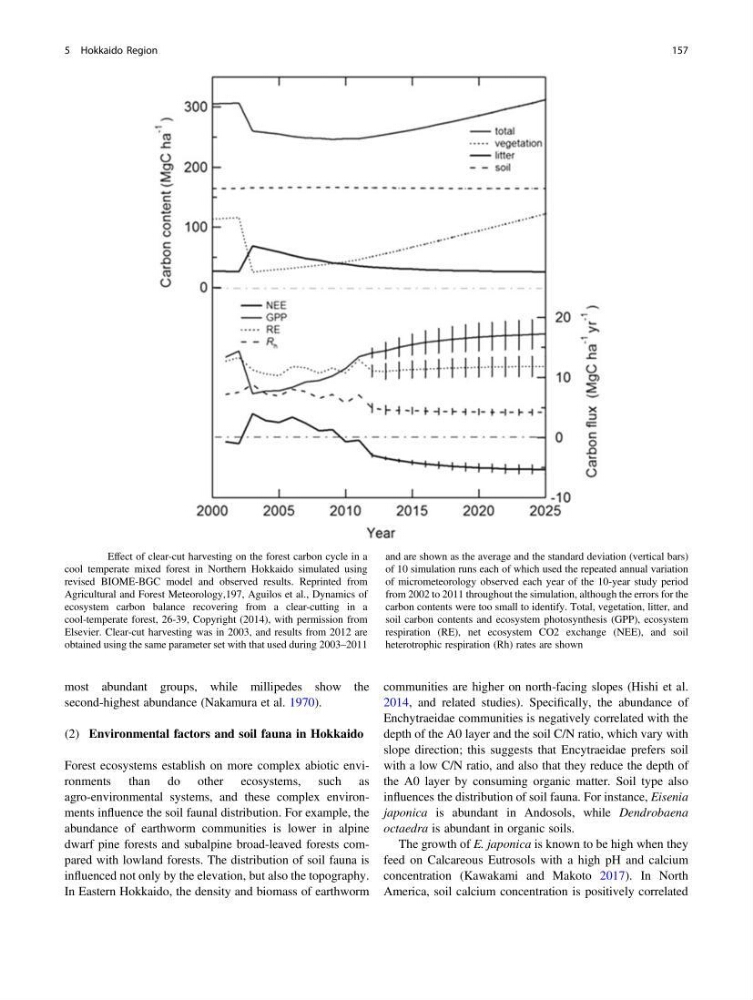
Fig. 5.7 Effect of clear-cut harvesting on the forest carbon cycle in a
cool temperate mixed forest in Northern Hokkaido simulated using
revised BIOME-BGC model and observed results. Reprinted from
Agricultural and Forest Meteorology,197, Aguilos et al., Dynamics of
ecosystem carbon balance recovering from a clear-cutting in a
cool-temperate forest, 26-39, Copyright (2014), with permission from
Elsevier. Clear-cut harvesting was in 2003, and results from 2012 are
obtained using the same parameter set with that used during 2003–2011
and are shown as the average and the standard deviation (vertical bars)
of 10 simulation runs each of which used the repeated annual variation
of micrometeorology observed each year of the 10-year study period
from 2002 to 2011 throughout the simulation, although the errors for the
carbon contents were too small to identify. Total, vegetation, litter, and
soil carbon contents and ecosystem photosynthesis (GPP), ecosystem
respiration (RE), net ecosystem CO2 exchange (NEE), and soil
heterotrophic respiration (Rh) rates are shown
5 Hokkaido Region
157
second-highest abundance (Nakamura et al. 1970).
(2) Environmental factors and soil fauna in Hokkaido
Forest ecosystems establish on more complex abiotic environments than do other ecosystems, such as
agro-environmental systems, and these complex environments influence the soil faunal distribution. For example, the
abundance of earthworm communities is lower in alpine
dwarf pine forests and subalpine broad-leaved forests compared with lowland forests. The distribution of soil fauna is
influenced not only by the elevation, but also the topography.
In Eastern Hokkaido, the density and biomass of earthworm
communities are higher on north-facing slopes (Hishi et al.
2014, and related studies). Specifically, the abundance of
Enchytraeidae communities is negatively correlated with the
depth of the A0 layer and the soil C/N ratio, which vary with
slope direction; this suggests that Encytraeidae prefers soil
with a low C/N ratio, and also that they reduce the depth of
the A0 layer by consuming organic matter. Soil type also
influences the distribution of soil fauna. For instance, Eisenia
japonica is abundant in Andosols, while Dendrobaena
octaedra is abundant in organic soils.
The growth of E. japonica is known to be high when they
feed on Calcareous Eutrosols with a high pH and calcium
concentration (Kawakami and Makoto 2017). In North
America, soil calcium concentration is positively correlated
Fig. 5.7 Effect of clear-cut harvesting on the forest carbon cycle in a
cool temperate mixed forest in Northern Hokkaido simulated using
revised BIOME-BGC model and observed results. Reprinted from
Agricultural and Forest Meteorology,197, Aguilos et al., Dynamics of
ecosystem carbon balance recovering from a clear-cutting in a
cool-temperate forest, 26-39, Copyright (2014), with permission from
Elsevier. Clear-cut harvesting was in 2003, and results from 2012 are
obtained using the same parameter set with that used during 2003–2011
and are shown as the average and the standard deviation (vertical bars)
of 10 simulation runs each of which used the repeated annual variation
of micrometeorology observed each year of the 10-year study period
from 2002 to 2011 throughout the simulation, although the errors for the
carbon contents were too small to identify. Total, vegetation, litter, and
soil carbon contents and ecosystem photosynthesis (GPP), ecosystem
respiration (RE), net ecosystem CO2 exchange (NEE), and soil
heterotrophic respiration (Rh) rates are shown
5 Hokkaido Region
157