

public works has been actively carried out. From the late
1940s, with the assistance of loans from the World Bank,
large-scale public works projects for irrigation and drainage
canals, subsurface drainage, and soil-dressing were implemented, especially in peatland (Hasegawa and Tabuchi
1995). A total of 65,000 ha of peatlands was converted into
paddy field in the 17 years from 1954 until 1970 (Matsushita
et al. 1985).
Each year, public works projects improve subsurface
drainage on 5000 ha of land through the installation of
subsurface drainage systems. To increase the mechanization
and efficiency of agricultural work, the land readjustment of
large fields (1 ha or more) is being advanced. To promote
subsurface drainage, drain pipes are installed at a depth of
60–80 cm with a spacing of 10 m, and filter material is filled
from the drain pipe to the bottom of the surface layer. Furthermore, subsurface drainage is achieved by constructions
that allow water to flow from irrigation canals into underdrain pipes for the purpose of cleaning and subirrigation.
Rice husk has been used as a filter material, but it decays
with time because of converted paddy field. Hence, the use
of filter materials other than rice husk was examined; now,
wood chips and inorganic materials such as gravel and
volcanic gravel are used. The use of organic filter materials
for improving subsurface drainage in paddy fields reduces
the occurrence of methane, and a carbon storage effect is
observed (Kitagawa and Tsukamoto 2014).
Clayey soil-dressing in paddy fields has been mainly
conducted to increase the depth of the plow layer and the
bearing capacity in peatlands. Recently, however, a project
using sandy soil-dressing with a high silicon content has
been conducted, mainly in the Ishikari area, to improve the
taste of paddy rice.
(3) Changes in soil physicochemical properties in paddy
fields
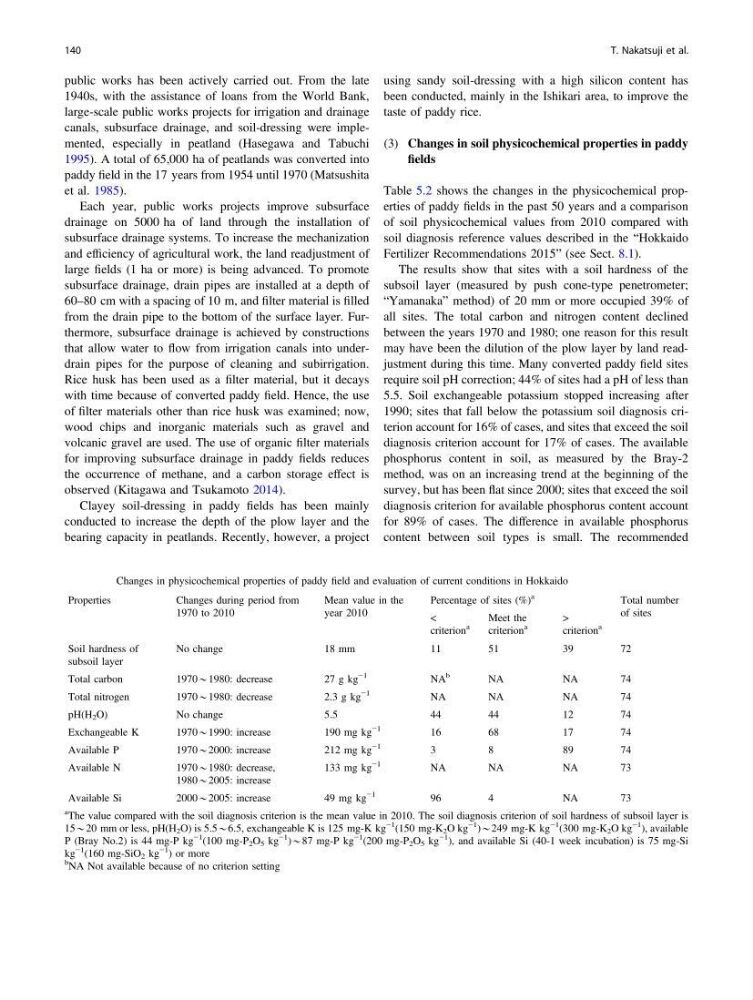
Table 5.2 shows the changes in the physicochemical properties of paddy fields in the past 50 years and a comparison
of soil physicochemical values from 2010 compared with
soil diagnosis reference values described in the “Hokkaido
Fertilizer Recommendations 2015” (see Sect. 8.1).
The results show that sites with a soil hardness of the
subsoil layer (measured by push cone-type penetrometer;
“Yamanaka” method) of 20 mm or more occupied 39% of
all sites. The total carbon and nitrogen content declined
between the years 1970 and 1980; one reason for this result
may have been the dilution of the plow layer by land readjustment during this time. Many converted paddy field sites
require soil pH correction; 44% of sites had a pH of less than
5.5. Soil exchangeable potassium stopped increasing after
1990; sites that fall below the potassium soil diagnosis criterion account for 16% of cases, and sites that exceed the soil
diagnosis criterion account for 17% of cases. The available
phosphorus content in soil, as measured by the Bray-2
method, was on an increasing trend at the beginning of the
survey, but has been flat since 2000; sites that exceed the soil
diagnosis criterion for available phosphorus content account
for 89% of cases. The difference in available phosphorus
content between soil types is small. The recommended
Table 5.2 Changes in physicochemical properties of paddy field and evaluation of current conditions in Hokkaido
Properties
Changes during period from
1970 to 2010
Mean value in the
year 2010
Percentage of sites (%)
a
Total number
of sites
<
criterion
a
Meet the
criterion
a
>
criterion
a
Soil hardness of
subsoil layer
No change
18 mm
11
51
39
72
Total carbon
1970*1980: decrease
27 g kg
−1
NA
b
NA
NA
74
Total nitrogen
1970*1980: decrease
2.3 g kg
−1
NA
NA
NA
74
pH(H 2 O)
No change
5.5
44
44
12
74
Exchangeable K
1970*1990: increase
190 mg kg
−1
16
68
17
74
Available P
1970*2000: increase
212 mg kg
−1
3
8
89
74
Available N
1970*1980: decrease,
1980*2005: increase
133 mg kg
−1
NA
NA
NA
73
Available Si
2000*2005: increase
49 mg kg
−1
96
4
NA
73
a The value compared with the soil diagnosis criterion is the mean value in 2010. The soil diagnosis criterion of soil hardness of subsoil layer is
15*20 mm or less, pH(H 2 O) is 5.5*6.5, exchangeable K is 125 mg-K kg
−1
(150 mg-K 2 O kg
−1
)*249 mg-K kg
−1
(300 mg-K 2 O kg
−1
), available
P (Bray No.2) is 44 mg-P kg
−1
(100 mg-P 2 O 5 kg
−1
)*87 mg-P kg
−1
(200 mg-P 2 O 5 kg
−1
), and available Si (40-1 week incubation) is 75 mg-Si
kg
−1
(160 mg-SiO 2 kg
−1
) or more
b
NA Not available because of no criterion setting
140
T. Nakatsuji et al.
1940s, with the assistance of loans from the World Bank,
large-scale public works projects for irrigation and drainage
canals, subsurface drainage, and soil-dressing were implemented, especially in peatland (Hasegawa and Tabuchi
1995). A total of 65,000 ha of peatlands was converted into
paddy field in the 17 years from 1954 until 1970 (Matsushita
et al. 1985).
Each year, public works projects improve subsurface
drainage on 5000 ha of land through the installation of
subsurface drainage systems. To increase the mechanization
and efficiency of agricultural work, the land readjustment of
large fields (1 ha or more) is being advanced. To promote
subsurface drainage, drain pipes are installed at a depth of
60–80 cm with a spacing of 10 m, and filter material is filled
from the drain pipe to the bottom of the surface layer. Furthermore, subsurface drainage is achieved by constructions
that allow water to flow from irrigation canals into underdrain pipes for the purpose of cleaning and subirrigation.
Rice husk has been used as a filter material, but it decays
with time because of converted paddy field. Hence, the use
of filter materials other than rice husk was examined; now,
wood chips and inorganic materials such as gravel and
volcanic gravel are used. The use of organic filter materials
for improving subsurface drainage in paddy fields reduces
the occurrence of methane, and a carbon storage effect is
observed (Kitagawa and Tsukamoto 2014).
Clayey soil-dressing in paddy fields has been mainly
conducted to increase the depth of the plow layer and the
bearing capacity in peatlands. Recently, however, a project
using sandy soil-dressing with a high silicon content has
been conducted, mainly in the Ishikari area, to improve the
taste of paddy rice.
(3) Changes in soil physicochemical properties in paddy
fields
Table 5.2 shows the changes in the physicochemical properties of paddy fields in the past 50 years and a comparison
of soil physicochemical values from 2010 compared with
soil diagnosis reference values described in the “Hokkaido
Fertilizer Recommendations 2015” (see Sect. 8.1).
The results show that sites with a soil hardness of the
subsoil layer (measured by push cone-type penetrometer;
“Yamanaka” method) of 20 mm or more occupied 39% of
all sites. The total carbon and nitrogen content declined
between the years 1970 and 1980; one reason for this result
may have been the dilution of the plow layer by land readjustment during this time. Many converted paddy field sites
require soil pH correction; 44% of sites had a pH of less than
5.5. Soil exchangeable potassium stopped increasing after
1990; sites that fall below the potassium soil diagnosis criterion account for 16% of cases, and sites that exceed the soil
diagnosis criterion account for 17% of cases. The available
phosphorus content in soil, as measured by the Bray-2
method, was on an increasing trend at the beginning of the
survey, but has been flat since 2000; sites that exceed the soil
diagnosis criterion for available phosphorus content account
for 89% of cases. The difference in available phosphorus
content between soil types is small. The recommended
Table 5.2 Changes in physicochemical properties of paddy field and evaluation of current conditions in Hokkaido
Properties
Changes during period from
1970 to 2010
Mean value in the
year 2010
Percentage of sites (%)
a
Total number
of sites
<
criterion
a
Meet the
criterion
a
>
criterion
a
Soil hardness of
subsoil layer
No change
18 mm
11
51
39
72
Total carbon
1970*1980: decrease
27 g kg
−1
NA
b
NA
NA
74
Total nitrogen
1970*1980: decrease
2.3 g kg
−1
NA
NA
NA
74
pH(H 2 O)
No change
5.5
44
44
12
74
Exchangeable K
1970*1990: increase
190 mg kg
−1
16
68
17
74
Available P
1970*2000: increase
212 mg kg
−1
3
8
89
74
Available N
1970*1980: decrease,
1980*2005: increase
133 mg kg
−1
NA
NA
NA
73
Available Si
2000*2005: increase
49 mg kg
−1
96
4
NA
73
a The value compared with the soil diagnosis criterion is the mean value in 2010. The soil diagnosis criterion of soil hardness of subsoil layer is
15*20 mm or less, pH(H 2 O) is 5.5*6.5, exchangeable K is 125 mg-K kg
−1
(150 mg-K 2 O kg
−1
)*249 mg-K kg
−1
(300 mg-K 2 O kg
−1
), available
P (Bray No.2) is 44 mg-P kg
−1
(100 mg-P 2 O 5 kg
−1
)*87 mg-P kg
−1
(200 mg-P 2 O 5 kg
−1
), and available Si (40-1 week incubation) is 75 mg-Si
kg
−1
(160 mg-SiO 2 kg
−1
) or more
b
NA Not available because of no criterion setting
140
T. Nakatsuji et al.