

5.1 Outline of Agriculture and Soils
5.1.1 Agriculture
(1) Early development up until World War II
Until 1868, Hokkaido was a frontier island where few
people, mostly the indigenous Ainu people, lived. At the
beginning of 1869, just after the Meiji Restoration, the
Japanese Government established the Development Commission, through which it launched a project to develop
Hokkaido. Development was undertaken with the strong
supervision and financial assistance of the central government, and the commission sent a contingent of colonial
troops to develop and defend the island.
Unlike the other Japanese islands, Hokkaido is on the
border between the temperate and subarctic zones. To adapt
to the cool climate, modern technology from the USA and
Europe was introduced. The Development Commission
invited many foreign specialists, including Horace Capron,
United States Commissioner of Agriculture, to lay the
foundation of industries. During the early stage of development, the Commission undertook a strategy of agricultural
development to introduce and extend the upland/dairy
farming system on the advice of foreign agronomists.
The Hokkaido Government (established in 1886) initiated
a survey to select suitable sites for cultivation and planned
the placement of farmlands and urban areas partitioned into a
grid by straight roads, forming a landscape that is particular
to Hokkaido. At this time, development was led primarily by
the private sector. After a law to dispose of undeveloped
nationally owned land was enacted in 1897, many large
farms were founded and accepted immense numbers immigrants from all over Japan. The peak period of immigration
spanned almost 30 years from 1890 to 1920, and the population of Hokkaido surpassed 2 million in 1917.
Agricultural development in Hokkaido began with field
crops combined with dairy farming, which were later followed by rice cultivation. Field crops first spread in lowlands
with good drainage and then extended to uplands with volcanic ash soils and other soil types, furthermore, spread to
the hilly lands along with livestock farming. In the 1890s,
the system of agricultural work using horses and plows
became widespread, making it possible to cultivate large
areas. However, repeated cultivation without the use of fertilizer led to a decline in the fertility, and therefore the
productivity, of the soil. During World War I, the price of
beans, potato starch, and other products soared in overseas
markets; as a result, exports increased rapidly, and the
development of farmland also progressed. Mechanical soil
improvement has been carried out since and has taken over
after World War II (Sakuma 1987).
Although rice cultivation was initially considered inappropriate by foreign experts, most immigrants were farmers
familiar with rice farming, and after migrating to Hokkaido
they continued their efforts to establish rice cultivation on
the island. Moreover, in 1892, the Hokkaido Government
adopted policy to encourage the cultivation of rice. Paddy
fields increased in number, replacing field crops in lowland
areas and spreading throughout almost all of Hokkaido
(excluding parts of the north and northeast) in the 1920s. In
terms of technology, the expansion of rice cultivation was
encouraged by the development and diffusion of
cold-resistant rice varieties, the development of direct seed
cultivation technology, the improvement of irrigation facilities, and so on. The Ishikari Plain and the Kamikawa Basin
became areas of large-scale rice farming.
Regarding fertilization technology, the application of
superphosphate started in the suburbs from around 1900. Its
use spread a little later, but the average fertilization amount
was small. From around 1925, in addition to superphosphate, fish meal, soybean meal, and the like were used for
fertilization. However, the amount of fertilizer was drastically reduced at the end of World War II (Imura 1987).
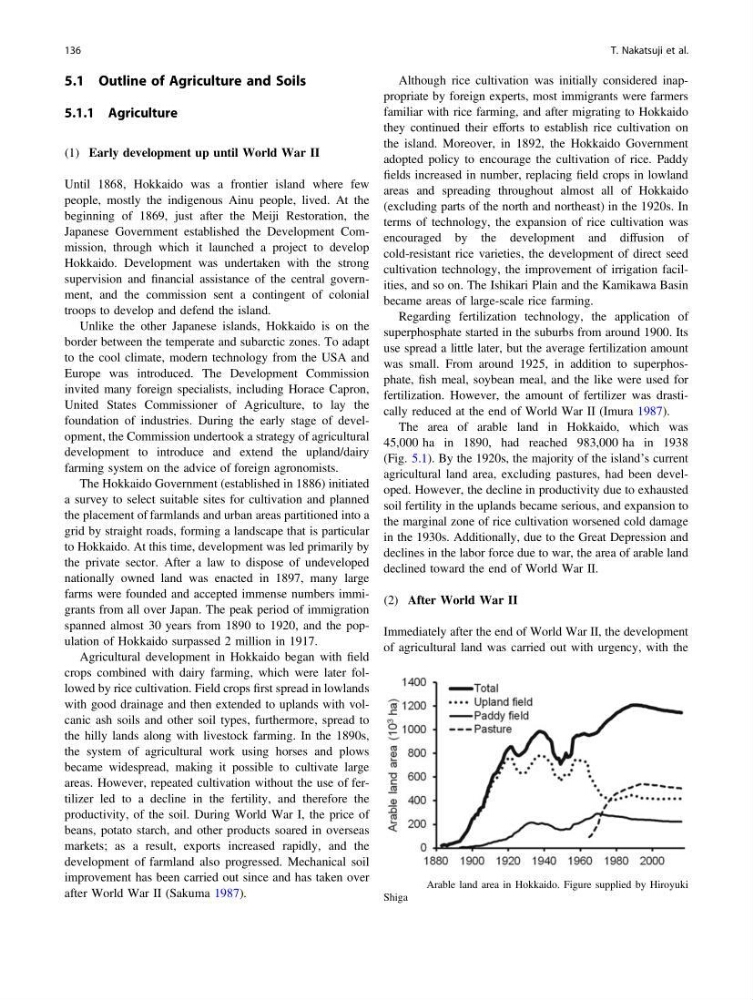
The area of arable land in Hokkaido, which was
45,000 ha in 1890, had reached 983,000 ha in 1938
(Fig. 5.1). By the 1920s, the majority of the island’s current
agricultural land area, excluding pastures, had been developed. However, the decline in productivity due to exhausted
soil fertility in the uplands became serious, and expansion to
the marginal zone of rice cultivation worsened cold damage
in the 1930s. Additionally, due to the Great Depression and
declines in the labor force due to war, the area of arable land
declined toward the end of World War II.
(2) After World War II
Immediately after the end of World War II, the development
of agricultural land was carried out with urgency, with the
Fig. 5.1 Arable land area in Hokkaido. Figure supplied by Hiroyuki
Shiga
136
T. Nakatsuji et al.
5.1.1 Agriculture
(1) Early development up until World War II
Until 1868, Hokkaido was a frontier island where few
people, mostly the indigenous Ainu people, lived. At the
beginning of 1869, just after the Meiji Restoration, the
Japanese Government established the Development Commission, through which it launched a project to develop
Hokkaido. Development was undertaken with the strong
supervision and financial assistance of the central government, and the commission sent a contingent of colonial
troops to develop and defend the island.
Unlike the other Japanese islands, Hokkaido is on the
border between the temperate and subarctic zones. To adapt
to the cool climate, modern technology from the USA and
Europe was introduced. The Development Commission
invited many foreign specialists, including Horace Capron,
United States Commissioner of Agriculture, to lay the
foundation of industries. During the early stage of development, the Commission undertook a strategy of agricultural
development to introduce and extend the upland/dairy
farming system on the advice of foreign agronomists.
The Hokkaido Government (established in 1886) initiated
a survey to select suitable sites for cultivation and planned
the placement of farmlands and urban areas partitioned into a
grid by straight roads, forming a landscape that is particular
to Hokkaido. At this time, development was led primarily by
the private sector. After a law to dispose of undeveloped
nationally owned land was enacted in 1897, many large
farms were founded and accepted immense numbers immigrants from all over Japan. The peak period of immigration
spanned almost 30 years from 1890 to 1920, and the population of Hokkaido surpassed 2 million in 1917.
Agricultural development in Hokkaido began with field
crops combined with dairy farming, which were later followed by rice cultivation. Field crops first spread in lowlands
with good drainage and then extended to uplands with volcanic ash soils and other soil types, furthermore, spread to
the hilly lands along with livestock farming. In the 1890s,
the system of agricultural work using horses and plows
became widespread, making it possible to cultivate large
areas. However, repeated cultivation without the use of fertilizer led to a decline in the fertility, and therefore the
productivity, of the soil. During World War I, the price of
beans, potato starch, and other products soared in overseas
markets; as a result, exports increased rapidly, and the
development of farmland also progressed. Mechanical soil
improvement has been carried out since and has taken over
after World War II (Sakuma 1987).
Although rice cultivation was initially considered inappropriate by foreign experts, most immigrants were farmers
familiar with rice farming, and after migrating to Hokkaido
they continued their efforts to establish rice cultivation on
the island. Moreover, in 1892, the Hokkaido Government
adopted policy to encourage the cultivation of rice. Paddy
fields increased in number, replacing field crops in lowland
areas and spreading throughout almost all of Hokkaido
(excluding parts of the north and northeast) in the 1920s. In
terms of technology, the expansion of rice cultivation was
encouraged by the development and diffusion of
cold-resistant rice varieties, the development of direct seed
cultivation technology, the improvement of irrigation facilities, and so on. The Ishikari Plain and the Kamikawa Basin
became areas of large-scale rice farming.
Regarding fertilization technology, the application of
superphosphate started in the suburbs from around 1900. Its
use spread a little later, but the average fertilization amount
was small. From around 1925, in addition to superphosphate, fish meal, soybean meal, and the like were used for
fertilization. However, the amount of fertilizer was drastically reduced at the end of World War II (Imura 1987).
The area of arable land in Hokkaido, which was
45,000 ha in 1890, had reached 983,000 ha in 1938
(Fig. 5.1). By the 1920s, the majority of the island’s current
agricultural land area, excluding pastures, had been developed. However, the decline in productivity due to exhausted
soil fertility in the uplands became serious, and expansion to
the marginal zone of rice cultivation worsened cold damage
in the 1930s. Additionally, due to the Great Depression and
declines in the labor force due to war, the area of arable land
declined toward the end of World War II.
(2) After World War II
Immediately after the end of World War II, the development
of agricultural land was carried out with urgency, with the
Fig. 5.1 Arable land area in Hokkaido. Figure supplied by Hiroyuki
Shiga
136
T. Nakatsuji et al.