

horizons of “brown forest soils” are in fact yellowish-brown,
red, and yellow, rather than brown. As a result, the actual
identification of “brown forest soils” was based on the organic
carbon content, not the soil color. Nevertheless, the SOC
contents of such soils were found to fluctuate depending on
the extent of volcanic ash addition, so organic carbon contents
may not be an appropriate indicator to divide “yellow-brown
forest soils” and “haplic brown forest soils.” It has also been
theorized that both of these soil groups could be classified
according to the activity of free iron oxides (Nagatsuka 1973);
however, the activity of free iron oxides was also found to
fluctuate depending on the extent of volcanic ash addition.
Therefore, it was uncertain whether the difference in the
activity of free iron oxides between “yellow-brown forest
soils” and “haplic brown forest soils” was due to climatic
conditions or degree of volcanic ash addition. Because it was
virtually impossible to distinguish the “yellow-brown forest
soils” as a zonal soil, the Soil Classification System of Japan
(2017) has only one soil group of Brown Forest soils in the
Brown Forest soil great group.
(3) Soil subgroup
The soil group of Brown Forest soils has nine soil subgroups
in the Soil Classification System of Japan (2017), namely the
Anthraquic subgroup, having an anthraquic horizon; the
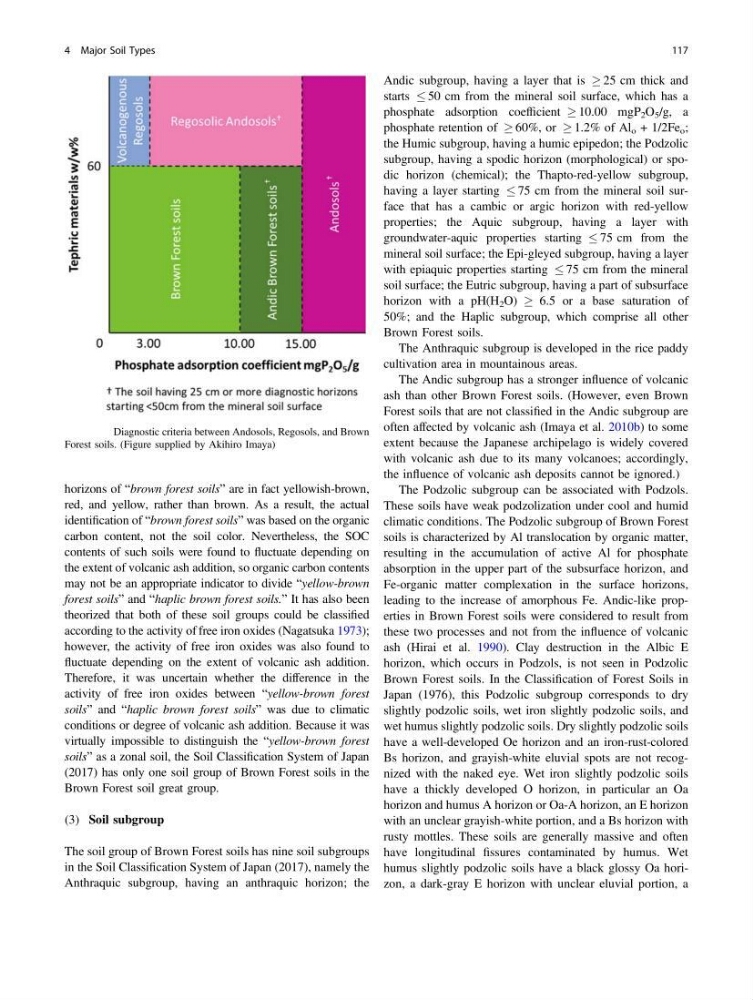
Andic subgroup, having a layer that is ! 25 cm thick and
starts 50 cm from the mineral soil surface, which has a
phosphate adsorption coefficient ! 10.00 mgP 2 O 5 /g, a
phosphate retention of ! 60%, or ! 1.2% of Al o + 1/2Fe o ;
the Humic subgroup, having a humic epipedon; the Podzolic
subgroup, having a spodic horizon (morphological) or spodic horizon (chemical); the Thapto-red-yellow subgroup,
having a layer starting 75 cm from the mineral soil surface that has a cambic or argic horizon with red-yellow
properties; the Aquic subgroup, having a layer with
groundwater-aquic properties starting 75 cm from the
mineral soil surface; the Epi-gleyed subgroup, having a layer
with epiaquic properties starting 75 cm from the mineral
soil surface; the Eutric subgroup, having a part of subsurface
horizon with a pH(H 2 O) ! 6.5 or a base saturation of
50%; and the Haplic subgroup, which comprise all other
Brown Forest soils.
The Anthraquic subgroup is developed in the rice paddy
cultivation area in mountainous areas.
The Andic subgroup has a stronger influence of volcanic
ash than other Brown Forest soils. (However, even Brown
Forest soils that are not classified in the Andic subgroup are
often affected by volcanic ash (Imaya et al. 2010b) to some
extent because the Japanese archipelago is widely covered
with volcanic ash due to its many volcanoes; accordingly,
the influence of volcanic ash deposits cannot be ignored.)
The Podzolic subgroup can be associated with Podzols.
These soils have weak podzolization under cool and humid
climatic conditions. The Podzolic subgroup of Brown Forest
soils is characterized by Al translocation by organic matter,
resulting in the accumulation of active Al for phosphate
absorption in the upper part of the subsurface horizon, and
Fe-organic matter complexation in the surface horizons,
leading to the increase of amorphous Fe. Andic-like properties in Brown Forest soils were considered to result from
these two processes and not from the influence of volcanic
ash (Hirai et al. 1990). Clay destruction in the Albic E
horizon, which occurs in Podzols, is not seen in Podzolic
Brown Forest soils. In the Classification of Forest Soils in
Japan (1976), this Podzolic subgroup corresponds to dry
slightly podzolic soils, wet iron slightly podzolic soils, and
wet humus slightly podzolic soils. Dry slightly podzolic soils
have a well-developed Oe horizon and an iron-rust-colored
Bs horizon, and grayish-white eluvial spots are not recognized with the naked eye. Wet iron slightly podzolic soils
have a thickly developed O horizon, in particular an Oa
horizon and humus A horizon or Oa-A horizon, an E horizon
with an unclear grayish-white portion, and a Bs horizon with
rusty mottles. These soils are generally massive and often
have longitudinal fissures contaminated by humus. Wet
humus slightly podzolic soils have a black glossy Oa horizon, a dark-gray E horizon with unclear eluvial portion, a
Fig. 4.47 Diagnostic criteria between Andosols, Regosols, and Brown
Forest soils. (Figure supplied by Akihiro Imaya)
4 Major Soil Types
117
red, and yellow, rather than brown. As a result, the actual
identification of “brown forest soils” was based on the organic
carbon content, not the soil color. Nevertheless, the SOC
contents of such soils were found to fluctuate depending on
the extent of volcanic ash addition, so organic carbon contents
may not be an appropriate indicator to divide “yellow-brown
forest soils” and “haplic brown forest soils.” It has also been
theorized that both of these soil groups could be classified
according to the activity of free iron oxides (Nagatsuka 1973);
however, the activity of free iron oxides was also found to
fluctuate depending on the extent of volcanic ash addition.
Therefore, it was uncertain whether the difference in the
activity of free iron oxides between “yellow-brown forest
soils” and “haplic brown forest soils” was due to climatic
conditions or degree of volcanic ash addition. Because it was
virtually impossible to distinguish the “yellow-brown forest
soils” as a zonal soil, the Soil Classification System of Japan
(2017) has only one soil group of Brown Forest soils in the
Brown Forest soil great group.
(3) Soil subgroup
The soil group of Brown Forest soils has nine soil subgroups
in the Soil Classification System of Japan (2017), namely the
Anthraquic subgroup, having an anthraquic horizon; the
Andic subgroup, having a layer that is ! 25 cm thick and
starts 50 cm from the mineral soil surface, which has a
phosphate adsorption coefficient ! 10.00 mgP 2 O 5 /g, a
phosphate retention of ! 60%, or ! 1.2% of Al o + 1/2Fe o ;
the Humic subgroup, having a humic epipedon; the Podzolic
subgroup, having a spodic horizon (morphological) or spodic horizon (chemical); the Thapto-red-yellow subgroup,
having a layer starting 75 cm from the mineral soil surface that has a cambic or argic horizon with red-yellow
properties; the Aquic subgroup, having a layer with
groundwater-aquic properties starting 75 cm from the
mineral soil surface; the Epi-gleyed subgroup, having a layer
with epiaquic properties starting 75 cm from the mineral
soil surface; the Eutric subgroup, having a part of subsurface
horizon with a pH(H 2 O) ! 6.5 or a base saturation of
50%; and the Haplic subgroup, which comprise all other
Brown Forest soils.
The Anthraquic subgroup is developed in the rice paddy
cultivation area in mountainous areas.
The Andic subgroup has a stronger influence of volcanic
ash than other Brown Forest soils. (However, even Brown
Forest soils that are not classified in the Andic subgroup are
often affected by volcanic ash (Imaya et al. 2010b) to some
extent because the Japanese archipelago is widely covered
with volcanic ash due to its many volcanoes; accordingly,
the influence of volcanic ash deposits cannot be ignored.)
The Podzolic subgroup can be associated with Podzols.
These soils have weak podzolization under cool and humid
climatic conditions. The Podzolic subgroup of Brown Forest
soils is characterized by Al translocation by organic matter,
resulting in the accumulation of active Al for phosphate
absorption in the upper part of the subsurface horizon, and
Fe-organic matter complexation in the surface horizons,
leading to the increase of amorphous Fe. Andic-like properties in Brown Forest soils were considered to result from
these two processes and not from the influence of volcanic
ash (Hirai et al. 1990). Clay destruction in the Albic E
horizon, which occurs in Podzols, is not seen in Podzolic
Brown Forest soils. In the Classification of Forest Soils in
Japan (1976), this Podzolic subgroup corresponds to dry
slightly podzolic soils, wet iron slightly podzolic soils, and
wet humus slightly podzolic soils. Dry slightly podzolic soils
have a well-developed Oe horizon and an iron-rust-colored
Bs horizon, and grayish-white eluvial spots are not recognized with the naked eye. Wet iron slightly podzolic soils
have a thickly developed O horizon, in particular an Oa
horizon and humus A horizon or Oa-A horizon, an E horizon
with an unclear grayish-white portion, and a Bs horizon with
rusty mottles. These soils are generally massive and often
have longitudinal fissures contaminated by humus. Wet
humus slightly podzolic soils have a black glossy Oa horizon, a dark-gray E horizon with unclear eluvial portion, a
Fig. 4.47 Diagnostic criteria between Andosols, Regosols, and Brown
Forest soils. (Figure supplied by Akihiro Imaya)
4 Major Soil Types
117