

118
M. E. Belfiori
A Simple Climate Change Model
Consider the following economy. Time is discrete and infinite, t ∈ {0, . . . , ∞}. A
continuum of identical individuals populates the economy. There are three production units: the final good and the energy producers, indexed by i = {0, 1, 2}. The
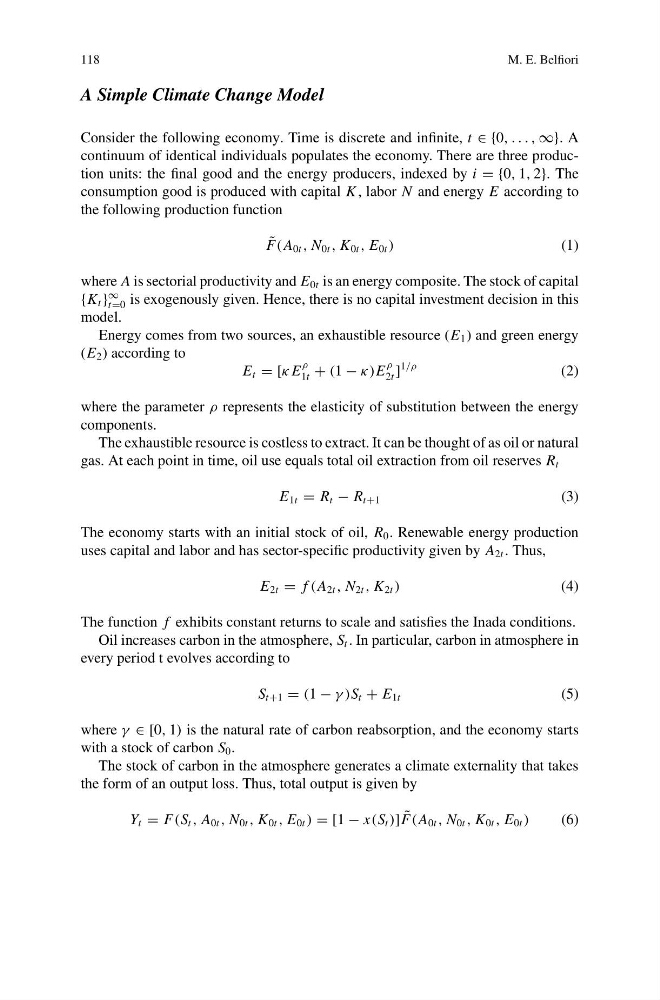
consumption good is produced with capital K , labor N and energy E according to
the following production function
˜
F(A 0t , N 0t , K 0t , E 0t )
(1)
where A is sectorial productivity and E 0t is an energy composite. The stock of capital
{K t }
∞
t=0 is exogenously given. Hence, there is no capital investment decision in this
model.
Energy comes from two sources, an exhaustible resource (E 1 ) and green energy
(E 2 ) according to
E t = [κ E
ρ
1t + (1 − κ)E
ρ
2t ]
1/ρ
(2)
where the parameter ρ represents the elasticity of substitution between the energy
components.
The exhaustible resource is costless to extract. It can be thought of as oil or natural
gas. At each point in time, oil use equals total oil extraction from oil reserves R t
E 1t = R t − R t+1
(3)
The economy starts with an initial stock of oil, R 0 . Renewable energy production
uses capital and labor and has sector-specific productivity given by A 2t . Thus,
E 2t = f (A 2t , N 2t , K 2t )
(4)
The function f exhibits constant returns to scale and satisfies the Inada conditions.
Oil increases carbon in the atmosphere, S t . In particular, carbon in atmosphere in
every period t evolves according to
S t+1 = (1 − γ )S t + E 1t
(5)
where γ ∈ [0, 1) is the natural rate of carbon reabsorption, and the economy starts
with a stock of carbon S 0 .
The stock of carbon in the atmosphere generates a climate externality that takes
the form of an output loss. Thus, total output is given by
Y t = F(S t , A 0t , N 0t , K 0t , E 0t ) = [1 − x(S t )] ˜
F(A 0t , N 0t , K 0t , E 0t )
(6)
M. E. Belfiori
A Simple Climate Change Model
Consider the following economy. Time is discrete and infinite, t ∈ {0, . . . , ∞}. A
continuum of identical individuals populates the economy. There are three production units: the final good and the energy producers, indexed by i = {0, 1, 2}. The
consumption good is produced with capital K , labor N and energy E according to
the following production function
˜
F(A 0t , N 0t , K 0t , E 0t )
(1)
where A is sectorial productivity and E 0t is an energy composite. The stock of capital
{K t }
∞
t=0 is exogenously given. Hence, there is no capital investment decision in this
model.
Energy comes from two sources, an exhaustible resource (E 1 ) and green energy
(E 2 ) according to
E t = [κ E
ρ
1t + (1 − κ)E
ρ
2t ]
1/ρ
(2)
where the parameter ρ represents the elasticity of substitution between the energy
components.
The exhaustible resource is costless to extract. It can be thought of as oil or natural
gas. At each point in time, oil use equals total oil extraction from oil reserves R t
E 1t = R t − R t+1
(3)
The economy starts with an initial stock of oil, R 0 . Renewable energy production
uses capital and labor and has sector-specific productivity given by A 2t . Thus,
E 2t = f (A 2t , N 2t , K 2t )
(4)
The function f exhibits constant returns to scale and satisfies the Inada conditions.
Oil increases carbon in the atmosphere, S t . In particular, carbon in atmosphere in
every period t evolves according to
S t+1 = (1 − γ )S t + E 1t
(5)
where γ ∈ [0, 1) is the natural rate of carbon reabsorption, and the economy starts
with a stock of carbon S 0 .
The stock of carbon in the atmosphere generates a climate externality that takes
the form of an output loss. Thus, total output is given by
Y t = F(S t , A 0t , N 0t , K 0t , E 0t ) = [1 − x(S t )] ˜
F(A 0t , N 0t , K 0t , E 0t )
(6)