

116
M. E. Belfiori
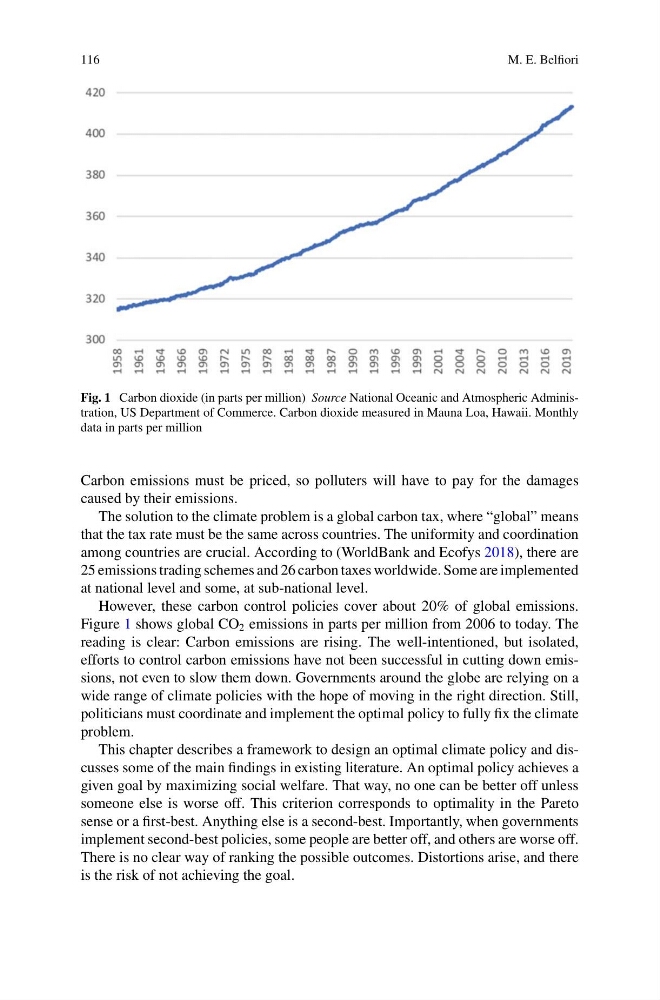
Fig. 1 Carbon dioxide (in parts per million) Source National Oceanic and Atmospheric Administration, US Department of Commerce. Carbon dioxide measured in Mauna Loa, Hawaii. Monthly
data in parts per million
Carbon emissions must be priced, so polluters will have to pay for the damages
caused by their emissions.
The solution to the climate problem is a global carbon tax, where “global” means
that the tax rate must be the same across countries. The uniformity and coordination
among countries are crucial. According to (WorldBank and Ecofys 2018), there are
25 emissions trading schemes and 26 carbon taxes worldwide. Some are implemented
at national level and some, at sub-national level.
However, these carbon control policies cover about 20% of global emissions.
Figure 1 shows global CO 2 emissions in parts per million from 2006 to today. The
reading is clear: Carbon emissions are rising. The well-intentioned, but isolated,
efforts to control carbon emissions have not been successful in cutting down emissions, not even to slow them down. Governments around the globe are relying on a
wide range of climate policies with the hope of moving in the right direction. Still,
politicians must coordinate and implement the optimal policy to fully fix the climate
problem.
This chapter describes a framework to design an optimal climate policy and discusses some of the main findings in existing literature. An optimal policy achieves a
given goal by maximizing social welfare. That way, no one can be better off unless
someone else is worse off. This criterion corresponds to optimality in the Pareto
sense or a first-best. Anything else is a second-best. Importantly, when governments
implement second-best policies, some people are better off, and others are worse off.
There is no clear way of ranking the possible outcomes. Distortions arise, and there
is the risk of not achieving the goal.
M. E. Belfiori
Fig. 1 Carbon dioxide (in parts per million) Source National Oceanic and Atmospheric Administration, US Department of Commerce. Carbon dioxide measured in Mauna Loa, Hawaii. Monthly
data in parts per million
Carbon emissions must be priced, so polluters will have to pay for the damages
caused by their emissions.
The solution to the climate problem is a global carbon tax, where “global” means
that the tax rate must be the same across countries. The uniformity and coordination
among countries are crucial. According to (WorldBank and Ecofys 2018), there are
25 emissions trading schemes and 26 carbon taxes worldwide. Some are implemented
at national level and some, at sub-national level.
However, these carbon control policies cover about 20% of global emissions.
Figure 1 shows global CO 2 emissions in parts per million from 2006 to today. The
reading is clear: Carbon emissions are rising. The well-intentioned, but isolated,
efforts to control carbon emissions have not been successful in cutting down emissions, not even to slow them down. Governments around the globe are relying on a
wide range of climate policies with the hope of moving in the right direction. Still,
politicians must coordinate and implement the optimal policy to fully fix the climate
problem.
This chapter describes a framework to design an optimal climate policy and discusses some of the main findings in existing literature. An optimal policy achieves a
given goal by maximizing social welfare. That way, no one can be better off unless
someone else is worse off. This criterion corresponds to optimality in the Pareto
sense or a first-best. Anything else is a second-best. Importantly, when governments
implement second-best policies, some people are better off, and others are worse off.
There is no clear way of ranking the possible outcomes. Distortions arise, and there
is the risk of not achieving the goal.